The Supreme Court has ruled that a lessee who has entered into a lease contract with a buyer who legally holds rental rights after concluding a sales contract for an unregistered house and receiving the property, and who has established opposability, can assert their lease rights against the seller who has recovered ownership even if the sales contract underlying the lessor's rental rights is canceled.
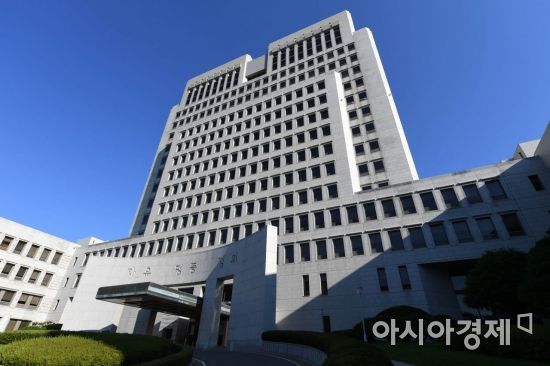
The Supreme Court's First Division (Presiding Justice No Tae-ak) overturned the lower court's ruling that dismissed lessee A's appeal in a deposit refund lawsuit against landlord B and real estate agent C, and remanded the case to the Suwon District Court on the 8th.
The court stated, "The lower court's judgment that A could not assert the lease rights against the defendants contains an error in the legal principles regarding the scope of third parties to whom the lessee's opposability and the effect of contract cancellation do not extend, which affected the judgment."
In October 2017, A entered into a lease contract with D for unit 302 of a five-story multi-family housing in Gwangju-si, Gyeonggi-do.
Previously, in November 2016, D had entered into a sales contract with B to purchase the multi-family housing and its land for 1.17 billion KRW. Since the building had not yet been registered, they agreed that "if the unit is leased before the final payment date, the tenant moving in will pay the balance immediately upon occupancy, and ownership will be transferred to D." The ownership preservation registration for the building was completed in December 2016 under B's name.
Then, in April 2017, as a follow-up contract to the initial sales contract, D entered into sales contracts with B to purchase unit 302 for 170 million KRW, among a total of seven exclusive-use units.
Later, while D completed the transfer registration for units 402 and 502 in April 2017, the registration for unit 302 was not completed. After B's death in August of the same year, the unregistered exclusive-use units, including 302, were inherited by B's heir, E.
Before the registration was transferred, D, through real estate agent C, entered into a lease contract with A for unit 302 in October 2017. The lease period was from October 2017 to March 2020, with a deposit of 89 million KRW.
Since the lease contract was made while D had not yet received registration, the contract included special provisions such as: ▲ the deposit and balance would be held by the real estate agent until the sale was completed ▲ the lease contract was made with D as the lessor, who was purchasing the building, and the real estate agent was responsible for transferring registration from E, the registered owner, to D ▲ even if ownership changed, the lease deposit, period, and refund obligations would be absolutely guaranteed as per the initial contract, and the lease contract would be comprehensively succeeded by the new owner and exempted for the old owner.
A paid the deposit to real estate agent C, who transferred the deposit to E's agent, the heir who inherited the registration for unit 302. A also completed the move-in registration on March 2, 2018, and obtained a fixed date on the lease contract, thereby establishing opposability under the Housing Lease Protection Act.
However, problems arose when D failed to pay the balance. E sent a certified letter to D declaring the cancellation of the sales contract due to non-payment and demanding eviction from the house.
Ultimately, A, who had entered into a lease contract with D, who had not properly acquired ownership, filed a lawsuit against E and real estate agent C to recover the deposit. E filed a counterclaim against A demanding the return of unit 302 and rent until its return.
The trial focused on whether D, who purchased and received possession of the unregistered house, had legitimate rental authority, and whether A could be considered a protected third party despite the cancellation of the initial sales contract with D.
Article 548, Paragraph 1 of the Civil Act states, "When one party cancels a contract, each party shall restore the other to the original state," but the proviso adds, "However, this shall not harm the rights of third parties," thereby protecting third parties who have interests established between contract conclusion and cancellation.
The first trial court ruled that A could not be protected.
The court reasoned, "B's delegation of rental authority over the property to D was ancillary to their sales contract and premised on the contract's proper performance, so the granting of rental authority was conditional on the contract not being canceled. Since the sales contract was canceled due to D's default, D lost the authority to lease the property."
Even though D received possession as the buyer of the unregistered property, D's right to lease it to a third party was contingent on the validity of the sales contract and recognized as part of the buyer's right to use and enjoy the property. Since the contract was canceled due to non-payment, D's rental authority was no longer valid and was retroactively lost due to the cancellation's retroactive effect.
The court stated, "Therefore, A, who entered into a lease contract with D without rental authority, cannot assert the right to use and enjoy the property against the seller B, and the same applies to the property's transferee."
The second trial court agreed with the first trial's judgment.
Furthermore, the second trial court held, "D, the buyer of the property, had only paid part of the purchase price after concluding the contract and had not yet received the property through contract performance, so D cannot be considered a 'buyer who has received the property through contract performance and is entitled to use and enjoy it and lawfully lease it to others,' and was merely a person granted rental authority by C, who represented the seller."
However, the Supreme Court's judgment differed.
The court found, "D entered into the land and building sales contract and subsequent contracts with B, the owner of the house, and was granted rental authority over the house by B. D then entered into the lease contract with A and, through real estate agent C, paid part of the remaining purchase price to E's agent and there is room to view that D received the house through contract performance."
The court concluded, "Therefore, A leased the house from D, who had legitimate rental authority based on the sales contract, before the contract was canceled, and by taking possession and registering residency, established opposability under Article 3, Paragraph 1 of the Housing Lease Protection Act. Accordingly, under the proviso of Article 548, Paragraph 1 of the Civil Act, A is a third party whose rights are not harmed by the cancellation of the sales contract. Thus, A can assert their lease rights against the house owner or transferee despite the cancellation of the sales contract."
© The Asia Business Daily(www.asiae.co.kr). All rights reserved.
![Clutching a Stolen Dior Bag, Saying "I Hate Being Poor but Real"... The Grotesque Con of a "Human Knockoff" [Slate]](https://cwcontent.asiae.co.kr/asiaresize/183/2026021902243444107_1771435474.jpg)
















