Different Operating Standards for Each ID Cause User Inconvenience
Maximum Character Limit Unified to 19 Korean Characters and 37 Roman Letters
The government has decided to establish a national ID card operation standard that sets an expiration date for resident registration cards, similar to driver's licenses, requiring reissuance after a certain period.
The Ministry of the Interior and Safety (MOIS) announced on the 7th that it has prepared a national ID card operation standard in consultation with relevant departments responsible for ID cards, including the Ministry of Foreign Affairs, Ministry of Justice, and the National Police Agency.
The standard will apply to seven types of government-issued ID cards: resident registration cards, youth ID cards, national veterans registration cards, passports, driver's licenses, disability registration cards, and foreigner registration cards.
Currently, each ID card has different operational standards and methods, causing inconvenience to users and inefficiency. While driver's licenses have a validity period of 10 years, resident registration cards have no expiration date, resulting in some cards being used for over 20 years, which can make identity verification difficult.
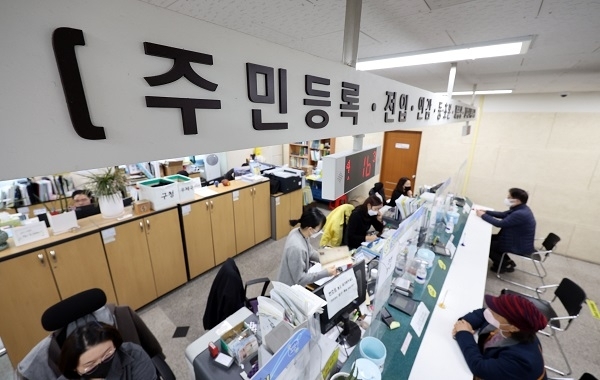 The government has decided to establish operational standards for the national ID card, which will have an expiration date like a driver's license, requiring reissuance after a certain period.
 [Photo by Yonhap News]
Accordingly, MOIS plans to set an expiration period for resident registration cards to update identity information, likely 10 years, similar to most countries overseas. MOIS stated, "Amendment of the Resident Registration Act is necessary and will be discussed in the National Assembly. We will also seek public opinion."
Among OECD member countries, 31 have ID cards like resident registration cards. Among them, only Korea and Colombia have no expiration period.
The government also intends to ensure that the full names of citizens and foreigners are properly displayed on all national ID cards. Currently, the maximum number of Hangul characters allowed for names on ID cards varies: 18 characters on resident registration cards, 10 characters on youth ID cards, driver's licenses, and disability registration cards, 8 characters on passports, and 14 characters on national veterans cards as of early this month.
Due to character limits, approximately 22,000 people have incomplete names displayed on their driver's licenses. Going forward, the maximum number of characters on ID cards will be standardized to 19 characters for Hangul names and 37 characters for Romanized names.
Additionally, the photo specifications submitted when applying for ID cards will be standardized to passport photo size, 3.5 cm wide by 4.5 cm high. MOIS plans to collect public opinions through an administrative notice from the 8th to the 28th and finalize and implement the ID card standards.
MOIS expects that once the national ID card operation standards are applied, both citizens and foreigners using ID cards will find it more convenient, and administrative processing efficiency and accuracy will improve.
© The Asia Business Daily(www.asiae.co.kr). All rights reserved.
![Clutching a Stolen Dior Bag, Saying "I Hate Being Poor but Real"... The Grotesque Con of a "Human Knockoff" [Slate]](https://cwcontent.asiae.co.kr/asiaresize/183/2026021902243444107_1771435474.jpg)















