The government will extend the validity period of essential technical personnel standards for chemical substance safety management. It will reduce administrative burdens on companies by improving safety education and import approval procedures. Additionally, it plans to relax qualification regulations for foreign instructors and simplify customs administrative burdens such as certification and reporting for export-import companies.
On the 7th, the Ministry of Economy and Finance and related ministries held a meeting of the Economic Regulatory Innovation Task Force (TF) to discuss the "Regulatory Innovation Plan for Small and Medium-sized Enterprises' Chemical Substances." The government has judged that the effectiveness of environmental risk management has been insufficient due to uniform chemical substance management and has promoted the improvement of the management system as a national agenda.
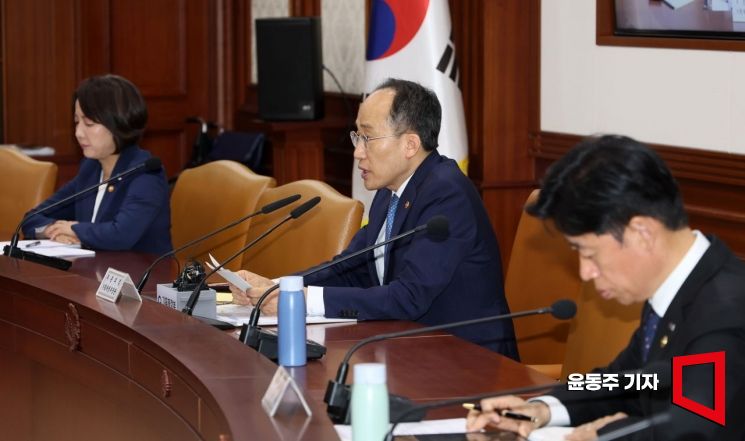 Deputy Prime Minister and Minister of Economy Choo Kyung-ho is delivering opening remarks at the Foreign Economic Ministers' Meeting and UAE Investment Cooperation Committee held at the Government Seoul Office in Jongno-gu, Seoul on the 2nd. Photo by Dongju Yoon doso7@
Extension of Hazardous Chemical Substance Management Technical Personnel Standards by 5 Years
First, the government will extend the validity period of the technical personnel standards for small-scale workplaces with fewer than 30 employees from the end of this year to 2028, a 5-year extension. Technical personnel are experts who handle facility safety management and are essential in workplaces handling hazardous chemical substances under the Chemical Substances Control Act (Chemicals Control Act). The problem is that the technical personnel standards are strict, making it difficult for small businesses to find professionals. Technical personnel must have a master's degree or higher and at least 3 years of relevant practical experience, or hold a professional engineer certificate and have at least 5 years of relevant practical experience. Considering the difficulty in appointing technical personnel who simultaneously meet degree and practical experience requirements, the government extended the validity period of their qualification standards to enable continuous hazardous chemical substance management even in small-scale workplaces.
Safety education and import approval procedures will also be improved. Until now, safety education for chemical substance handlers had to be completed 16 hours before handling, but it has been improved to allow the education to be split before and after handling (8 hours each, within 3 months). Also, when importing prohibited substances, the Ministry of Environment will recognize the import approval from the Ministry of Employment and Labor, and the Ministry of Environment will notify the Ministry of Employment and Labor of the import approval details.
Ventilation equipment standards have also been revised. Currently, ventilation equipment installation is mandatory even when storing solid-state substances, but an exception to the ventilation equipment standards will be applied when storing solid-state substances indoors that do not pose a risk of dispersion. Furthermore, when transferring mixed products, the government will allow the use of the European Union (EU) style "generic names" for trade secret components to strengthen trade secret protection. Based on the management system reform plan agreed upon by the private sector, industry, and government at the Chemical Safety Policy Forum at the end of last year, the government plans to prepare detailed amendment bills for the Chemical Substances Registration and Evaluation Act (Chemical Substances Registration and Evaluation Act) and the Chemicals Control Act by August.
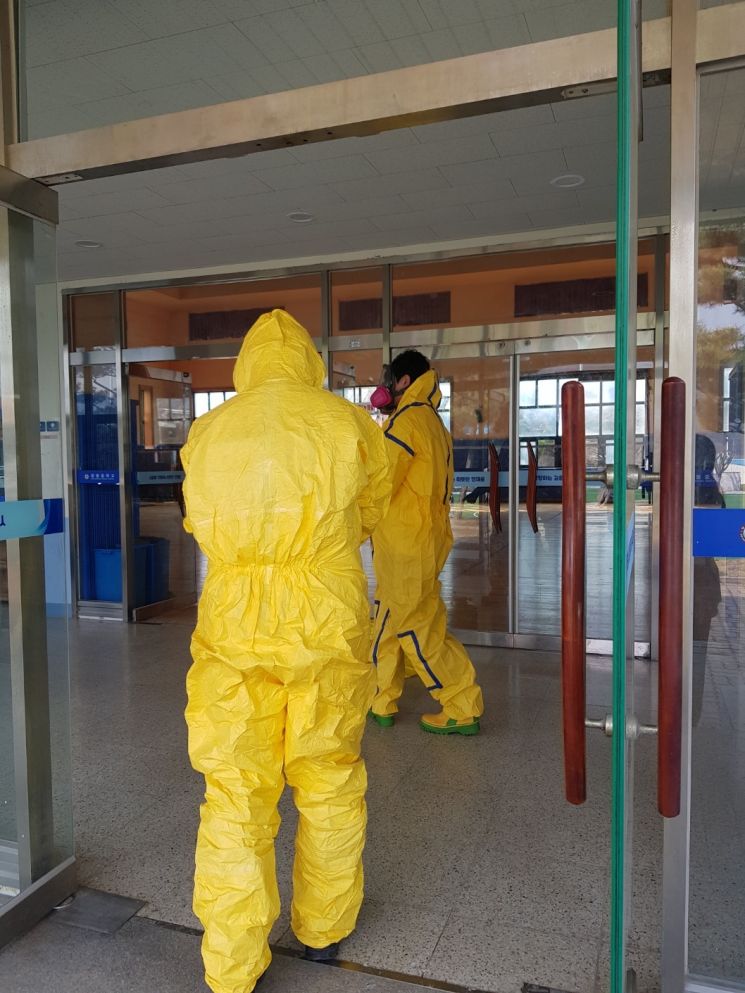 Checking for Chemical Substance Leakage
(Cheonan=Yonhap News) On the 23rd, officials from the Geumgang River Basin Environmental Office are inspecting a toxic chemical leak at a middle school gymnasium in Pungse-myeon, Cheonan-si, Chungnam. 2023.3.23 [Provided by reader. Redistribution and DB prohibited]
yej@yna.co.kr
(End)
<Copyright(c) Yonhap News Agency, Unauthorized reproduction and redistribution prohibited>
Supply of Industrial Water in Agricultural and Industrial Complexes
At the meeting, the Ministry of Economy and Finance also announced the "5th Economic Regulatory Innovation Plan" following the chemical substance regulatory innovation plan. First, it plans to invest 150 billion KRW to ensure that factory expansions in the Cheongsong Agricultural and Industrial Complex in Sejong City proceed smoothly by preparing an industrial water supply plan by the first quarter of next year. Currently, daily water usage ranges from 700 to 1,400 tons, and an additional 300 tons will be required when new businesses operate.
Restrictions on companies emitting atmospheric hazardous substances in the precision chemical and renewable energy zones of the Ulsan Technopolis Industrial Complex will be partially eased. Currently, companies emitting specific atmospheric hazardous substances (35 types) are restricted from settling regardless of emission concentration, but going forward, companies emitting hazardous substances below certain standards according to the Enforcement Rules of the Atmospheric Environment Conservation Act will be allowed to settle. Additionally, qualification regulations for foreign instructors, which are stricter than those for nationals, will be applied equally to foreign language online lectures. As a result, foreigners who graduated from junior colleges can be hired as foreign language online instructors. Furthermore, a research project will be conducted until December this year to devise measures to resolve military operational restrictions for the establishment of offshore wind power complexes.
The government will also ease customs administrative burdens such as certification and reporting for export-import companies. First, it will introduce an integrated renewal system for the validity period of origin certification exporters by product. Previously, the validity period of certification varied by product depending on the time of acquiring certification authority, but the expiration dates will be unified to allow bulk renewal of validity periods for multiple products. Also, the patent period for bonded factories operated by leasing facilities will be extended to 10 years. Previously, a 10-year patent period was granted only when operating a bonded factory in self-owned facilities, but now the same qualification will be granted even when operating by owning some facilities and leasing others. The government will also promote simplification of procedures for transfers between free trade zones and bonded factories.
The government has continuously pursued regulatory innovation by announcing 174 regulatory improvement tasks and 7 thematic regulatory innovation plans through six rounds of the Economic Regulatory Innovation TF and others. The government stated, "We will identify and improve difficulties in local government projects caused by central government regulations to revitalize the local economy."
© The Asia Business Daily(www.asiae.co.kr). All rights reserved.


















