Im In-taek Director Suspended and Reassigned
Apparently Due to Issues Responding to Nursing Act and Others
The sudden removal of Im In-taek, Director of Health and Medical Policy at the Ministry of Health and Welfare, who has overseen medical-related policies, has revealed a crisis in health and medical policy leadership. As a senior official who has dealt with major issues such as the Nursing Act, the pilot project for non-face-to-face medical treatment, and emergency medical measures has effectively been disciplined, concerns are rising about negative impacts on policy continuity.
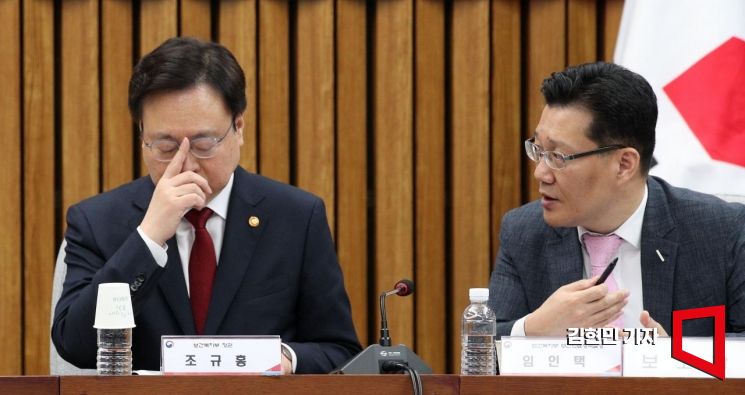 Minister of Health and Welfare Cho Kyu-hong (left) and Director Im In-taek of the Health and Medical Policy Office are talking at the Emergency Medical Care Urgent Measures Party-Government Council held at the National Assembly on the 31st of last month. Photo by Kim Hyun-min kimhyun81@
According to the Ministry of Health and Welfare on the 7th, the removal from position and reassignment of Director Im were issued as of the 5th. Director Im is a seasoned figure who served as Director of Elderly Policy, Director of Health Industry Policy Bureau, and Director of Health Policy Bureau at the Ministry before being promoted and appointed as Director of Health and Medical Policy last August.
The Director of Health and Medical Policy is responsible for overseeing the establishment and coordination of comprehensive plans related to health and medical policies. This office handles policies concerning medical professionals such as doctors and nurses, as well as medical institution evaluations, pharmaceutical policies, diseases, emergency medical services, and public healthcare. Director Im was in charge of recent hot-button issues including the controversy over the enactment of the Nursing Act, the pilot project for non-face-to-face medical treatment, essential medical support measures for pediatric, adolescent, and emergency medical care, and the expansion of medical school quotas.
This personnel action against Director Im is perceived as a disciplinary measure due to the Ministry’s failure to properly respond to related issues. In fact, amid severe conflicts dividing the health and medical community over the Nursing Act enactment, the Ministry faced criticism for failing to exercise mediating power. There were also criticisms that the government was being led by the medical community even in the pilot project for non-face-to-face medical treatment. The worsening public opinion following the ongoing 'emergency room rotation' incident appears to have also influenced the decision.
However, despite the Ministry’s limited capacity to respond to these issues, the fact that the person responsible for practical work is bearing the responsibility has caused unrest within the Ministry. In the case of the Nursing Act, the ruling party’s opposition-led passage in the National Assembly plenary session politicized the issue, turning it into a 'pass or veto' scenario. Although the role of the relevant ministry was inevitably limited in this atmosphere, internal dissatisfaction over the disciplinary personnel action is reportedly present.
Concerns are also emerging that policy leadership is at risk as the person responsible for practical work becomes vacant amid ongoing health and medical issues. The pilot project for non-face-to-face medical treatment has caused confusion in the field from the start, and essential medical support measures require continuous supplementation. In this context, if the public service community is shaken, it is pointed out that smooth opinion gathering and policy implementation will inevitably face obstacles.
© The Asia Business Daily(www.asiae.co.kr). All rights reserved.
![Clutching a Stolen Dior Bag, Saying "I Hate Being Poor but Real"... The Grotesque Con of a "Human Knockoff" [Slate]](https://cwcontent.asiae.co.kr/asiaresize/183/2026021902243444107_1771435474.jpg)











