Privately Entrusted Public Parking Lots Do Not Follow 'Monthly Regular Parking System Terms'
Expert: "Need to Create Practical 'Monthly Pass Operation Standard Guidelines'"
At around 8:30 p.m. on the 3rd, a public parking lot A, privately commissioned in Yongsan-gu, Seoul, was crowded with nearby residents trying to park and visitors to the bustling area. When the parking lot became full, users even illegally parked by encroaching on nearby roads. When the illegal parking enforcement vehicle from Yongsan-gu appeared, a farcical scene unfolded as drivers moved their cars one by one. Shin (27, male), who barely managed to park in a spot just vacated, expressed frustration over vehicles parked long-term. This is because an IPTV company had purchased monthly passes for 2 out of the total 16 parking spaces. Shin, who lives nearby, said, "There are always two corporate vehicles every day. They use monthly passes," adding, "This neighborhood lacks parking spaces, so even if they have monthly passes, it’s frustrating to see them using the spots like a garage."
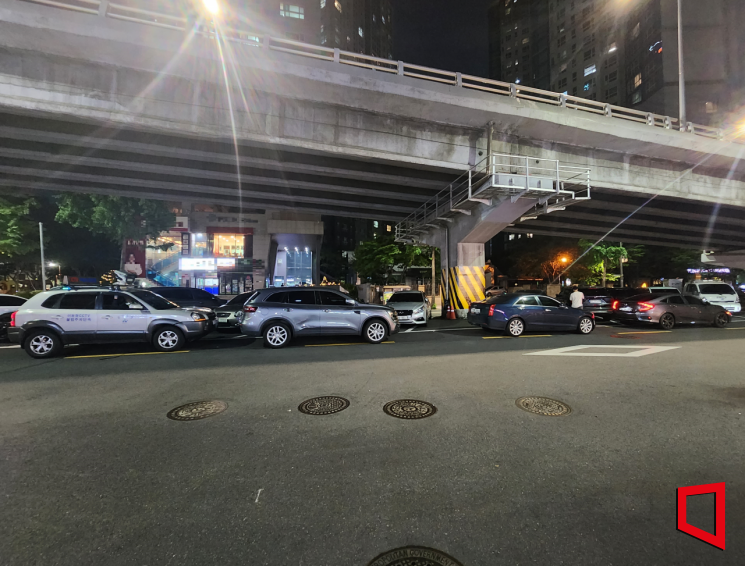 Around 8:30 PM on the 3rd, a private consignment public parking lot in Yongsan-gu, Seoul. Illegal parked vehicles are lined up in front of the fully occupied parking lot. On the far left is a Yongsan-gu illegal parking enforcement vehicle. Photo by Tae-won Choi skking@
Citizens are voicing complaints about difficulties in parking due to poor management of monthly pass sales at privately commissioned public parking lots. In particular, while local public parking lots operate terms and conditions to regulate this, privately commissioned lots are criticized for not following them. Experts point out the need to prepare alternatives such as a 'Standard Operation Plan for Monthly Passes.'
According to the Seoul Facilities Corporation on the 7th, as of May this year, there are 48 directly managed public parking lots in Seoul with 12,290 spaces, and 82 privately commissioned public parking lots with 4,552 spaces. Although privately commissioned public parking lots have fewer spaces, their number exceeds 170% of the directly managed ones.
A public parking lot is a parking facility managed and operated by a public organization for the public welfare. In Seoul, public parking lots are operated by the Seoul Facilities Corporation in two forms: direct management and private commissioning. They are generally characterized by lower fees compared to private parking lots.
For directly managed public parking lots, the corporation operates the 'Seoul Facilities Corporation Public Parking Lot Monthly Regular Parking System Terms and Conditions' to prevent citizen inconvenience. The ratio of monthly passes sold is adjusted according to available spaces. To prevent use as a garage, long-term parking is restricted. Parking for more than 28 days results in a one-month ban, and parking for more than 70 days results in a one-year ban from using the parking lot.
On the other hand, privately commissioned public parking lots follow their own operational policies rather than terms and conditions. The corporation explained that the current consignment contract does not include separate provisions regarding the operation of monthly passes. It also mentioned that many consignment companies are small-scale and lack the capacity to build online registration systems, so sales and guidance are conducted on-site.
In fact, Mr. B, who manages parking lot A under consignment, did not inform the corporation about the contract with the IPTV company using more than 12% of the parking spaces as monthly passes. Mr. B said, "Originally, I didn’t want to accept it, but after hearing the IPTV company’s situation of having nowhere to park, I made the contract," adding, "It’s not illegal, and I didn’t have to notify the corporation, so I didn’t."
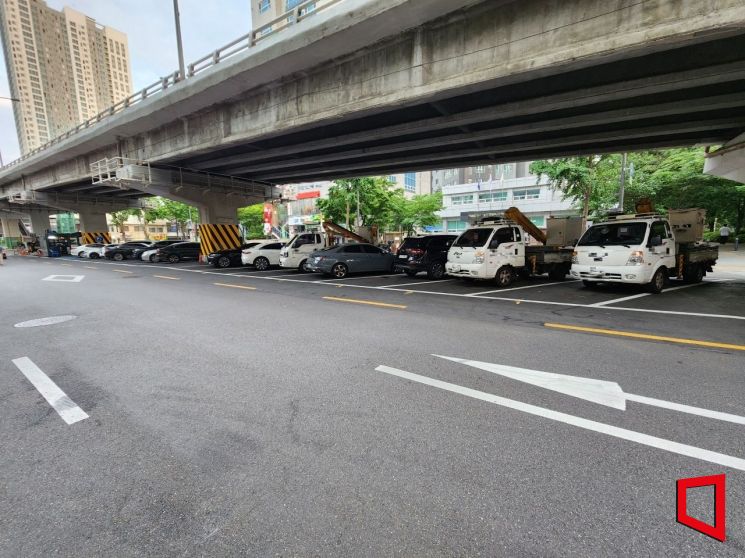 Around 7 p.m. on the 5th, a view of a privately commissioned public parking lot in Yongsan-gu, Seoul. A corporate vehicle of an IPTV company that uses the parking lot on a monthly subscription basis is parked there.
 Photo by Taewon Choi skking@
Citizens expressed dissatisfaction, saying that corporate vehicles using public parking lots like garages do not seem to align with the original purpose. Jeong (33, male), an office worker who visited parking lot A that day, said, "I often use this parking lot when visiting my regular restaurant, and I remember the IPTV company’s vehicles always being parked in the same spots," adding, "When there’s no space and I have to look for another parking lot, I sometimes wonder if it’s appropriate for corporate vehicles to use the spots long-term." Shin also said, "I’ve lived nearby for over a year, and I can count on one hand the times I’ve seen the IPTV company’s vehicles not parked there. Since it’s a publicly operated parking lot, I think it’s excessive."
Because of this, there are calls for the preparation of operational standards suitable for consignment operations. Professor Kim Jun-mo of Konkuk University’s Department of Public Administration diagnosed, "Even if it can’t be exactly the same as direct management, there seems to be a need to create a 'Standard Operation Plan for Monthly Passes' suitable for consignment operations." He added, "It would also be worth considering establishing an information-sharing system that can provide information on nearby private parking lots and guide users when the lot is full."
© The Asia Business Daily(www.asiae.co.kr). All rights reserved.
![Clutching a Stolen Dior Bag, Saying "I Hate Being Poor but Real"... The Grotesque Con of a "Human Knockoff" [Slate]](https://cwcontent.asiae.co.kr/asiaresize/183/2026021902243444107_1771435474.jpg)
















