Harsh Work Culture, Strict Rules, and Taiwan Training Demands
Lead to Rising Negative Reviews Among US Job Seekers... 4,500 Personnel Needed
TSMC, the world's largest foundry (semiconductor contract manufacturer), which is investing $40 billion (about 52.3 trillion KRW) to build a new semiconductor factory in Arizona, USA, is facing difficulties in securing personnel. The work-life balance, notorious for being the worst, and lower compensation compared to its competitor, US semiconductor company Intel, have led TSMC to seek solutions, but it is reported that resolving the situation is not easy.
According to Fortune on the 4th (local time), respondents who gave an "approval rating" indicating a positive evaluation of the working environment on the online job information site Glassdoor rated TSMC's US division at 27%. This means more than two out of three respondents considered it a difficult company to work for. Intel, which is building another semiconductor factory in Arizona, received a positive evaluation from 85% of respondents for the same question.
TSMC is investing $40 billion in Arizona to build two semiconductor factories, with mass production scheduled to start in 2024 and 2026, respectively. This investment decision was made in line with the Biden administration's support for the semiconductor industry, and President Joe Biden described it as a "game changer" in the semiconductor supremacy competition.
The problem lies in securing personnel. Over the past decade or so, as big tech companies have grown significantly in the US, there has been a shortage of semiconductor industry personnel. Although the Biden administration's investment policy is expected to create 42,000 jobs in the US alone by 2030, it is considered difficult to meet this demand domestically. In particular, TSMC is struggling to recruit personnel due to cultural differences between Taiwan and the US regarding working environments. TSMC plans to hire about 4,500 people for its Arizona factories alone. Currently, it has employed about 2,000 people, including 600 engineers.
Fortune cited sources saying that TSMC's harsh work culture, strict discipline, and mandatory long-term overseas training make it difficult to recruit American personnel.
First, TSMC's long working hours and vertical organizational culture are major obstacles to retaining American talent. On TSMC's Glassdoor page, comments such as "People sleep in the office all month long," "12-hour workdays are standard, and weekend work is routine. The worst work-life balance," are reportedly posted.
An engineer who worked at TSMC for six years said, "TSMC allows reasonable opinions related to work, but only engineers, deputy managers, and department managers can do so," adding, "In reality, it is impossible for managers to voice opinions to higher-ups." He also mentioned that applying for overtime pay can lead to disciplinary action.
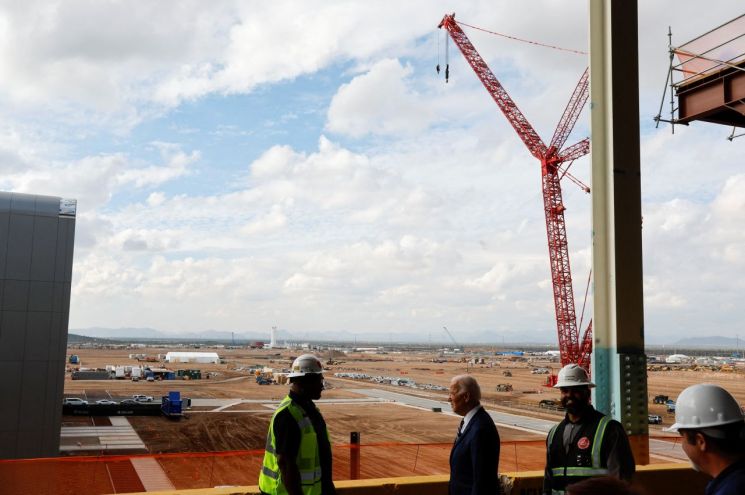 U.S. President Joe Biden is touring the construction site of the TSMC semiconductor factory in Arizona last December. [Image source=Reuters Yonhap News]
Fortune reported that TSMC's global employee turnover rate surged from 11.6% in 2017 to 17.6% in 2021.
Another challenge in securing personnel is TSMC's preference for highly educated employees with master's degrees or higher. According to a 2020 TSMC report, 60% of employees and over 80% of managers in Taiwan hold a master's degree or higher. Professor Santosh Kurinec of Rochester Institute of Technology (RIT) in the US pointed out that "While PhD holders are needed in the industry, not everyone needs to have a PhD," criticizing TSMC's requirements as excessive.
TSMC pays relatively high salaries in Taiwan, but in the US, its compensation is lower compared to competitors. Fortune explained that PhD holders at TSMC earn an average of $160,000, while at Intel, they can earn $30,000 more.
Another factor deterring job seekers is that after joining TSMC, employees must undergo 12 to 18 months of training in Taiwan. Many move with their families during this long training period, which some find undesirable. Additionally, some employees are concerned due to geopolitical tensions with China.
In April 2021, TSMC sent all 600 newly hired engineers in the US to Taiwan. TSMC told Fortune, "They are now properly learning advanced semiconductor technology and returning to Arizona."
TSMC is seeking changes to gain an advantage in the competition for talent. In 2021, it increased global employee salaries by 20%. It also established welfare facilities such as fitness centers for US employees and is actively communicating with employees while conducting activities to improve work-life balance, according to Fortune.
Earlier, Morris Chang, TSMC's founder, expressed concerns last year that the US semiconductor industry development might not succeed due to a shortage of semiconductor talent.
© The Asia Business Daily(www.asiae.co.kr). All rights reserved.
![Clutching a Stolen Dior Bag, Saying "I Hate Being Poor but Real"... The Grotesque Con of a "Human Knockoff" [Slate]](https://cwcontent.asiae.co.kr/asiaresize/183/2026021902243444107_1771435474.jpg)
















