Democratic Party ↓·People Power Party ↑... Support Rate Gap Narrows Within Margin of Error"
President Yoon Seok-yeol's approval rating for his administration, which had been rising for five consecutive weeks, slightly declined to the high 30% range. The Democratic Party of Korea was found to be ahead of the People Power Party in party support, but the gap in approval ratings narrowed to within the margin of error.
According to a regular public opinion poll released on the 5th by Realmeter (conducted via ARS automated response from April 30 to May 2, commissioned by Media Tribune, surveying 2,009 adults aged 18 and over nationwide), President Yoon's weekly approval rating for his administration dropped by 0.2 percentage points from the previous week to 39.8%. Negative evaluations that the administration is performing poorly rose by 0.7 percentage points to 57.4% compared to last week's survey.
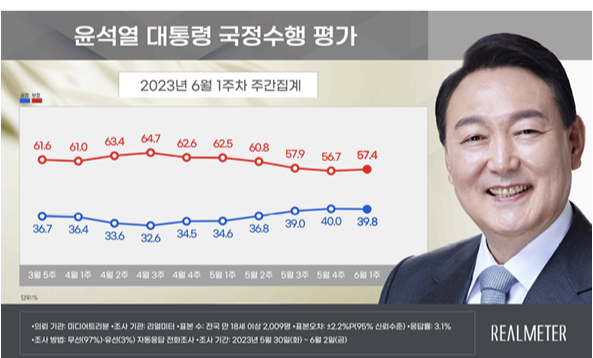
Realmeter explained, "The five-week upward trend in President Yoon's approval rating has stopped, hovering near 40%," adding, "Daily tallies showed an increase toward the end of the week." Bae Cheol-ho, Realmeter's senior expert, said, "The 'diplomacy' issue has functioned as momentum to raise approval ratings to the current level, but it is reaching a point of diminishing returns for further increases," and added, "To achieve additional rises in approval, it is time to reconsider the portfolio by actively discovering and presenting other momentum while keeping 'diplomacy and security' as the foundation."
In party support, the Democratic Party's approval rating fell by 0.8 percentage points to 43.7%. The People Power Party's support rose by 1.3 percentage points to 39.4%. As a result, the gap between the two parties narrowed from 6.4 percentage points last week to 4.3 percentage points this week, bringing the difference within the margin of error (±2.2 percentage points). The Justice Party dropped by 1.2 percentage points to 2.3%.
The Democratic Party's support notably declined in Busan, Ulsan, and Gyeongnam (down 4.0 percentage points, 40.4% to 36.4%), among people in their 40s (down 9.8 percentage points, 65.2% to 55.4%), 30s (down 7.5 percentage points, 46.1% to 38.6%), and progressives (down 5.3 percentage points, 76.6% to 71.3%). However, support increased among those in their 20s (up 9.5 percentage points, 38.5% to 48.0%).
The People Power Party's support rose significantly in Daejeon, Sejong, and Chungcheong (up 8.5 percentage points, 35.7% to 44.2%), Busan, Ulsan, and Gyeongnam (up 7.8 percentage points, 41.1% to 48.9%), and among people in their 40s (up 3.8 percentage points, 24.1% to 27.9%).
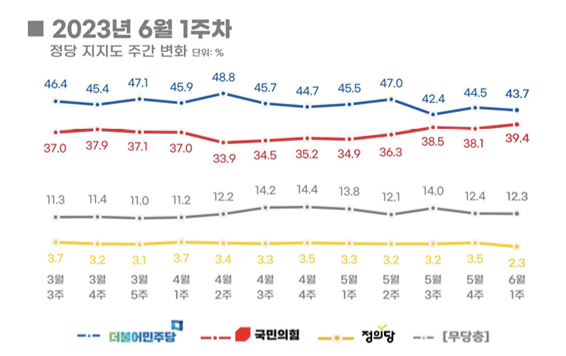
Commissioner Bae explained, "This week, there was consolidation of the ruling party's support as it showed a rare ruling party-like stance by engaging in fierce battles with the Democratic Party on various issues both inside and outside the National Assembly, defending and breaking through on behalf of Yongsan (the Presidential Office)." Regarding the Democratic Party, he said, "They focused their firepower on issues such as the Fukushima contaminated water inspection and the erroneous Seoul city text alert, but it appeared to have little effect on increasing their approval rating. Rather, public opinion reacted more sensitively to internal party issues such as the election of standing committee chairs, controversies over the university student committee, and the return of lawmaker Kim Nam-guk to the National Assembly."
For more details, please refer to the website of the Central Election Survey Deliberation Commission.
© The Asia Business Daily(www.asiae.co.kr). All rights reserved.
![Clutching a Stolen Dior Bag, Saying "I Hate Being Poor but Real"... The Grotesque Con of a "Human Knockoff" [Slate]](https://cwcontent.asiae.co.kr/asiaresize/183/2026021902243444107_1771435474.jpg)
















