Statistics Requested by Seoul City from January to April This Year
Jungnang-gu Ranks First Among Districts with Many Unprocessed Requests
#A report was received at a police station in Seoul about a shaman who wielded a weapon against a family member under the pretext of exorcism. The responding police officers managed the situation and then requested administrative hospitalization for the shaman at the local district mental health welfare center. However, the shaman refused any counseling, leaving the local government unable to intervene and only observe the situation.
It was found that in about one out of ten cases, administrative hospitalization requests do not proceed. The most common reasons for non-progression, as in the above case, were failure to meet or counsel the hospitalization subject.

According to data requested by Representative Choi Jong-yoon of the Democratic Party from the Seoul Metropolitan Government on the 6th, from January to April 20, there were 358 administrative hospitalization requests made to 25 districts, of which 41 cases did not proceed. Seoul has about 210 personnel, including public health officials and mental health center staff, managing mental illness such as administrative hospitalization across the 25 districts.
Administrative hospitalization is a type of involuntary hospitalization (along with protective hospitalization and emergency hospitalization) considered when a person with a mental illness poses a risk of harm to themselves or others but cannot be hospitalized voluntarily. Under the current Mental Health Welfare Act, hospitalization can be divided into 'protective hospitalization,' which requires family consent if the patient refuses, and 'administrative hospitalization,' which requires the consent of the head of the city, county, or district. 'Emergency hospitalization' is requested with the consent of a doctor and police officer in urgent cases but must be converted to another type of hospitalization or discharged within three days.
In the case of administrative hospitalization, the decision on whether the mental illness patient poses a risk of harm is made by a psychiatrist or mental health professional. After this assessment, they apply to the local government for diagnosis and protection through administrative hospitalization. Police officers can request psychiatrists or professionals to apply for administrative hospitalization but are not authorized to apply directly to the local government themselves. This is stipulated in Article 44 of the current Mental Health Welfare Act (Hospitalization by Special City Mayor, Special Self-Governing Province Governor, Mayor, County Governor, or District Head).
In the first quarter of this year, Jungnang-gu ranked first among districts with the highest number of non-proceeded administrative hospitalization requests (25 cases). It was followed by Dongdaemun-gu (13 cases) and Yongsan-gu (3 cases). These three districts also ranked among the top three in the number of administrative hospitalization requests during the same period. During this time, Jungnang-gu received 39 requests, Yongsan-gu 34, and Dongdaemun-gu 25.
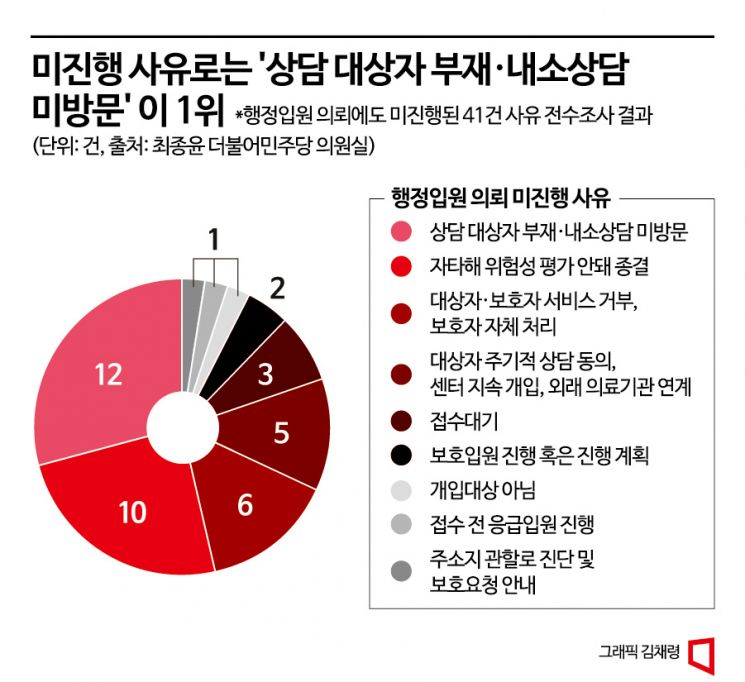
A full investigation of the 41 non-proceeded cases revealed that the most common reason was the absence of the subject or failure to visit for counseling (29.26%, 12 cases). Next were cases closed due to no risk of harm to self or others (24.39%, 10 cases), refusal of services by the subject or guardian and guardians handling the situation themselves (14.63%, 6 cases), and consent for periodic counseling, continued center intervention, or linkage to outpatient medical institutions (12.20%, 5 cases).
Experts pointed out that public officials find it difficult to actively engage in administrative actions. Professor Lee Ju-yeol of the Department of Health Administration at Namseoul University explained, "Because it is involuntary hospitalization, guardians or others may later raise human rights issues. Even if mistakes occur in promoting administrative hospitalization, if the public official can prove justifiable reasons, they should not be disciplined and should be supported to take proactive administrative actions."
Recently, the number of administrative hospitalization requests has continued to increase, surpassing 1,000 cases. Requests numbered 651 in 2020, 819 in 2021, and reached 1,031 last year.
However, as the number of administrative hospitalization requests increases, the proportion of non-proceeded cases is also growing. Last year, 198 cases did not proceed despite requests, accounting for 19.2% of all administrative hospitalization requests?the highest rate in the past five years. The rates were 16.24% in 2021, 12.44% in 2020, 12.24% in 2019, and 2.15% in 2018.
Despite cases of non-progression, frontline police officers reported that they sometimes do not receive feedback on hospitalization status. For example, a police station in Seoul made six administrative hospitalization requests in the first quarter, but only two cases received notification of hospitalization status. One frontline officer said, "We requested administrative hospitalization, but it is difficult to know the outcome, which raises concerns about gaps in public safety."
Regarding this, Professor Lee said, "The disconnect between ministries is a chronic problem in Korea's administrative system. While personal efforts are necessary, changes such as implementing a computerized system that provides feedback on administrative hospitalization status are needed to reduce blind spots."
© The Asia Business Daily(www.asiae.co.kr). All rights reserved.