Former Arizona Police Officer Cooly Passed Away Last Month
1963 Suspect Arrest Led to 'Miranda Rights' Establishment
A former police officer, known as the protagonist of the so-called ‘Miranda warning,’ which police or prosecutors must inform suspects or defendants of before arresting or interrogating them, has passed away.
On the 2nd (local time), major foreign media reported that Carol Cooley, a former police officer in Phoenix, Arizona, died at the age of 87 on May 29 due to chronic lung disease.
Cooley, who began working at the Phoenix Police Department in 1958, became known worldwide in 1963 due to the so-called ‘Miranda arrest case.’ That year, an 18-year-old woman was kidnapped by a stranger in Phoenix, dragged through the desert, and sexually assaulted.
The woman could not remember the assailant’s facial features but testified that she was kidnapped in a green vehicle, which had a distinctive handle made of rope inside. Subsequently, the victim’s cousin spotted the suspect’s vehicle in the neighborhood and reported it to the police. Ernesto Miranda, then 22 years old, was arrested.
Although the victim could not precisely identify Miranda as the suspect, the circumstances strongly indicated he was the perpetrator, so Cooley, the officer in charge, conducted an intense interrogation. He obtained a confession from Miranda and had him write a statement. The statement read, “This statement was made voluntarily, I am fully aware of my legal rights, and I understand that my statement may be used against me.” Ultimately, the trial courts in the first and second instances found Miranda guilty and sentenced him to a heavy penalty.
However, Alvin Moore, the public defender representing Miranda, persistently argued that “Miranda was not informed of basic rights such as the right to counsel before the interrogation.” He claimed that Miranda’s confession, made without knowledge of these rights, could not be admitted as evidence from the start. Subsequently, other lawyers and human rights organizations became involved in the case, and the Miranda ruling eventually reached the U.S. Supreme Court on appeal.
The nine justices of the Supreme Court, led by Chief Justice Earl Warren, who is regarded as one of the most progressive in U.S. judicial history, overturned the lower court’s decision by a 5-4 ruling on June 13, 1966, and acquitted Miranda. They ruled that there must be clear procedures for a suspect to make a free statement in an isolated environment, and confessions obtained without following these procedures cannot be used as evidence of guilt.
Cooley and other police officers protested, saying, “If this continues, investigations will become impossible,” and fierce debates erupted across the United States, but the Supreme Court’s ruling could not be changed. Since then, police officers across the country have carried papers with the Miranda warning written on them and memorized the wording, informing suspects of the Miranda warning upon arrest.
Although Miranda was acquitted of the kidnapping and sexual assault charges against the 18-year-old woman due to the Supreme Court ruling, he was not released because other charges surfaced. Later, the prosecution re-indicted him with full consideration of the Miranda warning, and a 10-year prison sentence was confirmed. Miranda was released on parole but died in February 1976 after being stabbed during an argument with another patron at a bar in downtown Phoenix.
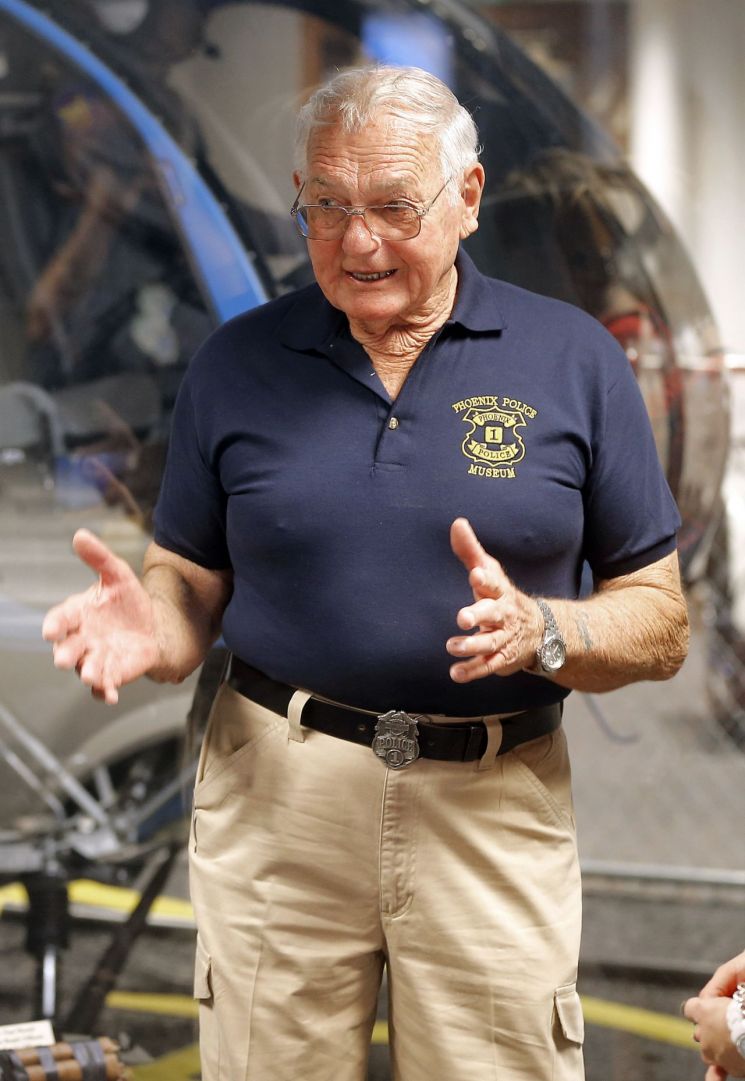
Cooley later served as the chief of the Phoenix Police Department and, after retiring from the police, worked in Arizona’s Department of Public Safety. On the 50th anniversary of the Miranda arrest in 2013, he volunteered at the Phoenix Police Museum and shared his reflections on the case.
Cooley’s wife, Glee Cooley, said in an interview with local Arizona media on the 2nd, “My husband never agreed with the Supreme Court ruling, but there was nothing he could do.”
On the other hand, Cooley’s grandson, Dennis Cooley, said, “Grandfather often talked to his grandchildren about the case that created the Miranda warning and seemed proud of his historic role.”
© The Asia Business Daily(www.asiae.co.kr). All rights reserved.
![Clutching a Stolen Dior Bag, Saying "I Hate Being Poor but Real"... The Grotesque Con of a "Human Knockoff" [Slate]](https://cwcontent.asiae.co.kr/asiaresize/183/2026021902243444107_1771435474.jpg)















