Announcement of the Results of the 'Minimum Wage and Management·Labor Conditions Survey'
Five out of ten self-employed individuals believe that the minimum wage should be frozen next year.
The Federation of Korean Industries (FKI) announced on the 4th that it conducted a "Minimum Wage and Management·Labor Conditions Survey" targeting self-employed people nationwide through the polling firm Monoresearch, yielding these results. The survey was conducted from the 2nd to the 5th of last month with 500 self-employed respondents nationwide.
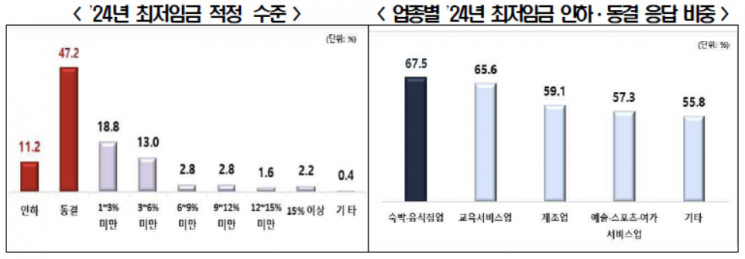
Among the respondents, 58.4% answered that the minimum wage next year should be "frozen or lowered." Looking in detail at opinions on the appropriate minimum wage level, the responses were ▲lowered (11.2%) ▲frozen (47.2%) ▲increased by less than 1?3% (18.8%) ▲increased by less than 3?6% (13.0%) ▲increased by less than 6?9% (2.8%) . The industries with a high proportion of respondents who said the minimum wage should be frozen or lowered were accommodation and food service (67.5%) and education services (65.6%).
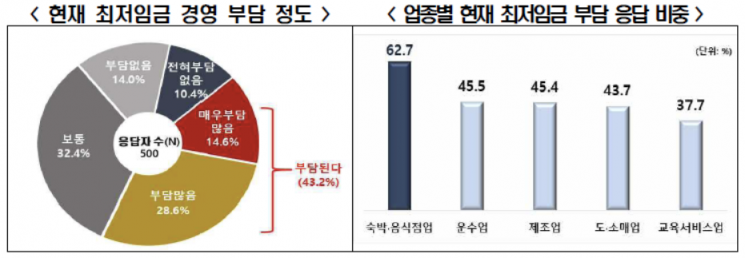
43.2% of respondents said that the current minimum wage (9,620 KRW per hour) is a burden on management. The proportion who said it was not a burden was 24.4%. Among the industries that responded that the current minimum wage level is a burden on management, accommodation and food service (62.7%) was the highest. Following were transportation (45.5%), manufacturing (45.4%), and wholesale and retail trade (43.7%) in that order.
When asked how much the minimum wage would have to increase for them to raise sales prices, 4 out of 10 self-employed people (40.0%) responded that they already have plans to raise sales prices even without a minimum wage increase. Regarding the question of how much the minimum wage would have to increase for them to consider closing their business, 7.6% said they would consider closing if the minimum wage increased by less than 1?3%, and 5.2% said they would consider closing if it increased by less than 3?6%.
The average daily working hours of self-employed individuals was 8.7 hours. The average monthly days off was 4.0 days. Compared to last year's survey, daily working hours decreased by 0.6 hours, and days off increased by 0.2 days. The FKI analyzed that although the working conditions of the self-employed have improved compared to last year, they work 0.5 hours more per day and take 2.6 fewer days off per month than wage workers.
The most urgent improvement task in the current minimum wage system identified by the self-employed was "limiting the minimum wage increase rate considering economic conditions, etc. (28.2%)." Following were ▲differentiated application by industry and region (26.2%) ▲expansion of support for minimum wage increases for micro and small businesses (13.8%) ▲supplementing the minimum wage calculation criteria (13.2%) in that order.
Choo Kwang-ho, head of the Economic and Industrial Headquarters at the FKI, said, “Due to the recent economic recession and high inflation, household consumption has shrunk, causing self-employed individuals to suffer from severe sales slumps. Since a significant number of self-employed people are already in a difficult situation to endure, the minimum wage for next year needs to be reasonably adjusted considering these aspects.”
© The Asia Business Daily(www.asiae.co.kr). All rights reserved.
![Clutching a Stolen Dior Bag, Saying "I Hate Being Poor but Real"... The Grotesque Con of a "Human Knockoff" [Slate]](https://cwcontent.asiae.co.kr/asiaresize/183/2026021902243444107_1771435474.jpg)
















