The rapid integrated planning for the redevelopment project around Sanggye Station in Nowon-gu, which had long been neglected in development, has been confirmed. A residential complex with approximately 4,300 households is expected to be built in this area.
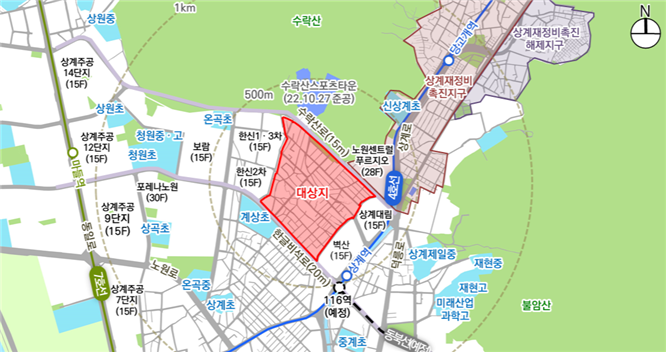
On the 5th, the Seoul Metropolitan Government announced the confirmation of the redevelopment project for 154-3, Sanggye 5-dong, Nowon-gu. According to the confirmed rapid integrated planning proposal, the area of 154-3, Sanggye 5-dong will be reborn as a residential complex (up to 39 floors, approximately 4,300 households) that connects the city and nature, featuring a transit-oriented zone near Sanggye Station, a school-friendly complex near Gyesang Elementary School, and a forest-friendly environment linked to Suraksan Mountain.
The site was selected as a private redevelopment candidate in December 2021, and it is expected to become a leading model for large-scale redevelopment of aging low-rise residential areas through flexible urban planning applied via rapid integrated planning. Over the past year, Seoul City formed a team with the local district office, residents, and experts, and finalized the rapid integrated planning proposal through active communication with residents.
First, to improve accessibility and efficient land use, some parcels on the southern part of the site were included in the district, and religious facilities and the community center were relocated to lay the foundation for smooth project implementation. Additionally, considering the surrounding area, the zoning was upgraded from Type 2 General Residential to Type 3 General Residential, and flexible urban planning was applied.
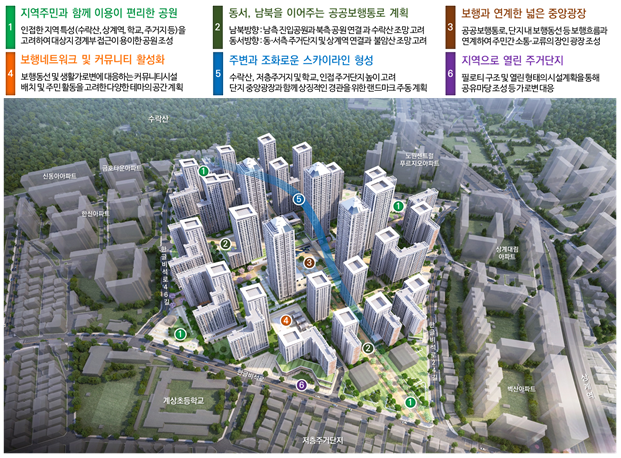
Four parks were placed along the boundaries of the complex to connect with adjacent Suraksan Mountain, Sanggye Station, schools, and surrounding complexes. To enhance accessibility from Sanggye Station and Suraksan Mountain to the complex, pedestrian paths running east-west and north-south were planned, passing from the parks through the central plaza of the complex.
Considering the characteristics of the surrounding area, plans were made for customized outdoor spaces and community facilities tailored to the activities and needs of residents of various generations. In addition, the city stated that by designing low-rise pilotis structures at the base of the main buildings and open facilities along the street, they aimed to create an open residential complex that fosters communication and interaction among residents.
Jo Nam-jun, Director of the Urban Planning Bureau of Seoul City, said, “The area of 154-3, Sanggye-dong, is a case that maximizes the locational advantage where the city meets nature, creating a creative landscape in connection with the surrounding area.” He added, “By planning the largest redevelopment complex in the northeastern part of Seoul through rapid integrated planning, positive ripple effects are expected to lead the development and revitalization of the local area.”
© The Asia Business Daily(www.asiae.co.kr). All rights reserved.
![Clutching a Stolen Dior Bag, Saying "I Hate Being Poor but Real"... The Grotesque Con of a "Human Knockoff" [Slate]](https://cwcontent.asiae.co.kr/asiaresize/183/2026021902243444107_1771435474.jpg)

















