Court: "Considering the necessity of investigation, appropriate scope of seizure can be determined"
Prosecution: "Discovery of substantive truth ideology can fundamentally shake"
Prosecutor present at the scene: "Honored to hear about solidarity between judges and prosecutors"
The court and the prosecution remain at an impasse over the ‘pre-hearing system for search and seizure warrants’ being promoted by the court.
While the court emphasized the necessity of the pre-hearing system as a means to resolve doubts and ambiguities regarding the scope of seizure, the prosecution argued that the pre-hearing system cannot serve as an effective measure to limit the targets and scope of seizure.
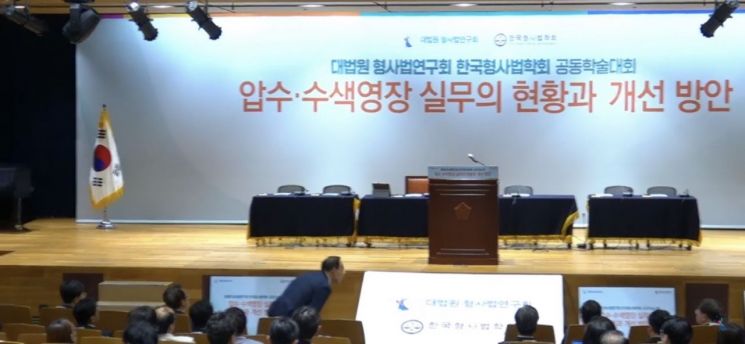 The joint academic conference of the Supreme Court Criminal Law Research Association and the Korean Criminal Law Society held on the 2nd at Cheongsim Hall, the main auditorium on the 1st floor of the Seoul Court Complex.
On the afternoon of the 2nd, the Supreme Court Criminal Law Research Association and the Korean Criminal Law Association held an academic conference at the Court Complex in Seocho-gu, Seoul, under the theme ‘Current Status and Improvement Measures of Search and Seizure Warrant Practices.’
Jang Jaewon, Chief Judge of the Gimcheon Branch of Daegu District Court, who participated as a discussant, said, "Even if there are doubts or ambiguous parts related to the application for a search and seizure warrant, under the current system, the judge in charge of warrants has only the options to issue or dismiss the search and seizure warrant." He added, "In such situations, when a search and seizure warrant is issued, there is a possibility that information unrelated to the crime may be seized beyond the scope necessary to prove the criminal charges, or that the search and seizure may proceed in a way that causes excessive infringement of fundamental rights compared to the necessity of investigation or relevance to the crime."
He continued, "If the pre-hearing system for search and seizure warrants is introduced, the judge responsible for warrants can decide whether to issue the warrant with doubts or ambiguities resolved during the warrant hearing, and can comprehensively consider the necessity of investigation and the degree of infringement of fundamental rights to set an appropriate scope of seizure." He added, "In particular, it is expected to have the effect of selectively seizing electronic information, which has been the subject of much controversy recently, in advance, and it can also serve as an effective measure to properly control the seizure of unrelated information beforehand."
However, the prosecution expressed concerns that the premature introduction of the pre-hearing system for search and seizure might have little practical benefit in terms of the development of the principle of due process and could fundamentally shake the ideal of discovering substantive truth.
Han Munhyuk, Chief Prosecutor of the Namyangju Branch of Uijeongbu District Prosecutors’ Office, countered, "Even if the pre-hearing system is implemented, it cannot appropriately limit the scope of seizure by specifying the seizure targets in advance, thus lacking suitability as a measure." He added, "Conducting a pre-hearing at the stage of applying for a search and seizure warrant does not mean that the seizure targets can be specified more concretely, and control can be exercised by guaranteeing the participation rights of the person subject to seizure during the execution of the search and seizure and selectively handling relevant materials."
Furthermore, the prosecution actively pointed out problems with the pre-hearing system for search and seizure. The partial amendment to the Criminal Procedure Rules, which the Court Administration Office announced for legislative notice, stipulates that "persons who have information necessary for reviewing the requirements for search and seizure may be examined." This means that whistleblowers can also be questioned.
Chief Prosecutor Han argued, "Whether to conduct a search and seizure is a very important investigative secret, but if a whistleblower participates in the pre-hearing process for a search and seizure warrant, the whistleblower will learn whether the search and seizure will be conducted, and it is difficult to exclude the risk that the whistleblower may approach the suspect again and use the investigative secret to demand money or other acts." He claimed, "If a pre-hearing is conducted, there is a high possibility that investigative secrets will be exposed during the process."
The prosecution also pointed out the issue of procedural delays. If a pre-hearing is held, the hearing date can only be set several days after the warrant application date due to notification and scheduling coordination with the examinee, causing procedural delays.
Additionally, the prosecution cited legal systems of Germany and France, which have continental law systems relatively similar to Korea’s, explaining that the pre-hearing system for search and seizure has not been introduced in those countries.
At the academic conference, many prosecutors attended and posed sharp questions to the presenters, creating a somewhat tense atmosphere.
Professor Cho Kiyoung of Jeonbuk National University Law School, who was a presenter, stated, "If the judge in charge of warrants frequently dismisses search and seizure warrant applications, they may be evaluated as lacking a sense of solidarity as a person engaged in criminal justice, and such a perspective may psychologically pressure judges to actively sign warrants requested by prosecutors, resulting in a solidarity effect."
In response, during the Q&A session after the presentation, Prosecutor A said, "I am honored to hear that judges feel solidarity with prosecutors," but added sharply, "It is puzzling to evaluate that warrants are issued based on solidarity. Socially, judges are even criticized for siding with suspects by focusing too much on their human rights."
Earlier, the Court Administration Office announced in March this year a partial amendment to the Criminal Procedure Rules, introducing the previously nonexistent pre-hearing system for search and seizure warrants starting from the 1st of this month. It also newly established a provision requiring the inclusion of ‘search terms’ to be used for analysis in applications for search and seizure warrants related to electronic information such as mobile phones.
The Court Administration Office is expected to complete the opinion collection process soon, carry out revisions, and re-announce the new partial amendment to the Criminal Procedure Rules before Chief Justice Kim Myungsoo retires in September.
© The Asia Business Daily(www.asiae.co.kr). All rights reserved.
![Clutching a Stolen Dior Bag, Saying "I Hate Being Poor but Real"... The Grotesque Con of a "Human Knockoff" [Slate]](https://cwcontent.asiae.co.kr/asiaresize/183/2026021902243444107_1771435474.jpg)
















