Weakened Automatic Exchange Rate Stabilization through Trade Balance
Importance of Strengthening Export Competitiveness and Substituting Intermediate Goods Imports
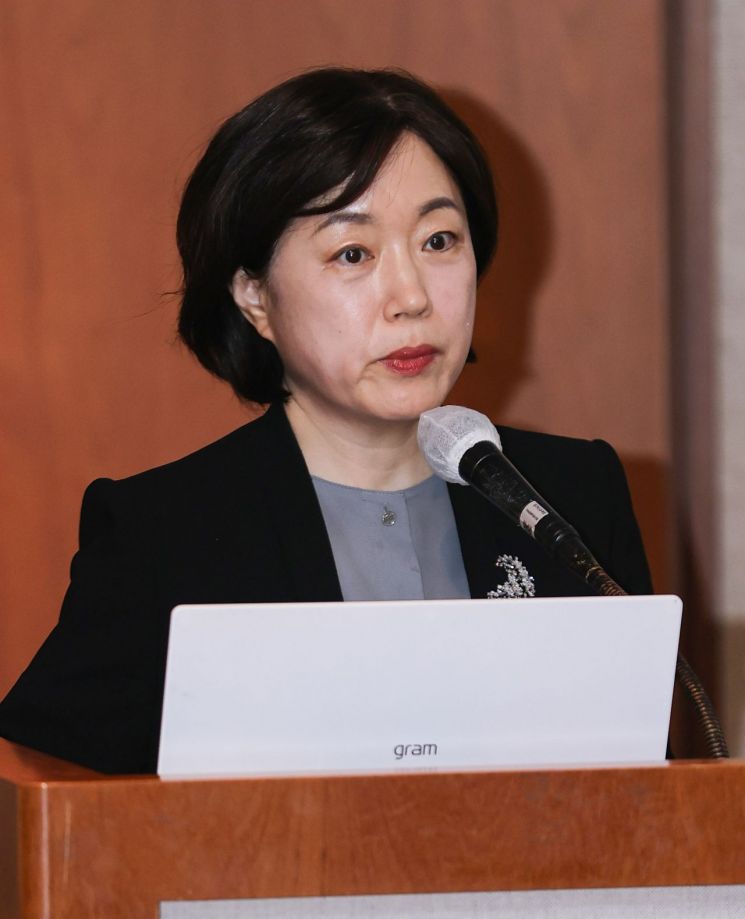 Seo Young-kyung, a member of the Monetary Policy Committee of the Bank of Korea, is delivering opening remarks at the American Chamber of Commerce in Korea (AMCHAM) meeting held on the morning of February 7 at the Grand Hyatt Hotel in Yongsan-gu, Seoul.
 [Image source=Yonhap News]
Seo Young-kyung, a member of the Monetary Policy Committee of the Bank of Korea, predicted that it would be difficult for the won-dollar exchange rate to fall to pre-COVID-19 levels due to intensified competition with China and population aging. However, she explained that even if the won depreciates, the effects of increased exports and decreased imports are not significant, and the risk of a sharp decline in domestic capital inflows is low.
At the BOK International Conference held on the 2nd in Jung-gu, Seoul, Seo explained this through a presentation titled 'The New Normal After the Pandemic: Changes in the Transmission Channels of Exchange Rate Fluctuations.'
Seo stated that the challenges faced by emerging market central banks, including Korea, after the COVID-19 pandemic are to seek a new balance among domestic price stability, financial stability, and external sector stability under changing conditions such as rising inflation and debt, shrinking global supply chains, and rapid tightening by advanced economies.
She added, "Since last year, the won exchange rate has weakened and volatility has increased due to the strengthening of the US dollar, Korea's reduced trade surplus, and increased overseas investment," and explained that "structural changes such as intensified competition with China, population aging, and expanded overseas investment demand by corporations and households, as well as cyclical factors, are at play, making it difficult for the won exchange rate to fall to pre-pandemic levels."
However, Seo noted that the 'automatic stabilization channel of the exchange rate through the trade balance' has weakened compared to the past. Since the dollar-denominated prices of exports and imports have increased and the dependence on imports of intermediate goods and energy is high, even if the won depreciates, the effects of increased exports and decreased imports are not significant. Instead, considering that the inflationary effect due to won depreciation occurred amid overlapping supply shocks, it is estimated to be greater than in the past.
Seo pointed out that despite the won's weakness and increased volatility, the risk of a sharp decline in capital inflows is not large. In this regard, she explained, "thanks to the reduction of short-term external debt in the banking sector and the increase in private external assets since the global financial crisis, the currency mismatch problem in our economy has been greatly alleviated."
She also emphasized that although there are concerns that long-term external debt has recently increased due to foreign investment in domestic bonds, making these funds vulnerable to won depreciation and widening domestic-foreign interest rate differentials, such concerns are not significant given that much of the investment is long-term and based on the fundamentals of the Korean economy.
Seo evaluated that unlike the trade balance, the 'automatic stabilization channel of the exchange rate through capital flows' has strengthened. Since last year, the scale of outflows from overseas stock investments has decreased, and related legal amendments have expanded dividend inflows from overseas investments, which helps alleviate downward pressure on the won.
She said that since the automatic stabilization function of the exchange rate through the trade balance has weakened, structural efforts such as strengthening export competitiveness, diversifying export markets, and substituting imports of intermediate goods are important to improve the trade balance.
She added that to strengthen the automatic stabilization function of the exchange rate through capital accounts, improvements in conditions for repatriation of dividends from foreign direct investment and incentives for foreigners to invest in domestic securities, among other economic and financial conditions, are necessary.
Seo concluded, "For countries like Korea, whose domestic currency is not internationalized, an integrated policy framework that combines sound macroeconomic policies and foreign exchange market stabilization policies is important to overcome the trilemma among price stability, financial stability, and external sector stability."
© The Asia Business Daily(www.asiae.co.kr). All rights reserved.
![Clutching a Stolen Dior Bag, Saying "I Hate Being Poor but Real"... The Grotesque Con of a "Human Knockoff" [Slate]](https://cwcontent.asiae.co.kr/asiaresize/183/2026021902243444107_1771435474.jpg)















