Mercedes-Benz Korea Executive Moves to Key Positions at Global Headquarters and Subsidiaries
Recognized for Expertise in Luxury and Electrification Strategies in Korean Market
Korea Grows as Mercedes-Benz's 4th Largest Global Sales Market
Headquarters Emphasizes Importance of Korean Market... Reflected in Personnel Changes
Mercedes-Benz headquarters and key global corporate positions have begun to be dominated by personnel from the Korean subsidiary. This is in recognition of the achievements of Mercedes-Benz Korea, which recorded its best-ever performance last year despite numerous adversities such as the COVID-19 pandemic, semiconductor supply crisis, and global interest rate hikes.
The Korean market is regarded as the place where Mercedes-Benz's luxury and electrification strategies have achieved the greatest success. Korean consumers are discerning and trendy. Industry insiders say that marketing strategies that succeed in Korea work anywhere in the world. Recently, Mercedes-Benz promoted executives from the Korean subsidiary to the German headquarters and the U.S. subsidiary. This is seen as an acknowledgment of their experience and know-how in targeting the demanding Korean market and an intention to apply these insights to advanced markets as well.
Thomas Klein, currently serving as the CEO of Mercedes-Benz Korea, will move to the German headquarters in July to take charge of product management and sales for the passenger car division. He is being promoted and transferred to headquarters just two and a half years after his appointment as the head of the Korean subsidiary.
The former CEO, Dimitris Silarakis, is currently serving as the CEO of the U.S. subsidiary. His predecessor, Britta Seeger, is now the head of marketing and sales at the German headquarters. Seeger also serves as a board member discussing key decisions for the Mercedes-Benz passenger car division.
Kim Ji-seop, former Vice President in charge of customer service at the Korean subsidiary, moved in May to become the head of customer service at the U.S. subsidiary. He is the first Korean within the Mercedes-Benz Group to be promoted to an executive-level position.
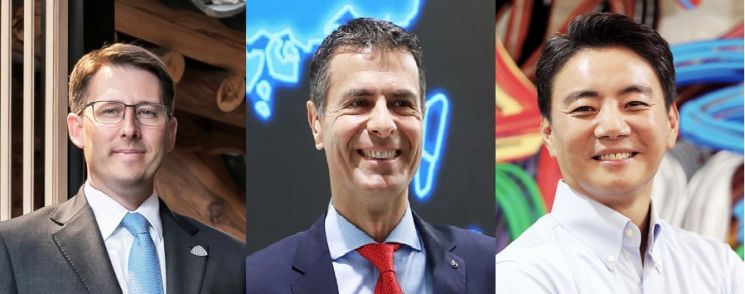 (Photo from left) Thomas Klein, CEO of Mercedes-Benz Korea; Dimitris Silarakis, CEO of Mercedes-Benz USA; Jiseop Kim, Head of Customer Service at Mercedes-Benz USA. Photo by Mercedes-Benz Korea
In the past, Mercedes-Benz used a top-down personnel approach by sending managers from advanced markets to the Korean subsidiary. However, recently, there is a clear trend of bottom-up promotions, with key executives from the Korean subsidiary being promoted to the German headquarters or the U.S. subsidiary.
Looking at last year's Mercedes-Benz sales, Korea ranks fourth globally as a single market, following China, the United States, and Germany. Mercedes-Benz Korea set a record by selling 80,000 units for the first time last year and achieved sales of around 7 trillion KRW. Except for China, the Mercedes-Benz E-Class sold the most units in Korea among global markets. The S-Class ranked second worldwide in sales, and Maybach ranked third.
Even by domestic market standards, Mercedes-Benz's performance stands out. Last year, Mercedes-Benz's domestic sales surpassed those of mass-market brands produced domestically such as Korea GM, Renault Korea, and KG Mobility. Moreover, Korea is a market where the native premium brand Genesis is strong. Having confirmed its achievements in the fiercely competitive Korean luxury car market, Mercedes-Benz dispatched its Chief Marketing Officer (CMO) from headquarters last year to monitor market trends in Korea.
© The Asia Business Daily(www.asiae.co.kr). All rights reserved.

















