NVIDIA Rides Generative AI 'Boom' to Soaring Earnings
De Facto Monopoly in GPU Supply
'AI Bandochae' Emerges as Alternative
The AI semiconductor market is experiencing a favorable wind. As demand for artificial intelligence (AI) services such as ChatGPT is explosively increasing, the shortage of supply of GPUs (graphics processing units), which are the core of AI computation processing, continues, causing AI semiconductors to rapidly emerge as an alternative. Domestic companies are also actively increasing investments in related fields and aggressively targeting the market.
According to the earnings data announced by the U.S. semiconductor company Nvidia on the 25th of last month, it recorded sales of $7.19 billion in the first quarter of this year. This significantly exceeded Wall Street's forecast of $6.52 billion. In particular, Nvidia projected second-quarter sales to reach $11 billion, which is more than 50% above the market expectation of $7.15 billion.
Following the earnings announcement, the stock price soared. On the 30th (local time) at the New York Stock Exchange, Nvidia's stock price briefly pushed its market capitalization beyond $1 trillion during trading hours. Until now, only four companies?Apple, Microsoft (MS), Alphabet (Google), and Amazon?have achieved a $1 trillion market cap on the New York Stock Exchange. Nvidia is the first semiconductor company to join the $1 trillion market cap club.
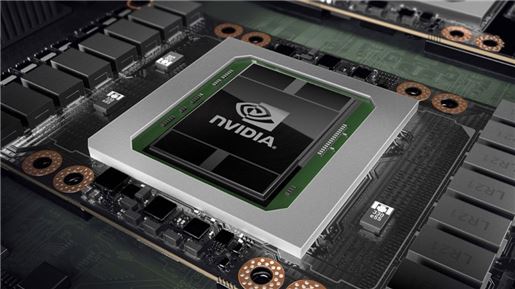 NVIDIA Volta
This quantitative growth of Nvidia was largely driven by the AI boom triggered by ChatGPT. GPUs are typically used for AI computation processing, and Nvidia holds a 90% market share. The structure inevitably leads to a supply shortage compared to demand. Elon Musk, CEO of Tesla, even mentioned at the WSJ CEO Council Summit on the 23rd of last month that "GPUs are much harder to obtain than drugs."
The domestic industry expects this situation to have a positive impact on the expansion of the AI semiconductor market. AI semiconductors refer to semiconductors that execute large-scale computations required for AI services at ultra-high speed and ultra-low power. Traditionally, CPUs (central processing units) and GPUs have played the role of the brain. Since graphics processing and AI computation proceed in similar ways, GPUs have been used for AI purposes until now.
With the emergence of ChatGPT, AI services are rapidly expanding in daily life and across industries, and the amount of data to be processed is increasing exponentially. The industry analyzes that relying solely on GPUs is burdensome due to their high price and operating costs caused by power consumption. AI semiconductors are evaluated as substitutes because they have higher power efficiency than GPUs in large-scale computations.
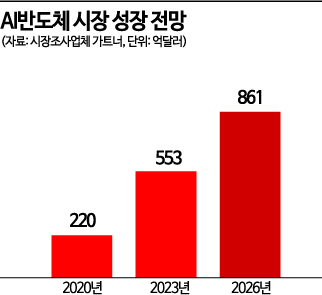
Market research firm Gartner also forecasted that the AI semiconductor market size will nearly double from $44.4 billion (about 43 trillion KRW) last year to $86.1 billion (about 87 trillion KRW) in 2026. It is expected that by 2030, AI semiconductors will account for more than 30% of system semiconductors.
In response to this growth potential, domestic companies are actively targeting the AI semiconductor market. A representative example is SK Telecom. The company established 'Sapeon' to promote its AI semiconductor business. Recently, it secured its first investment through a Series A funding round and has begun its first commercial service by embedding AI-based video quality enhancement in broadcasting equipment, showing tangible business results.
In April, Sapeon successfully attracted investments worth 50 billion KRW from GS Group and Daebo Group. It was recognized with a corporate valuation of about 500 billion KRW, achieving more than sixfold growth from 80 billion KRW at the time of its establishment last year within just one year. Additionally, on the 25th, it announced the commercialization of services by equipping the Sapeon semiconductor X220 in broadcasting equipment supplied to MBC for video quality enhancement. Although Sapeon semiconductors have already been pilot-applied in various fields such as NHN data centers and the NPU farm at the University of Toronto in Canada, this broadcasting equipment installation marks its practical commercialization.
KT also plans to commercialize its super-large AI service 'MIDEUM' in the first half of this year and has early on selected the AI semiconductor company Rebellion for application. To this end, KT invested 30 billion KRW in Rebellion last year and decided to use the invested funds for AI semiconductor development and mass production.
In addition, AI semiconductor startup Purios, which launched the neural processing unit (NPU) 'Warboy,' supplies semiconductors to Kakao Enterprise, and Naver announced a collaboration with Samsung Electronics for AI semiconductor development at the end of last year, declaring its intention to develop its own semiconductors without relying on GPUs.
An industry insider said, "At a time when demand for AI services is increasing exponentially, the market structure where GPU supply is virtually monopolized by one company will not last long," and added, "With market restructuring, business opportunities for AI semiconductors, which are more efficient than GPUs, will increase."
© The Asia Business Daily(www.asiae.co.kr). All rights reserved.
![Clutching a Stolen Dior Bag, Saying "I Hate Being Poor but Real"... The Grotesque Con of a "Human Knockoff" [Slate]](https://cwcontent.asiae.co.kr/asiaresize/183/2026021902243444107_1771435474.jpg)
















