The inflation rate in the Eurozone (20 countries using the euro) has dropped to its lowest level since the Russia-Ukraine war. As the inflation momentum weakens, some expect that the European Central Bank (ECB) may soon halt interest rate hikes. However, since core inflation remains high, it is expected to be difficult to translate this into an actual pivot in monetary policy direction.
On the 1st (local time), Eurostat, the statistical office of the European Union (EU), announced that the Eurozone consumer price index (flash estimate) rose by 6.1% year-on-year in May. This is significantly lower than both the market forecast (6.3%) and the previous month (7.0%), marking the lowest level since the outbreak of the Russia-Ukraine war in February last year (5.9%). The core inflation rate, which shows the underlying trend of prices, also slightly decreased to 5.3% from 5.6% in the previous month.
Foreign media reported, "Consumer prices decreased in 18 out of the 20 Eurozone member countries," and evaluated that "this shows that the Eurozone consumer price inflation, which had repeatedly hit record highs due to the surge in energy prices following the Russia-Ukraine war last year, is gradually stabilizing."
As the inflation surge slows, expectations for an imminent ECB pivot are gaining strength. The Eurozone economy is cooling rapidly, making it challenging for the ECB to raise interest rates further. Germany, the largest economy in the Eurozone, has already entered a recession. Germany's GDP growth rate in the first quarter of this year was -0.3%, marking two consecutive quarters of negative growth following -0.5% in the previous quarter. There are even forecasts that the already unfavorable economic conditions, including still higher-than-expected inflation, will worsen in the second half of the year.
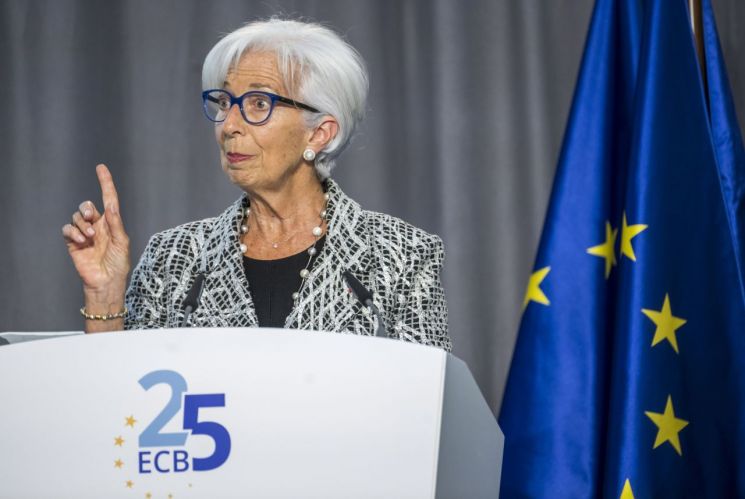
However, the ECB has stated that there is no change in its stance on raising interest rates. Christine Lagarde, President of the ECB, said immediately after the inflation data was released, "To bring inflation back to the target (2%), it is necessary to maintain the interest rate hike cycle." She added, "There is no clear evidence that inflation has peaked," and "We will raise interest rates to a sufficiently restrictive level."
A key variable in the ECB's interest rate trajectory is core inflation. The ECB is focusing on core inflation, which shows the underlying trend of prices. Despite the easing of price pressures in all sectors except services (energy and food), core inflationary pressures remain high. Jack Allen Reynolds, an economist at Capital Economics, said, "It seems likely that the Eurozone's benchmark interest rate will gradually decline, but this will not prevent the ECB from implementing additional rate hikes in June and July."
The ECB implemented a 'big step' (a 0.5 percentage point increase in the benchmark interest rate) for the first time in 11 years in July last year. It has continued to raise rates, reaching 3.75% in early last month. The market expects additional increases of 0.25 percentage points each on June 15 and in July.
© The Asia Business Daily(www.asiae.co.kr). All rights reserved.
![Clutching a Stolen Dior Bag, Saying "I Hate Being Poor but Real"... The Grotesque Con of a "Human Knockoff" [Slate]](https://cwcontent.asiae.co.kr/asiaresize/183/2026021902243444107_1771435474.jpg)















