Seoul apartment prices rose for the second consecutive week. Among the 25 districts, 16 districts, including the Gangnam 3 districts (Gangnam, Seocho, Songpa), Yongsan, Mapo, Nowon, and Yeongdeungpo, recorded either increases or remained steady, accounting for the majority.
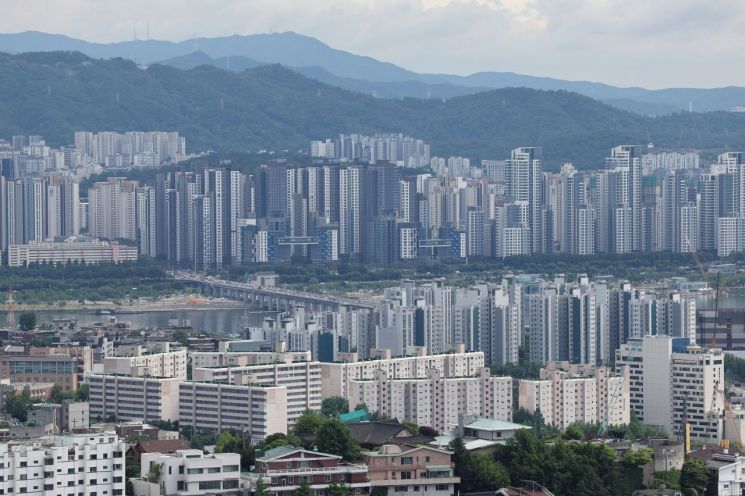
According to the 'Weekly Apartment Price Trend' announced by the Korea Real Estate Board on the 1st, Seoul apartment prices rose by 0.04% in the fifth week of May (as of the 29th), increasing the rate of growth compared to the previous week (0.03%).
Seoul apartment prices had been declining for 51 weeks since the first week of May last year (0.01%) due to factors such as a transaction freeze during the interest rate hike period, but turned to an increase last week. The Real Estate Board explained, "After the exhaustion of urgent sale properties, prices of listings are gradually rising locally. However, due to the gap between buyers' and sellers' desired prices, a wait-and-see stance remains, showing mixed trends by region."
In the Gangnam area, Seocho-gu (0.13%→0.21%) and Gangnam-gu (0.19%→0.13%) rose for the 7th and 6th consecutive weeks respectively, while Songpa-gu (0.26%→0.22%) and Gangdong-gu (0.05%→0.09%) also rose for the 4th consecutive week with varying rates.
Dongjak-gu (0.05%→0.07%), Yongsan-gu (0.04%), Jung-gu (0.03%→0.03%), and Mapo-gu (0.02%→0.05%) also maintained their upward trends. Nowon-gu and Seongdong-gu recorded steady prices for two consecutive weeks, and Geumcheon, Seodaemun, and Yeongdeungpo-gu (each -0.02%→0.00%) stopped declining. Additionally, Seongbuk-gu (-0.04%→0.01%) turned to an increase, while Yangcheon-gu (0.00%→-0.02%) fell back into decline after a week.
In Incheon, which had risen for two consecutive weeks (0.00%), prices remained flat. Although major complexes with good living conditions in Jung-gu (0.14%), Seo-gu (0.05%), and Yeonsu-gu (0.04%) saw urgent sale properties disappear, leading to an upward trend, Bupyeong-gu (-0.09%) declined due to supply burdens.
Gyeonggi Province (-0.06%→-0.02%) reduced its rate of decline. Cheoin-gu in Yongin-si (0.28%) continued to rise for the 10th consecutive week, driven by the ongoing benefits of national industrial complex development centered around Namsa and Idong-eup. Hanam-si (0.18%) and Bundang-gu in Seongnam-si (0.16%) also showed strong performance. On the other hand, Yangju-si (-0.46%) saw declines in older complexes in Deokjeong and Samsung-dong due to high supply, and Uijeongbu-si (-0.23%) also declined due to the impact of upcoming housing supply.
Seoul jeonse prices (0.01%→0.05%) continued their upward trend after rising for the first time in 1 year and 4 months last week. Strong increases were notable in Gangnam-gu (0.46%), Songpa-gu (0.23%), and Gangdong-gu (0.18%). The Real Estate Board stated, "While mixed trends of rises and falls are seen by region, the upward trend continued due to recognition of a bottom after long-term jeonse price declines and price increase contracts in preferred areas."
Nationally, jeonse prices saw a reduced rate of decline from -0.08% to -0.06%. Both the metropolitan area (-0.04%→-0.02%) and provinces (-0.12%→-0.09%) saw a narrowing of the decline. Among them, Sejong rose by 0.03%, continuing its upward trend for the 9th consecutive week since turning to an increase in the last week of March.
© The Asia Business Daily(www.asiae.co.kr). All rights reserved.
![Clutching a Stolen Dior Bag, Saying "I Hate Being Poor but Real"... The Grotesque Con of a "Human Knockoff" [Slate]](https://cwcontent.asiae.co.kr/asiaresize/183/2026021902243444107_1771435474.jpg)















