DPL Association to Hold 'SID Review Symposium' on the 1st
"MicroLED and OLED Markets to More Than Double in 4 Years"
It has been pointed out that the production gap in organic light-emitting diode (OLED) panel technology between Korea and competing countries such as China has narrowed to within two years. It is a situation where both technology and price competitiveness must be secured. As the next-generation display market, including MicroLED and MicroOLED, is expected to more than double in size in four years, opinions have been raised that private companies should promote international cooperation to raise the technological level above that of competing countries in this market.
The Korea Display Industry Association announced on the morning of the 1st that it held the '2023 SID Review Symposium' at the Samjung Hotel in Gangnam-gu, Seoul. About 130 display industry officials attended. It was an occasion to share major technological trends from the 'Display Week 2023' hosted by the Society for Information Display. The technological levels of AMOLED panels, eco-friendly QD (Quantum Dot) panels, and nano LED panels, which were designated as national advanced strategic technologies on the 17th of last month, were reviewed.
Lee Sang-jin, Executive Director of the association, introduced market research firm DSCC’s forecasts. DSCC predicted that the MicroLED and MicroOLED markets would grow at a rate of over 100% by 2027. With the increase in Apple OLED adoption models, it is expected that the share of OLED in tablets and laptops will reach 40% by 2027.
Executive Director Lee introduced the proposals Korea made to the International Committee for Display Metrology (ICDM). ICDM is an organization operated under U.S. leadership within the Society for Information Display. It deals with international standardization and related matters. It was announced that Korea is being considered as the host country for the ICDM meeting next year. It was also stated that cooperation with domestic specialized certification bodies is planned so that U.S. VESA (Video Electronics Standards Association) certification can be conducted in Korea. Previously, VESA certification was conducted through Taiwan’s Elion.
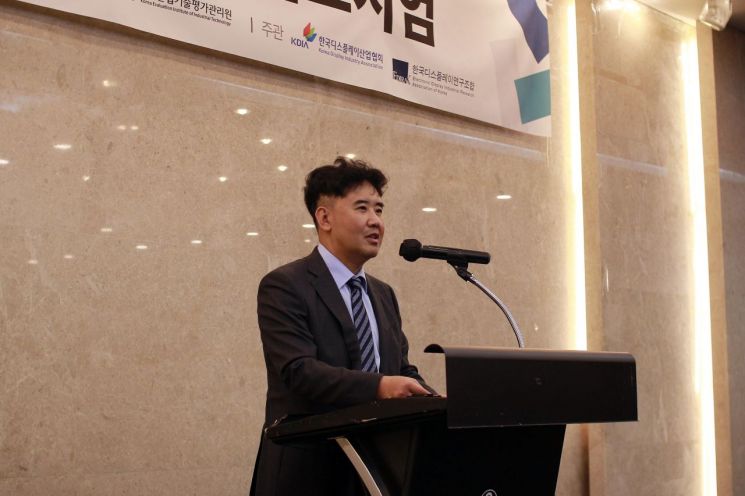 Lee Dong-wook, Executive Vice President of the Korea Display Industry Association, delivering the opening address at the '2023 SID Review Symposium.'
 [Photo by Korea Display Industry Association]
At the symposium presentations, the technological levels of major countries announced at SID 2023 were reviewed. Kim Yong-seok, head of the Display Innovation Process Project Group, said that the production gap in OLED panel technology is rapidly narrowing to within two years. He emphasized that it is necessary not only to improve quality but also to secure price competitiveness.
Professor Seo Min-cheol of Kyung Hee University said that Japan and China have become able to easily implement various Ex (Extended)-OLED technologies. Representative examples include photolithography patterning technology (Japan’s JDI and SEL, China’s Visionox), and 65-inch 8K inkjet printing foldable OLED technology (China’s TCL).
Byun Jun-won, director at the Electronics and Telecommunications Research Institute (ETRI), said that domestic microOLED panel companies need to quickly increase market share by cooperating with optical and system companies. Since Taiwan’s Innolux and the U.S.’s Magic Leap are enhancing XR (Extended Reality) device technology, Korea must shake off the pursuit. He added that Korea’s LG Display, Samsung Display, and China’s BOE and CSOT need to further develop technologies such as dizziness reduction for device commercialization.
Kim Jung-hyun, center director at the Korea Photonics Technology Institute, said that to raise the technological capabilities of domestic MicroLED materials, parts, and equipment companies, cooperation with U.S. Dow, Germany’s Merck, and Baker is necessary. Professor Kwak Jung-hoon of Seoul National University proposed partnerships with U.S. Nanosys for QD and cooperation with Japan’s Panasonic and others for 8th generation QD inkjet technology.
Lee Dong-wook, full-time vice chairman of the association, said, "At this Display Week, we confirmed that Korea’s technological level is higher than competing countries in foldable and rollable OLEDs, but the technological gap in future markets is not large," adding, "It is time to strategically promote international cooperation at the private sector level to enhance technological competitiveness."
The association said it plans to operate an international cooperation channel within the 'Display International Joint Research Group' to enable domestic companies to collaborate with overseas institutions possessing advanced technologies.
© The Asia Business Daily(www.asiae.co.kr). All rights reserved.
![Clutching a Stolen Dior Bag, Saying "I Hate Being Poor but Real"... The Grotesque Con of a "Human Knockoff" [Slate]](https://cwcontent.asiae.co.kr/asiaresize/183/2026021902243444107_1771435474.jpg)















