2.597 Trillion KRW Invested, Focused Development of SMR and MSR
The 8th term of the Gyeongnam Provincial Government announced a comprehensive mid- to long-term plan for fostering the nuclear power industry in Gyeongnam on the 1st.
On the same day, Gyeongnam Province held a briefing at the provincial government press center and stated that the plan was developed by organizing and operating a private expert working group from industry, academia, and research sectors for over 10 months since August last year, and by collecting opinions from companies in the field.
They explained that to implement the national agenda of "abolishing the nuclear phase-out policy and strengthening the nuclear industry ecosystem" and the core task of the 8th term provincial government, "development of Small Modular Reactor (SMR) technology and normalization of the nuclear power industry," they diagnosed the current status of the nuclear power industry in the province and actively discovered new projects linked to the main industries.
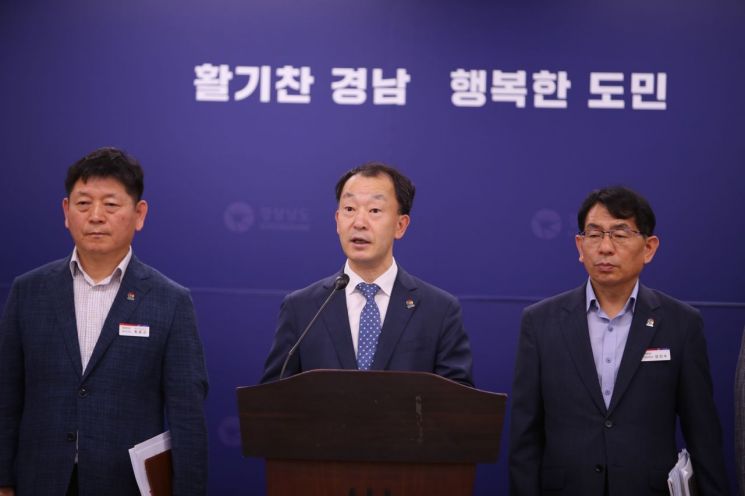 Ryu Myung-hyun, Director of the Industry and Trade Bureau of Gyeongnam Province, is announcing the mid- to long-term comprehensive plan for fostering the nuclear power industry in Gyeongnam.
 [Photo by Lee Se-ryeong]
The province set "Fostering a Global Manufacturing Hub for Next-Generation Nuclear Power Plants" as its mid- to long-term vision.
To this end, a total of KRW 2.597 trillion, including national funds, local funds, and private capital, will be invested by 2023.
They prepared three major strategies?▲Establishment of a Manufacturing Innovation Cluster ▲Development of Next-Generation Nuclear Power Manufacturing Innovation Technologies ▲Fostering Global Export Small and Medium Enterprises (SMEs)?and 13 key tasks, and plan to implement 41 detailed projects to achieve four goals, including nurturing 100 global export SMEs.
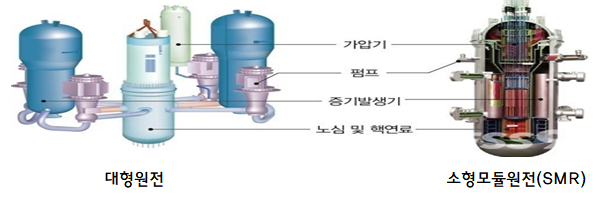 Structure of Large Nuclear Power Plants and Small Modular Reactors. [Image provided by Gyeongnam Provincial Government]
Regarding the establishment of the manufacturing innovation cluster, six projects were identified to lay the foundation for fostering the nuclear power industry, such as creating a manufacturing innovation cluster through convergence and fusion between the nuclear power industry and main industries, with a total investment of KRW 1.5025 trillion.
The industrial sector will expand from large nuclear power plants to next-generation nuclear power industries such as Small Modular Reactors (SMRs), 4th generation nuclear power plants, nuclear power plant decommissioning, and spent nuclear fuel storage industries.
They will also focus on ▲early establishment of the Changwon Defense and Nuclear Fusion National Industrial Complex and concentration of corporate and research infrastructure ▲construction of the Gyeongnam Nuclear Power Industry Comprehensive Support Center ▲activation of the Energy Industry Convergence Complex ▲securing research infrastructure for manufacturing innovation technology development.
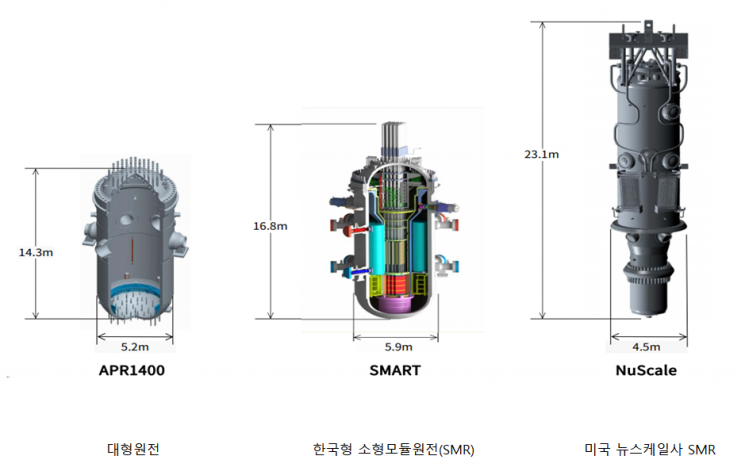 Reactor sizes of large nuclear power plants, Korean SMRs, and US NuScale SMRs.
 [Image provided by Gyeongnam Provincial Government]
Regarding the development of next-generation nuclear power manufacturing innovation technologies, 28 detailed projects were identified with a total investment of KRW 765.9 billion planned.
The province has been preparing since the second half of last year to promote a government preliminary feasibility study project at the local government level for a KRW 400 billion export-oriented Small Modular Reactor (SMR) advanced manufacturing process technology development project, including actual production and commercialization fields.
To secure economic feasibility by shortening the production period from 11 months to 2 months and reducing material costs by 60%, innovative manufacturing technologies different from existing methods, such as high-temperature isostatic pressing powder metallurgy technology (PM-HIP), will be promoted as government research and development (R&D) projects.
They will also pursue ▲development and demonstration research of next-generation nuclear power technologies such as molten salt reactors (MSR) applicable to ships and offshore plants ▲support for technology development for nuclear power plant decommissioning and spent nuclear fuel storage containers ▲establishment of a cooperation system (MOU) with related organizations for next-generation nuclear manufacturing innovation.
Regarding fostering global export SMEs, seven projects were identified with a total investment of KRW 328.6 billion planned to nurture global SMEs by strengthening export competitiveness.
Gyeongnam Province, POSCO Technology Investment, Korea Hydro & Nuclear Power, and 10 other institutions will jointly invest to create and operate an Energy Innovation Growth Fund worth KRW 44.5 billion.
To subsidize loan interest rates of 2-3%, the newly established nuclear industry promotion financial support fund will provide about KRW 50 billion annually.
The Nuclear Power Company Rapid Support Center, opened last year to resolve difficulties faced by nuclear power companies, will continue to operate.
They plan to strengthen export capabilities through a customized package support project for nuclear power companies in cooperation with the Korea Trade-Investment Promotion Agency (KOTRA).
By attracting the Energy Technology Sharing University promoted by the government and establishing the ASEAN Engineering Technology Institute at the University of Science and Technology (UST), they will cultivate specialized technical personnel and researchers for the nuclear power industry and deploy them in the field.
Gyeongnam Province expects that this nuclear power industry promotion policy will generate a production inducement effect of KRW 5.2996 trillion and create 27,123 jobs.
Through the promotion strategies, although there are currently no global SMEs with exports exceeding USD 5 million, they aim to increase to 20 companies by 2027 and 100 companies by 2032, and to expand technical and research personnel to 160 in four years and 500 by 2032.
By 2032, they aim to fully secure SMR advanced manufacturing technology and surpass annual sales of KRW 22 trillion.
Ryu Myeong-hyun, Director of the Industry and Trade Bureau, said, "Although Gyeongnam nuclear power companies were hit hard by the previous government's nuclear phase-out policy, orders such as the KRW 1.6 trillion El-Dabaa nuclear power plant in Egypt last year, the resumption of construction of Shin Hanul Units 3 and 4 this year with a KRW 2.9 trillion main equipment supply contract over 10 years, and future auxiliary equipment supply worth KRW 2 trillion will bring new vitality to local nuclear power companies."
He added, "In line with government policies, we will further enhance Gyeongnam's strengths in nuclear power manufacturing capabilities and do our best to make Gyeongnam a global manufacturing hub in the fields of next-generation land-based and offshore nuclear power SMR and MSR."
© The Asia Business Daily(www.asiae.co.kr). All rights reserved.
![Clutching a Stolen Dior Bag, Saying "I Hate Being Poor but Real"... The Grotesque Con of a "Human Knockoff" [Slate]](https://cwcontent.asiae.co.kr/asiaresize/183/2026021902243444107_1771435474.jpg)

















