Final 3 Candidates for People Power Party Supreme Council By-election on 9th All Zero-term and Non-incumbents
"Role of Supporting Supreme Council Members Disappears"
The ruling party leadership is experiencing a 'shortage of incumbent lawmakers.' The three final registered candidates for the People Power Party's Supreme Council by-election, which is just four days away, are all 'first-timers' with no prior experience as elected members of the National Assembly and are affiliated outside the legislature. This contrasts with the past when the Supreme Council was led by senior lawmakers with at least two terms, and up to seven terms. Why has the Supreme Council, once regarded as a 'guarantee for nomination' due to its control over nomination rights, lost popularity within the legislature?
Three Supreme Council Candidates... Zero Incumbents
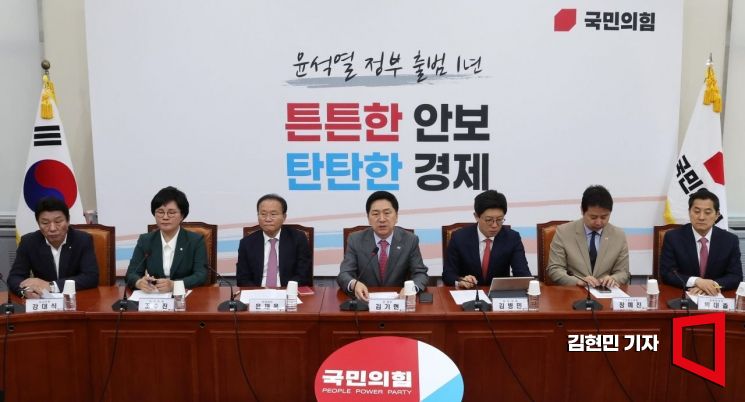 Kim Ki-hyun, leader of the People Power Party, is speaking at the Supreme Council meeting held at the National Assembly on the 25th. Photo by Kim Hyun-min kimhyun81@
The candidates participating in the People Power Party Supreme Council by-election debate on the 5th are Kim Garam, Lee Jongbae, and Cheon Gangjeong. All are non-incumbents with no experience as members of the National Assembly. Initially, in this election triggered by the resignation of lawmaker Tae Young-ho from the Supreme Council, re-elected lawmakers based outside the Yeongnam region were considered strong candidates, including lawmakers Lee Yongho, Kim Seokki, and Song Eon-seok. However, by the registration deadline on the 30th of last month, not a single lawmaker had thrown their hat into the ring.
The Supreme Council, along with the party leader, is responsible for deliberation and resolution of overall party affairs and has mainly been held by lawmakers with at least two terms. During the Saenuri Party era, which had a 'collective leadership system' where the first-place candidate became the party leader (representative supreme council member) and the second place and onwards became supreme council members, the lowest-ranking supreme council member had at least two terms, with some holding up to seven terms (such as lawmaker Seo Cheong-won).
In particular, since the Supreme Council is the body that makes the final decision on nominations for National Assembly elections, it wields enormous influence over nominations. Article 32 of the People Power Party's constitution specifies one of the Supreme Council's functions as the 'resolution of candidates for National Assembly and other public offices.' Because of this, in the March 8 party convention, 13 candidates registered for the Supreme Council and 11 for youth supreme council members, drawing significant attention.
In fact, from the Saenuri Party through the 21st general election and the United Future Party, most elected supreme council members received nominations for the next general election. Out of 19 total, only four supreme council members failed to secure nominations due to factors such as scandalous remarks and changes in electoral districts.
Supreme Council as a Nomination Guarantee... More Poison than Benefit, Why?
However, ahead of next year's general election, the situation has changed rapidly. There is talk that holding a Supreme Council position might actually be disadvantageous in the general election. A party official said, "The idea that the Supreme Council holds nominations like collateral is an old story," adding, "In this general election, the leadership might take the lead in making sacrifices (by not running). Being part of the leadership could actually be a barrier to candidacy." This implies that the party leadership, including supreme council members, might resolve not to run to ensure victory in the general election.
This internal party atmosphere is said to have solidified further after Supreme Council member Kim Jaewon, who was embroiled in repeated controversies, received a severe disciplinary action of 'one-year suspension of party membership rights.' Kim was barred from applying for the People Power Party's nomination in next year's general election after the party ethics committee imposed the suspension on the 10th of last month.
Additionally, the analysis suggests that the Supreme Council's degeneration into a 'nominal leadership' has led to avoidance of the supreme council position. During the March 8 party convention, amid controversies over President Yoon Seok-yeol's interference in party affairs, the Supreme Council became dominated by pro-Yoon factions, leading to criticism that there is a lack of critical voices in party-government relations. Lawmaker Lee Yongho said on CBS Radio on the 30th of last month, "The Supreme Council is the highest decision-making body, but is it fitting? Is it just a figurehead? There are stories that important core agenda decisions are made elsewhere," adding, "There is even talk of a 'Group of Five' within the party." Inside and outside the party, members such as Secretary-General Lee Cheol-gyu, Yeouido Research Institute Director Park Sooyoung, and Strategy Planning Deputy Chief Park Seongmin, who attend private strategy meetings with party leader Kim Ki-hyun, are speculated to be members of this 'Group of Five.'
Party leader Kim Ki-hyun and the leadership have dismissed the 'Group of Five' controversy. However, criticism remains that the 'Group of Five' reflects the current state of the Supreme Council as a 'plant leadership.' Lawmaker Lee clarified on Facebook on the 2nd, "I retract my 'Group of Five' comment made on the broadcast on the 30th of last month," but added, "I made the comment out of a desire for the Supreme Council to quickly regain its role and status, and it was an inappropriate choice of words."
Structural Limitations of a Single Leadership System with Separately Elected Supreme Council Members
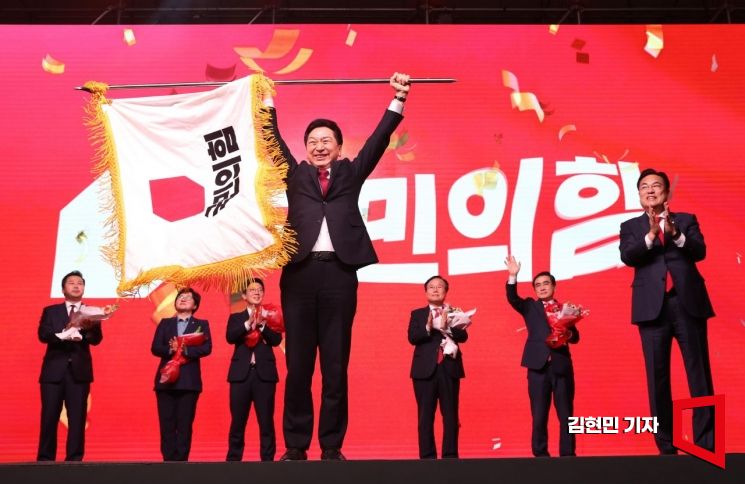 Kim Ki-hyun, the newly elected leader of the People Power Party, is waving the party flag after being elected as the party leader at the party's 3rd national convention held on the afternoon of the 8th at KINTEX in Ilsan, Gyeonggi Province. Photo by Kim Hyun-min kimhyun81@
However, some within the party point out that the diminished status of the Supreme Council is a structural limitation of the single leadership system. In a 'single leadership system,' where the party leader is elected separately from the supreme council members and decisions are made centered on the leader, the likelihood of first-term or non-incumbent candidates running and winning increases compared to senior lawmakers. The People Power Party returned to a single leadership system after the 2016 general election. A re-elected lawmaker explained, "Under the collective leadership system, 'strong figures' sat on the Supreme Council, but after switching to the single leadership system, heavyweight figures do not run for the Supreme Council at all," adding, "The single leadership system centers on the party leader, and the rest have limited roles."
It is also interpreted that the influx of non-incumbents into the leadership began with the election of former People Power Party leader Lee Jun-seok. In the party's first convention, Lee was elected as the first 'zero-term non-incumbent' party leader in a conservative party, surpassing mid-level lawmakers with four to five terms. At that time, the Supreme Council also had lower weight compared to the past, with two first-term lawmakers (Jo Su-jin and Bae Hyun-jin) and two non-incumbents (Kim Jae-won and Jung Mi-kyung). A party official explained, "It was a breeze created by former leader Lee," adding, "Since non-incumbents consistently topped opinion polls, many non-incumbents applied for the Supreme Council at that time."
Regardless of which candidate wins in the Supreme Council by-election on the 9th, criticism continues that the three elected supreme council members, except for lawmaker Jo Su-jin, will be non-incumbents, lacking weight. Supreme Council member Kim Jae-won said on YTN Radio on the 31st of last month, "Although President Yoon Seok-yeol is in power, the situation is still a minority government, and the Democratic Party holds a majority and is engaging in all sorts of legislative tyranny," adding, "In such a situation, the opposition party needs to have combat power, but if the ruling party's Supreme Council is weakly composed, it causes significant problems. There is definitely regret in that regard." The Democratic Party's elected supreme council members include two three-term lawmakers (Jung Cheong-rae and Seo Young-kyo), one two-term lawmaker (Park Chan-dae), and two first-term lawmakers (Ko Min-jung and Jang Kyung-tae), all of whom are within the legislature.
© The Asia Business Daily(www.asiae.co.kr). All rights reserved.
![Clutching a Stolen Dior Bag, Saying "I Hate Being Poor but Real"... The Grotesque Con of a "Human Knockoff" [Slate]](https://cwcontent.asiae.co.kr/asiaresize/183/2026021902243444107_1771435474.jpg)
















