If you were to name the leading region in the real estate market, nine times out of ten it would be Seoul, and among Seoul, Gangnam stands out. Boasting the highest land prices in the country and established as a proper noun symbolizing the super-rich, Gangnam is South Korea's premier affluent neighborhood and a dream town for those aspiring to join the upper class, boasting endless demand.
The ‘Masterpiece’ of Infrastructure... ‘Gangnam’ Becoming a Brand
The answer to how Gangnam, once simply the ‘area south of the Han River,’ became the most popular area favored by wealthy asset holders lies in its infrastructure environment. Until the 1990s, Seoul’s central areas were mainly Jongno and Gwanghwamun, but as business and commercial hubs shifted to Gangnam, perceptions began to change.
Especially in the 2000s, following the opening of COEX Mall in Samseong-dong (now Starfield COEX Mall), large department stores and shopping malls such as Shinsegae Department Store Gangnam Branch, Central City, and Lotte Department Store Gangnam Branch were established, creating an unparalleled living infrastructure that absorbed market demand nationwide.
Gangnam is unique in that it concentrates all infrastructure?from large-scale office facilities, administrative towns, school districts, culture, shopping, to medical services. It houses Teheran-ro, the heart of South Korea’s business, as well as upscale commercial districts catering to wealthy individuals, and numerous high-quality hospitals and clinics.
Based on this infrastructure, numerous luxury residential complexes have been developed, naturally attracting wealthy residents, and the name ‘Gangnam’ itself has become a ‘brand.’ The advantage of enjoying all infrastructure near one’s home perfectly meets the needs of asset holders who prioritize quality of life, leading to the formation of affluent neighborhoods as high-ranking government officials, corporate executives, and entrepreneurs move in.
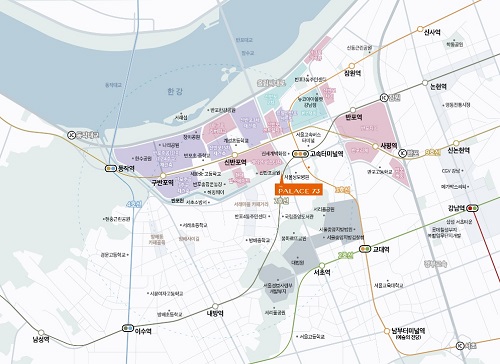
Banpo-dong: A ‘Complete’ Location with the Nation’s Top Department Store and Excellent Transportation Network
Recently, Banpo-dong has emerged as a key area within Gangnam favored by asset holders for its high-value infrastructure. Notably, Shinsegae Department Store, which has held the top spot among domestic department stores for six consecutive years since surpassing Lotte Department Store Myeongdong Main Branch in 2016, serves as the central axis. According to the distribution industry, last year Shinsegae Department Store Gangnam Branch recorded sales of 2.8398 trillion KRW, benefiting from its location adjacent to Gangnam’s top affluent neighborhood and a weekend daily floating population exceeding one million, securing both high-income VIP customers and general consumers.
Nearby development is also active, with the redevelopment of the former Intelligence Service site, considered prime land in Gangnam, drawing attention first. Purchased for 1.0956 trillion KRW, this site is expected to transform into a large-scale office town blending advanced companies, nature, and cultural spaces. The site covers approximately 96,797㎡, large enough to fit 13 soccer fields, surpassing the size of the Samsung-dong GBC site (74,148㎡) in Gangnam. Additionally, the Lotte Chilsung site (42,312㎡), Lion Mising site (5,363㎡), and Samsung site (5,305㎡) along Seocho-daero have been designated as special planning zones and are planned to be developed into business and commercial complexes.
The transportation network further enhances Banpo-dong’s future value. The area is conveniently accessible via subway lines 3, 7, and 9, allowing easy travel anywhere in the city center. The local Express Bus Terminal is located here, and nearby stops serve various trunk, branch, metropolitan, and airport bus routes, sharing a rich transportation network. Banpo IC provides access to the Gyeongbu Expressway, and road networks such as Olympic-daero and Gangbyeonbuk-ro are easily accessible.
‘The Palace 73’ in Banpo-dong: A Core Location Continuing the ‘Heritage’ Value
The recent highlight in this area is ‘The Palace 73,’ a hyper-end residential complex built on the site of the former Sheraton Palace Gangnam, Gangnam’s first luxury hotel.
‘The Palace 73’ chose Banpo-dong?not Cheongdam, Sinsa, or Apgujeong?to realize the value of a truly hyper-end residence, a special home that only a limited number of wealthy individuals can select. This choice reflects Banpo-dong’s high value, the pride inherited from the five-star hotel that once represented Gangnam, and the green living environment essential to luxury residential areas.
The market response has been enthusiastic. The introduction of a hyper-end residential product aimed at super-rich demand in Banpo-dong is seen as a forward-looking decision considering both the current and future value of Banpo-dong’s location. This emergence of hyper-end residences is expected to further raise expectations for Banpo-dong, creating a positive synergy between location and product.
The project site is located in Banpo-dong’s core area, diagonally across from Express Bus Terminal Station and Shinsegae Department Store Gangnam Branch, and directly facing Catholic University St. Mary’s Hospital. It offers excellent accessibility not only to Gangnam but throughout Seoul, with nearby Seorigol Park, Seoripul Park, Montmartre Park, and Banpo Sports Complex allowing residents to enjoy various urban parks like a garden right outside their home.
A representative from the developer of ‘The Palace 73’ stated, “Choosing Banpo-dong for the complex’s location is based on premium convenience in daily life and the perfect infrastructure to realize ‘The Palace 73’s’ residential philosophy of being the most perfect, top-tier living space of the current era.” They added, “We will pursue the utmost perfection to make it a symbolic landmark representing hyper-end above high-end, elevating Banpo-dong’s future value to a new level.”
Meanwhile, the private gallery where ‘The Palace 73’ can be directly experienced operates by prior reservation only for verified clients and has been designed as an artistic space embodying the project’s architectural philosophy and intent.
© The Asia Business Daily(www.asiae.co.kr). All rights reserved.

















