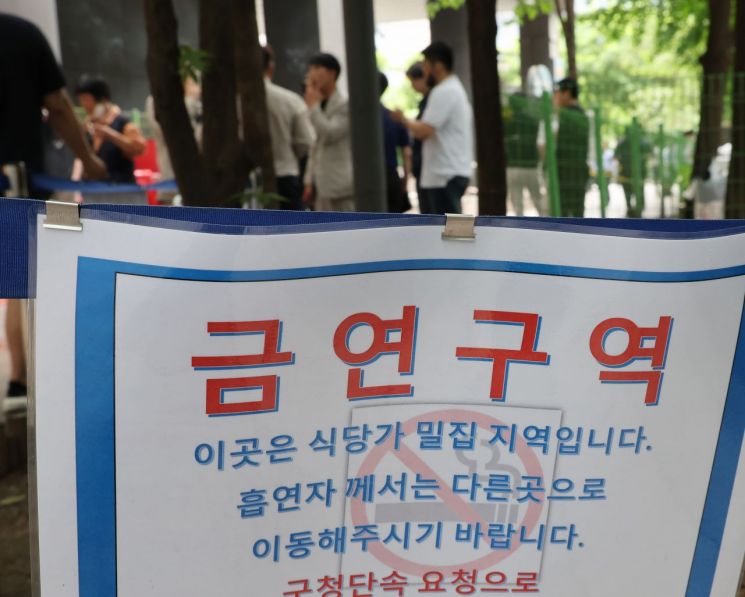
Discussions about raising the cigarette price, which has been fixed at 4,500 won for eight years, are reigniting. This is due to concerns that smoking rates may generally rise again as South Korea entered a de facto endemic phase of infectious diseases starting from the 1st. Although the Ministry of Health and Welfare oversees various smoking cessation policies such as warning images and texts on cigarette packs and smoking prevention education, experts believe that raising cigarette prices is the most effective way to expand smoking cessation.
According to the Korea Disease Control and Prevention Agency, the adult smoking rate (based on combustible cigarettes) in South Korea was 19.3% last year, up 0.2 percentage points from the previous year. The adult smoking rate had dropped to 19.1% in 2021, the second year of COVID-19, due to the "stay-at-home effect," marking the lowest since statistics began in 1998, but it has been gradually rising with the return to normal life. In particular, the male smoking rate decreased from 19.6% to 19.3%, while the female smoking rate increased from 2.7% to 3.4%. The usage rates of liquid-type and combustible-type electronic cigarettes rose by 0.3 and 0.7 percentage points respectively from the previous year, reaching 2.3% and 4.3%.
As the era of 100% combustible cigarettes shifts to one with various tobacco products, the actual smoking rate is expected to be higher. Lee Sung-gyu, director of the Korea Tobacco Control Research and Education Center, said, "Electronic cigarettes, once called new types of tobacco, have now become mainstream tobacco products, and products such as dissolvable tobacco, electronic pipe tobacco, electronic water pipe tobacco, nicotine pouches, and toothpick tobacco have emerged."
On the other hand, the budget for smoking cessation programs has been steadily decreasing. According to the Ministry of Health and Welfare, the budget for the national smoking cessation support service peaked at 147.5 billion won in 2015, when cigarette prices were raised, but shrank to 116.5 billion won last year.
Professor Cho Hong-jun of Ulsan University College of Medicine emphasized, "Raising cigarette prices leads to increased tax revenue related to smoking cessation and lowers cigarette purchase rates, thereby expanding smoking cessation. It is the most effective measure among smoking cessation policies." He added, "South Korea's cigarette price has been frozen for eight years since it was raised by 2,000 won (from 2,500 won to 4,500 won) in 2015." Professor Cho also noted, "Since real per capita national income increased by 10.1% from 2015 to last year, the real price of cigarettes has effectively decreased," and said, "If the Ministry of Health and Welfare does not propose a cigarette price increase plan, it can be seen as lacking the will to regulate tobacco."
Among the 38 OECD countries, South Korea's cigarette price was the fourth cheapest as of 2020. The most expensive country, Australia (25,000 won), has prices more than five times higher than South Korea. Generally, countries with higher cigarette prices tend to have lower smoking rates. The Ministry of Health and Welfare had set a goal in 2021 to raise cigarette prices to the OECD average of 8,100 won within ten years but reversed its stance to "no plan to proceed" after controversy spread. The ministry agrees with the purpose of raising cigarette prices but states that, since it is a sensitive issue, sufficient social discussion and opinion gathering are necessary.
To reduce smoking rates, some say the most urgent step is to broaden the legal definition of tobacco. In South Korea, tobacco is defined as products made from tobacco leaves. Therefore, some new tobacco products using electronic cigarettes and synthetic nicotine, which are not included in the legal definition of tobacco, evade various regulations. One expert argued, "While the World Health Organization's Framework Convention on Tobacco Control (FCTC) states that all tobacco containing nicotine is harmful, South Korea remains passive in regulation," and insisted, "The tobacco industry should not be considered at all in the smoking cessation policy decision-making process."
© The Asia Business Daily(www.asiae.co.kr). All rights reserved.