Originally a natural disaster warning system for earthquakes, etc.
Evacuation guidelines by situation also specified on the portal site
Amid growing controversy over the false emergency alert sent by Seoul city after North Korea launched a space launch vehicle on the morning of the 31st, Japan's nationwide warning system (J-ALERT), also known as 'J-Alert,' which calmly issued a detailed alert immediately after North Korea's launch, is drawing attention.
The Japanese government quickly responded by broadcasting evacuation instructions through J-Alert just one minute after North Korea's missile launch and displaying action guidelines on portal sites, leading to comparisons with Seoul city's emergency text messages. Originally, this system is an alert issued during natural disasters such as earthquakes, and it is widely used in Japan, where earthquakes, volcanic eruptions, and tsunamis are frequent. It is also evaluated as being useful for evacuation alerts in cases of missile launches and terrorist attacks.
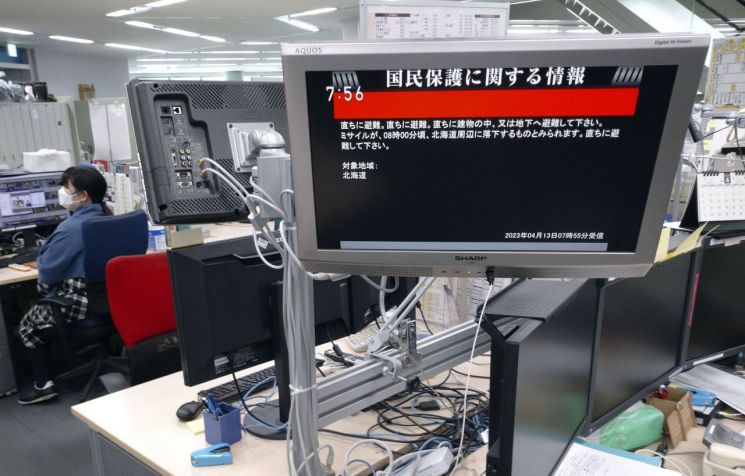
According to NHK, the Japanese government issued an evacuation alert for Okinawa Prefecture, the expected missile fall area, through the nationwide warning system (J-ALERT) at 6:30 a.m., just one minute after North Korea launched the missile. Through J-ALERT, smartphone notification texts are sent simultaneously while the speakers of the relevant local governments automatically turn on to broadcast evacuation announcements.
On that day, a message was sent to smartphones via J-ALERT stating, "Missile launch. Missile launch. It appears that North Korea has launched a missile. Please take shelter inside buildings or underground." The notification message also specified the time of the government's alert announcement, 6:30 a.m., and the alert area, Okinawa.
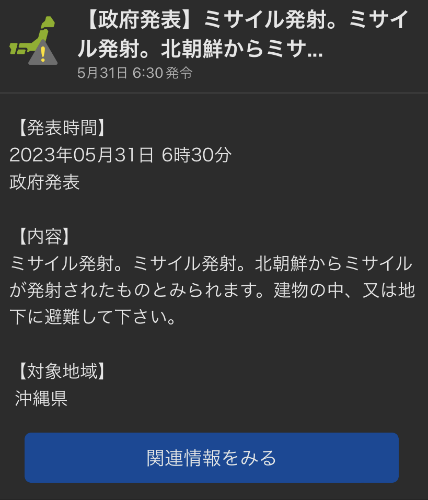 At 6:30 a.m. on the 31st, a J-ALERT message was sent to smartphones. It specifies the missile launch information along with the alert announcement time.
The broadcast began with a 14-second siren, followed by a voice message repeated three times: "Missile launch information. Missile launch information. There is a possibility that a missile will fall in this area. Please take shelter indoors and turn on your TV and radio." The broadcast was transmitted not only through disaster prevention administrative speakers installed outdoors but also through 'household receivers' installed in each home or business.
Japan, where natural disasters such as earthquakes and tsunamis are frequent, has established and uses J-ALERT, a communication system between the national government and local governments, and the Emergency Network System (Em-Net).
J-ALERT is a system through which the national government sends alerts directly to the public without going through local government responses. It is issued when there is little time to respond to events such as tsunamis or ballistic missile launches.
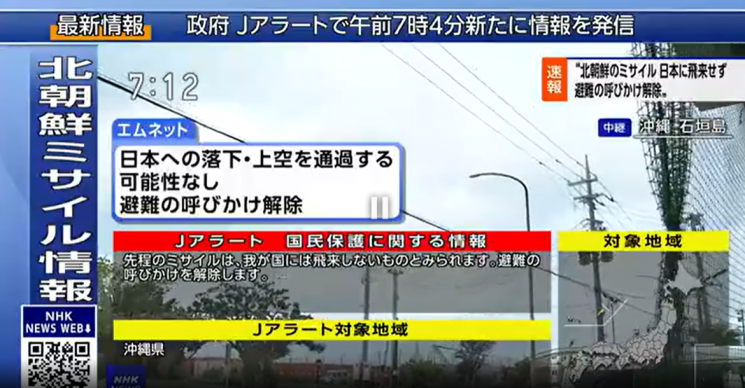
Missile launches or terrorist incidents are handled by the Cabinet Secretariat, while natural disasters are managed by the Meteorological Agency. Once the decision to issue an alert is made, it is conveyed to the Fire and Disaster Management Agency of the Ministry of Internal Affairs and Communications, which automatically activates the disaster prevention administrative speakers of local governments via communication satellites to broadcast the alert. There is no need for local governments to make individual judgments; the central alert is delivered immediately.
When the Fire and Disaster Management Agency issues an alert, it is transmitted to the relevant local governments within 1 to 2 seconds, accompanied by sirens and voice information. Mobile carriers send emergency alert texts to mobile phones in the target area and can also send disaster or evacuation information from local governments.
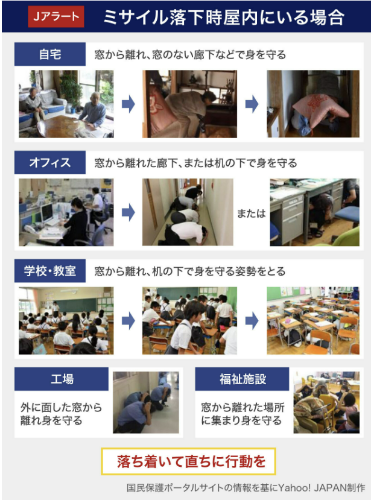 Indoor Shelter Guidelines During Missile Fall Provided by Yahoo Japan. The instructions are divided by location such as home, office, school, factory, and welfare facilities. (Photo by Yahoo Japan)
J-ALERT was first introduced in 2007, mainly in some areas such as Hokkaido and Nagano Prefecture. Subsequently, the Japanese government expanded it nationwide through a supplementary budget in 2009. In April 2014, receivers were installed in all local governments, and in May 2016, a system was established that automatically transmits central information without local government operation, as it does now.
Em-Net is a communication system between local governments and the national government. Using an administrative exclusive network, it enables message transmission and reception between the Prime Minister's Office Crisis Management Center and local governments. It immediately notifies local governments of alert-related content in text or document form. Although slower than J-ALERT, it provides more detailed information.
Local governments that have introduced J-ALERT post related information on their official websites. Above all, many upload audio files of the siren sounds used in alerts so that residents do not get startled when they hear the sirens.
The response of portal sites is also noteworthy. On the morning of the day, Yahoo Japan prominently displayed action guidelines at the top of its homepage under the message "Prepare for ballistic missiles."
What stands out is the presentation of specific action guidelines according to location and situation. For those outdoors, it advises taking shelter inside the nearest building or underground, and if no buildings are nearby, to hide in the shade or lie down on the ground protecting the head. It further breaks down instructions for those in cars, classrooms, workplaces, and welfare facilities with many elderly people, attaching photos and graphics for easy understanding at a glance.
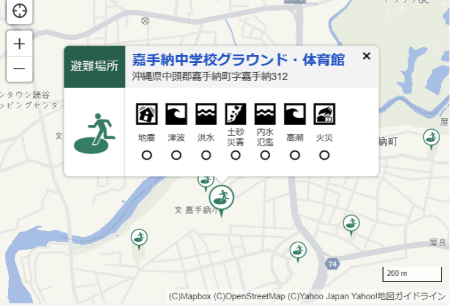
Yahoo Japan also provides an "Evacuation Site Map." It categorizes damage situations such as earthquakes, tsunamis, floods, landslides, and fires, allowing users to search by region. When searched, the map marks locations for easy identification and shows pictograms indicating which situations the evacuation sites are suitable for. For example, a gymnasium building with good seismic design is suitable for earthquakes, tsunamis, floods, and landslides, while a park is suitable only for earthquakes and fires.
© The Asia Business Daily(www.asiae.co.kr). All rights reserved.
![Clutching a Stolen Dior Bag, Saying "I Hate Being Poor but Real"... The Grotesque Con of a "Human Knockoff" [Slate]](https://cwcontent.asiae.co.kr/asiaresize/183/2026021902243444107_1771435474.jpg)


















