From Vulnerable Groups to Middle Class as Social Service Recipients
Welfare for Vulnerable Groups by the State, Welfare for Middle Class by Themselves
"Increase Social Service Usage Rate by 7%P by 2027"
Diversification and Advancement Strategies Including Niche Care and Emergency Care
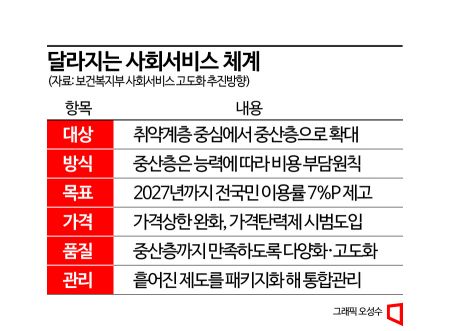
The government will effectively extend social service benefits, which were previously provided only to vulnerable groups, to the middle class as well. However, the middle class will have to pay according to their ability in order to receive welfare benefits. This is seen as the start of President Yoon Suk-yeol’s selective welfare system, where the state is responsible for identifying welfare blind spots and supporting the vulnerable, while the general public bears their own costs.
On the 31st, the Ministry of Health and Welfare held a ‘Social Security Strategy Meeting’ to discuss the ‘Social Service Advancement Promotion Direction’ containing these details. The meeting was organized to gather opinions from experts in the social security field with the goal of building a sustainable welfare state.
According to the agenda discussed that day, the government will expand the target recipients of social services from primarily low-income groups to the middle class. If appropriate fees are paid, care services that were previously available only to those earning 140-160% or less of the median income will become accessible to everyone. For short-term care, a new childcare service is being developed, which, once launched, will allow the middle class to use it by paying additional fees. Community service vouchers and customized elderly care will also pilot the removal or relaxation of income criteria based on the principle of ‘differentiated burden according to ability.’ Psychological support for children and adolescents will be allowed even if their income exceeds 160% of the median income. This represents a typical selective welfare system where the state supports vulnerable groups, and the middle class manages their own welfare.
The government’s push toward selective welfare is driven by a mismatch between supply and demand. According to a survey by the Ministry of Health and Welfare, 60% of the public desires social services, and 44.1% are willing to pay to use them. However, due to limited fiscal capacity, only 33.1% currently benefit from these services. The government believes that allowing the middle class to access social services under the condition of bearing costs will increase the number of beneficiaries. Jeon Byeong-wang, Director of Social Welfare Policy at the Ministry of Health and Welfare, explained, “With this change, the social service utilization rate among the entire population is expected to increase by 7 percentage points by 2027.”
Advancing Social Service Quality... Price Regulation Also Eased
As social service fees will be charged to the public, the quality will be enhanced accordingly. To this end, the government will ease price regulations on social services. Special activity fees provided to daycare centers will have differentiated caps based on age and demand, and the authority to set usage fees for the Together Care service will be delegated to the centers. A ‘price elasticity system’ will also be piloted in the second half of this year. Social service providers will be able to request various prices by differentiating co-payments within a certain range according to their expertise. The government’s strategy is to improve social service quality by introducing competition principles, such as removing substandard institutions during the service provision process.
As a result, various forms of care services are expected to change. Elderly care services, which previously only checked on vulnerable seniors, will transform to meet the expectations of financially capable older adults. Support will extend beyond daily living assistance and health management to include mobility and housing environment improvements. For elementary school care, types will diversify to include flexible care during gap times such as commuting hours. New services will also be expanded for family caregivers who were previously in welfare blind spots, such as young carers (young caregivers) and middle-aged groups. In particular, an ‘emergency care’ system will be established to provide national support for 1-2 months regardless of income when sudden illness or injury requires care.
The strategy meeting also discussed integrating social security systems managed by central government ministries. Currently, complex social security systems operated separately by various agencies will be packaged together. For example, connections among child care services like Neulbom School, Together Care, and community child centers will be strengthened. Dispersed response systems for domestic violence, child abuse, elder abuse, and disability abuse will also be linked. To improve convenience for the public, the system guidance windows will be consolidated into ‘110 (Government Civil Service Call Center)’ and ‘120 (Local Government Consultation Hotline).’ Various social security websites will also be unified under the Ministry of Health and Welfare’s ‘Bokjiro’ portal.
Experts have evaluated these changes as necessary for Korea’s social service system. Professor Jeong Jae-hoon of the Department of Social Welfare at Seoul Women’s University explained, “In advanced countries like Germany, social services provided to the middle class and vulnerable groups do not differ qualitatively. Instead, low-income groups receive funding from local governments or health insurance associations, while the middle class pays out-of-pocket.” He added, “Building such a social service system is essential to solving the problems faced by people in welfare blind spots.”
© The Asia Business Daily(www.asiae.co.kr). All rights reserved.
![Clutching a Stolen Dior Bag, Saying "I Hate Being Poor but Real"... The Grotesque Con of a "Human Knockoff" [Slate]](https://cwcontent.asiae.co.kr/asiaresize/183/2026021902243444107_1771435474.jpg)















