The urgent threat of an unprecedented default that loomed over the United States has been temporarily averted with the final agreement on raising the debt ceiling, but caution remains. Currently, the leadership of both parties is confident about the bill’s passage, yet voices of opposition continue, particularly from hardliners such as the Republican Freedom Caucus. While the market anticipates a short-term rally due to eased default concerns, there is vigilance over potential negative impacts on the U.S. economy stemming from future fiscal spending restrictions.
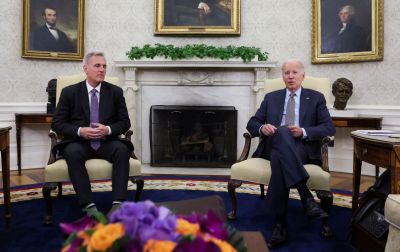 President Joe Biden and House Speaker Kevin McCarthy meet to negotiate raising the U.S. debt ceiling
 [Photo by Reuters Yonhap News]
House vote scheduled for the 31st... Opposition from Republican hardliners is key
On the 30th (local time), the House Rules Committee announced on the 29th that it will discuss the 'Fiscal Responsibility Act,' which contains the results of the debt ceiling negotiations, at 3 p.m. House Speaker Kevin McCarthy, a Republican, has indicated plans for a full House vote on the 31st, marking the start of the bill’s processing beginning with the so-called 'gatekeeper,' the House Rules Committee.
Notably, the House Rules Committee, composed of nine Republicans and four Democrats, includes some Republican hardliners, raising concerns that the hard-won agreement may face difficulties. The Washington Post (WP) reported, "The House Rules Committee meeting on Tuesday afternoon will be the first test," noting that among the nine Republicans, three are far-right members. Representatives Ralph Norman and Chip Roy have already expressed opposition." Florida Governor Ron DeSantis, a leading Republican presidential candidate, also criticized the agreement on Fox News that day, stating, "Before the negotiations, the U.S. was heading toward bankruptcy, and even after the agreement, it is still heading toward bankruptcy."
Even if the bill passes the Rules Committee and proceeds to a full House vote, some procedural steps remain before final approval. WP assessed that the bill faces a "challenging path" to pass by the Treasury’s newly set default deadline of June 5. The Wall Street Journal (WSJ) also described it as a "difficult and potentially lengthy journey."
Currently, the House is divided with 222 Republicans and 213 Democrats. At least half of the 222 Republican members must support the bill. If the bill fails to secure the necessary 218 votes and is rejected, the budget revision process could take several days, making timely passage difficult. Accordingly, Speaker McCarthy has reportedly been meeting with fellow Republican lawmakers early on Memorial Day to explain the bill’s contents and seek their support.
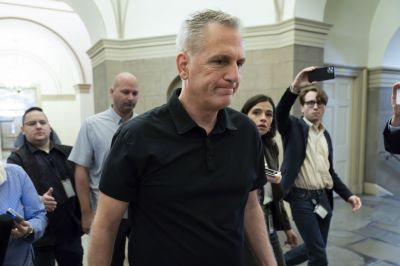
However, the leadership of both parties appears confident about the bill’s passage. Speaker McCarthy told reporters he is not worried about the House Rules Committee. Especially, key centrist groups such as the New Democrat Coalition and the Problem Solvers Caucus have expressed support, suggesting the bill can secure enough votes. Annie Kuster, chair of the New Democrat Coalition, stated that day, "We have achieved a bipartisan agreement that saves the U.S. from default through 2025 while protecting the nation from economic collapse and preventing cuts to key programs relied upon by millions of Americans."
The White House plans to continue persuasion efforts through one-on-one calls with senators returning from the Memorial Day recess. Senate Majority Leader Chuck Schumer said that if the bill passes the House on the 31st, the Senate will immediately take it up, warning senators to "prepare for a potential vote on Friday or over the weekend." President Joe Biden, returning to Washington the previous day, urged Congress to pass the bill, saying, "From the start, I made it clear that bipartisan agreement is the only way forward."
The day before, the White House and Republican leadership unveiled an agreement to suspend the debt ceiling until January 1, 2025, in exchange for some government spending cuts. Non-defense discretionary spending will be frozen for fiscal year 2024 and increased by 1% in fiscal year 2025. The agreement includes reclaiming $30 billion of unused COVID-19 response funds and reducing spending by expanding age restrictions on food stamp applications and ending student loan repayment deferrals for low-income groups. However, key Biden administration legislation such as the Inflation Reduction Act (IRA) will maintain its budget for climate change and clean energy initiatives.
Caution persists despite agreement... Concerns over future economic slowdown intensify
Despite the agreement, market caution remains. While the immediate risk of default has diminished, variables that may arise during the congressional voting process and the economic impact of reduced fiscal spending and liquidity cannot be overlooked. Bloomberg News described the deal as "avoiding the worst-case scenario of a default that would trigger financial collapse, but an agreement that could increase recession risks for the world’s largest economy."
Government spending cuts are typically considered a major factor that can constrain economic recovery. Moreover, in recent quarters, the federal government’s fiscal contribution to the U.S. real gross domestic product (GDP) growth has been increasing. Michael Feroli, Chief U.S. Economist at JPMorgan Chase, pointed out, "If the economy enters a recession, reduced fiscal spending will have a greater impact on GDP and employment." JPMorgan Chase expects the U.S. to enter a recession in the second half of 2023. Moody’s also forecasts that the agreement could result in a reduction of up to 120,000 jobs by the end of 2024.
Investment bank UBS predicts that monetary tightening capacity will expand further, potentially leading to a stronger dollar and rising Treasury yields. This would negatively affect emerging market financial markets. JPMorgan and Macquarie also expect increased Treasury issuance to push yields higher. Wall Street analysts say that while the exact impact of this new wave of Treasury issuance is uncertain, it will likely remove significant liquidity from the financial system.
This will pose considerable challenges for the Federal Reserve’s monetary policy path. Diane Swonk, Chief Economist at KPMG LLP, evaluated, "Monetary policy will become somewhat more restrictive, while fiscal policy will also be constrained. The two policies are moving in opposite directions and amplifying each other."
Last Friday’s release of the Personal Consumption Expenditures (PCE) price index showed a larger-than-expected increase, already raising expectations for a Fed rate hike in June. According to the Chicago Mercantile Exchange (CME) FedWatch tool, as of that afternoon, federal funds futures priced in nearly a 60% chance of a 0.25 percentage point rate increase in June?a sharp rise from about 25% just a week earlier. Conversely, the probability of a rate hold dropped from the mid-70% range to 41%.
The New York Stock Exchange remained closed through the day due to the Memorial Day holiday weekend. Wall Street expects a short-term relief rally this week as default fears ease. However, given ongoing risks such as the June rate decision, fiscal spending and liquidity reductions, Treasury yield volatility, and recession concerns, investors are expected to remain cautious for the time being. Additionally, major foreign media outlets have noted that President Biden faces significant political pressure as he moves toward a final agreement to avoid default.
© The Asia Business Daily(www.asiae.co.kr). All rights reserved.
![Clutching a Stolen Dior Bag, Saying "I Hate Being Poor but Real"... The Grotesque Con of a "Human Knockoff" [Slate]](https://cwcontent.asiae.co.kr/asiaresize/183/2026021902243444107_1771435474.jpg)
















