KIST Research Team Studies Using Proton Transfer Mass Spectrometer
Measures Volatile Organic Compound Concentration Inside New Cars
"Ventilation Can Reduce Concentration by 62%"
It has been found that the concentration of pollutants significantly increases when the interior heater of a new car is turned on in the afternoon during winter. This highlights the necessity of ventilation.
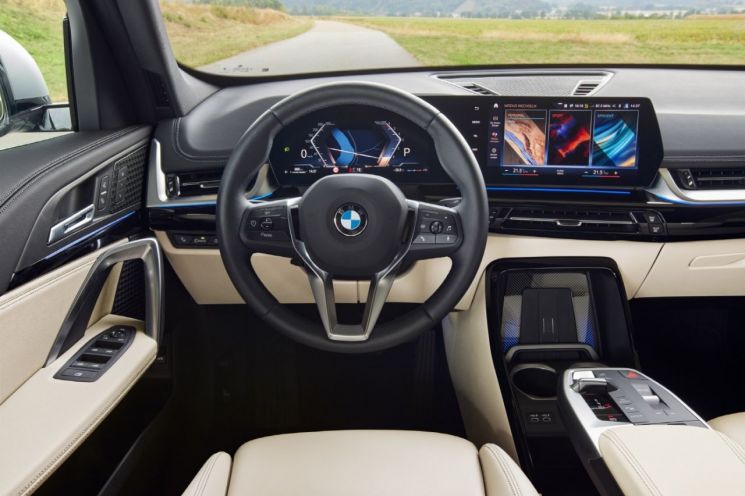
The National Research Foundation of Korea announced on the 29th that a research team led by Dr. Lee Ji-won at the Korea Institute of Science and Technology (KIST) confirmed that the use of heaters in vehicles during winter increases the emission of volatile organic compounds (VOCs) by more than 50%. They also explained that active ventilation, such as setting the vehicle’s air conditioning system to allow outside air intake, can reduce the concentration of VOCs by up to 62%. Volatile organic compounds are a general term for organic compounds in liquid or gaseous form that easily evaporate into the atmosphere due to their low boiling points. They vary widely in type, and their harmfulness differs depending on the substance.
Dr. Lee’s research team measured the volatile organic compounds generated inside new cars in real time during winter and investigated the effects of sunlight and automotive air conditioning on the indoor air quality of vehicles. The interior of a car is smaller than indoor spaces such as homes and schools and is composed of various materials including plastic, glass, and rubber. Since it is greatly affected by sunlight and outside air, the development of materials and reduction devices that take these factors into account is required.
Last year, the number of registered vehicles in Korea exceeded 25 million, and the time people spend using cars is gradually increasing. However, research on volatile organic compounds generated inside new cars, including electric vehicles, remains insufficient. Most existing studies on in-car air quality have used chromatography methods, which analyze a limited number of substances and make it difficult to determine real-time concentrations. Chromatography is a method that separates mixtures of samples by using appropriate stationary and mobile phases to exploit differences in the movement speeds of the components.
The research team monitored about 200 types of volatile organic compounds generated inside new cars using a proton transfer reaction time-of-flight mass spectrometer and systematically investigated the effects of sunlight exposure, heater operation, and outside air intake. The proton transfer reaction time-of-flight mass spectrometer is a state-of-the-art mass spectrometry technology capable of real-time analysis with high resolution even at low concentrations of gases.
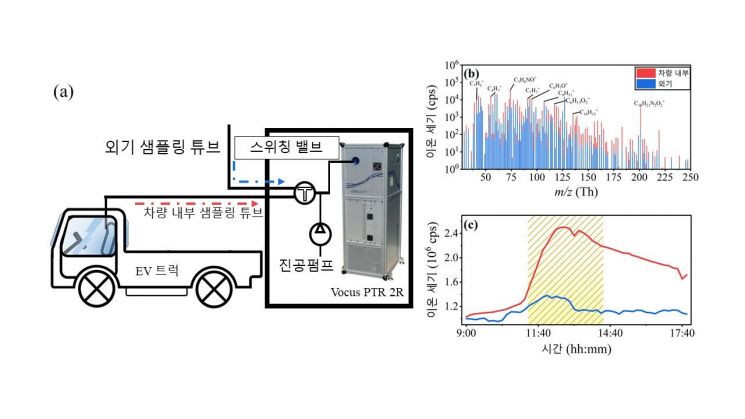 Method of measuring new car interior and outside air (left), average mass spectrum of outside and inside air, and daily total ion variation pattern. Photo source=KIST
Simultaneous comparative measurements of the interior of new cars and outside air showed that the concentration of volatile organic compounds inside the vehicle was more than twice as high as outside air, and the concentration in the afternoon, when sunlight exposure increases, was more than twice that of the morning. Additionally, when the heater was used, the concentration of volatile organic compounds surged by more than 50%, but when outside air was introduced through the air conditioning system, the concentration immediately decreased to around 50%.
Dr. Lee stated, “This study is significant in that it measured various types of volatile organic compounds generated inside new cars in real time and identified their characteristics according to different conditions,” adding, “Based on this, we hope to establish a foundation for developing various technologies that reduce substances generated inside vehicles and maintain a clean environment.”
The results of this study were published on the 7th of last month in the international environmental journal Journal of Hazardous Materials.
© The Asia Business Daily(www.asiae.co.kr). All rights reserved.
![Clutching a Stolen Dior Bag, Saying "I Hate Being Poor but Real"... The Grotesque Con of a "Human Knockoff" [Slate]](https://cwcontent.asiae.co.kr/asiaresize/183/2026021902243444107_1771435474.jpg)
















