Ministry of Science and ICT - Institute for Basic Science
Successful Beam Extraction on the 23rd
Practical Research Use Starting Second Half of Next Year
Unlocking Space Secrets and Developing New Materials and Cancer Treatments
South Korea's largest basic science infrastructure project, the "Korean Superconducting Heavy Ion Accelerator (RAON)," has finally reached the practical application stage after 14 years of work. It could serve as a foundation for innovations in materials science, including the secrets of the origin of the universe, semiconductors, secondary batteries, and cancer treatment.
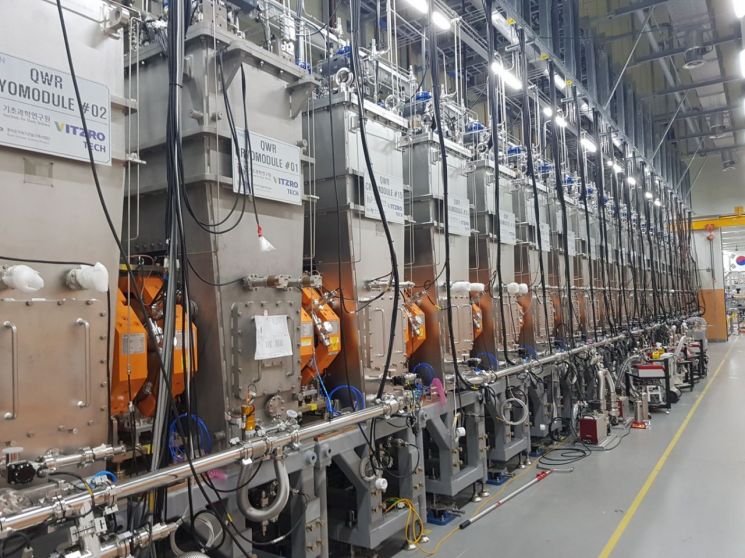
The Ministry of Science and ICT and the Institute for Basic Science (IBS) Heavy Ion Accelerator Research Center announced on the 29th that they successfully conducted beam commissioning across the entire low-energy acceleration section of RAON on the 23rd. RAON is South Korea's largest basic science research project, built with 1.5 trillion won invested since 2010 using domestic technology, completed at the end of 2021. RAON is a device that accelerates heavy elements (heavy ions) such as uranium and collides them with targets to generate new rare isotopes. Through this process, experimental data that can reveal the origins of the universe and elements, as well as the evolution of stars, can be obtained. Industrial ripple effects are also expected, including innovations in new material development and medical fields such as semiconductors, secondary batteries, and cancer treatment. At the end of last year, the beam was extracted from the front section of the accelerator (22 QWR units) for the first pilot operation.
This time, since March of this year, they succeeded in commissioning all 124 superconducting accelerator units, including the rear section accelerators (102 HWR units). Maintaining ultra-high vacuum and cryogenic helium cooling (around minus 270 degrees Celsius), they controlled the frequency and beam phase of all 124 superconducting accelerators to understand the unique characteristics of each accelerator and set optimal acceleration parameters, accumulating operational technology and know-how. Subsequently, through additional reproducibility experiments, they succeeded in reaching a beam energy of 17.6 MeV/u (accelerated energy per nucleon (u) in electron volts (eV)) and a beam current of 21.3 μA (microamperes (μA), beam charge per hour). The low-energy section can accelerate particles to about one-tenth the speed of light (approximately 30,000 km/s) over an accelerator length of about 100 meters.
The Ministry of Science and ICT and IBS plan to proceed with performance optimization, commissioning linked with various experimental devices, and establishing selection criteria for domestic and international research proposals, aiming to begin full-scale operation from the second half of next year.
Oh Tae-seok, the first vice minister of the Ministry of Science and ICT, said, "It is significant that we have confirmed the achievement and consistency of RAON's target performance, into which a huge national budget has been invested," adding, "Through the performance optimization process, we will ensure that creative and leading international joint research can be actively conducted here from the second half of next year."
Meanwhile, the second phase project, the high-energy section, was originally planned to be constructed simultaneously but has been tentatively postponed after several plan revisions due to technical issues. Preliminary research has been underway since last year, and construction will proceed depending on the results. It is planned to be built to accelerate particles up to half the speed of light, approximately 150,000 km/s.
© The Asia Business Daily(www.asiae.co.kr). All rights reserved.
![Clutching a Stolen Dior Bag, Saying "I Hate Being Poor but Real"... The Grotesque Con of a "Human Knockoff" [Slate]](https://cwcontent.asiae.co.kr/asiaresize/183/2026021902243444107_1771435474.jpg)















