Strong Domestic Consumption and Yen Depreciation Boost Corporate Earnings, Driving Stock Market Rally
Retail Investors Buy 194.5 Billion KRW Worth of Japanese Stocks This Month
Experts Warn of Short-Term Overheating, Advise Monitoring Economic Conditions in Second Half
This year, the number of individual investors directly investing in the Japanese stock market has significantly increased. This is due to the upward trend in the Japanese stock market, supported by accommodative monetary policies and a strong domestic market. The Japanese stock market has risen more than 20% since the beginning of the year, ranking first in growth among major Asian stock markets. However, there are considerable concerns about short-term overheating. Analysts suggest that it is not too late to invest after further confirming the continuity of the Japanese government's monetary policy and economic indicators.
Over 20% Increase Since Early Year... Individual Investors Net Buy 194.5 Billion KRW This Month
According to the Korea Securities Depository on the 30th, domestic investors purchased Japanese stocks worth 194.5 billion KRW (based on an exchange rate of 1,328 KRW per USD) from the 1st to the 26th of this month. Compared to the previous month's purchase amount of 115.5 billion KRW and March's 106.5 billion KRW, this is 68% and 82% higher, respectively. In terms of purchase amount, this is the highest since August 2021 (155 billion KRW).
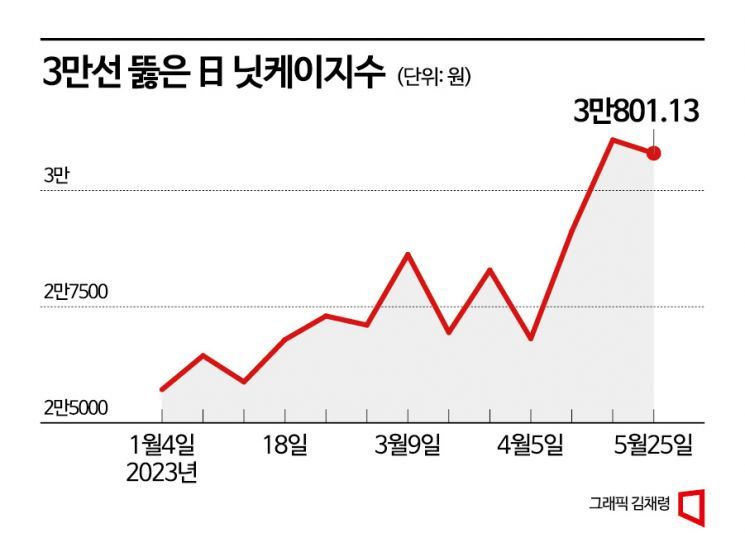
The rise in the Japanese stock market since the second half of last year has attracted investors' attention. The Nikkei 225 index surged about 8% in the past month and has risen more than 20% since the beginning of the year, ranking first in growth among major Asian stock markets. During the same period, the Taiwan Weighted Index rose 16.04%, and the KOSPI increased 14.97%, showing favorable performance but still lower than the Nikkei index. Following were the Shanghai Composite Index (3.08%), India’s SENSEX Index (2.18%), Singapore’s STI Index (-1.35%), and Hong Kong’s Hang Seng Index (-7%).
The rise in the Japanese stock market is largely influenced by a high domestic demand ratio and expectations of export improvement due to the weak yen (Yen depreciation). Fundamentally, Japan’s economic growth remains solid despite the global economic slowdown. The first quarter GDP growth rate increased by 0.4% quarter-on-quarter, exceeding the expected 0.2%. Sanghyun Park, a researcher at Hi Investment & Securities, explained, “Due to relatively low external dependence, Japan continued growth based on domestic demand despite overall export sluggishness caused by conflicts between the U.S. and China.”
Domestic demand is also strong as the number of tourists visiting Japan increases. Before COVID-19, the average spending per tourist was about 170,000 yen, which has now increased to 212,000 yen. The continuation of ultra-loose monetary policy and the significant improvement in earnings of export companies due to the yen depreciation effect have also driven the rise in the Japanese stock market. Major Japanese media have predicted that the earnings of leading listed companies will reach record highs this year, supported by the weak yen effect. Lastly, news that Warren Buffett, chairman of Berkshire Hathaway, purchased shares of Japan’s five major trading companies (Mitsubishi Corporation, Mitsubishi Shoji, Itochu Corporation, Sumitomo Corporation, Marubeni) also stimulated investors.
The top net purchase stocks by individual investors included exchange-traded funds (ETFs) investing in Japanese semiconductor companies, ETFs investing in long-term U.S. bonds, and shares of trading companies bought by Warren Buffett. The most purchased stock by individual investors this month was the Global X Japan Semiconductor ETF, with about 19.6 billion KRW bought. The Japanese government’s commitment to investing in the semiconductor industry positively influenced stock prices. The iShares 20+ Year Treasury Bond ETF was also purchased with 9.6 billion KRW. Investors took advantage of the low yen value to expect gains from currency exchange and price appreciation. Next were the Next Fund Nasdaq (6.3 billion KRW), Next Fund TOPIX ETF (2.3 billion KRW), IT parts manufacturer Nidec (2.1 billion KRW), Itochu Corporation (1.8 billion KRW), semiconductor electronic parts manufacturer Rohm (1.8 billion KRW), and Mitsubishi Corporation (1.7 billion KRW) in net purchases.
Economic Growth Rate Expected to Follow Upward Trend
Experts expect Japan to record an upward trend in economic growth centered on domestic consumption. Although there is little justification to continue accommodative monetary policy given the highest inflation rate in 41 years (4.3%), even if a shift to tightening policy occurs, the real economy is unlikely to respond immediately. The emergence of wage increase movements and the strengthening of travel-centered consumption momentum due to China’s reopening of economic activities are further boosting economic growth expectations.

The expansion of capital investment focused on semiconductors is also a positive factor for economic growth. The Japanese government recently secured a subsidy budget for semiconductor industry revitalization and plans to increase financial support for startup development. Samsung Electronics also plans to establish a semiconductor development base in Japan.
Limitations of Domestic Consumption Momentum and Potential Monetary Policy Changes in Q3 Are Variables
However, domestic consumption momentum is unlikely to continue through the second half of the year. Yoonjung Shin, a researcher at eBest Investment & Securities, stated, “Upward pressure on prices remains due to increases in public utility fees, mainly electricity, and service prices, and there are clear limits to the recovery of travel-centered consumption momentum. As the year progresses, the improvement in the semiconductor industry and economic recovery in major export countries will become more important for economic growth prospects.”
The possibility of changes in the Bank of Japan’s (BOJ) monetary policy is also a factor to watch. Last month, the BOJ emphasized that premature tightening would negatively affect achieving the inflation target but also announced it would begin verifying side effects from large-scale monetary easing, leaving room for potential policy changes. Namjoong Moon, a researcher at Daishin Securities, explained, “The recent sharp rise in the Japanese stock market should be viewed as a tactical opportunity to reduce exposure. It is not too late to invest after confirming the continuity of economic growth through monetary policy changes and GDP growth in the third quarter of this year.”
Accordingly, some advise that it is better to approach investments by individual stocks rather than relying on index gains in the second half of the year. Historically, the 12-month forward price-to-earnings ratio (P/E ratio) of the Nikkei index remained between 14 and 17 times, but it currently exceeds 18 times, indicating a high valuation burden. Meanwhile, despite favorable corporate earnings, earnings per share (EPS) indicators have not significantly improved. Bowen Choi, a researcher at Korea Investment & Securities, analyzed, “Companies benefiting from the normalization of economic activities in Japan and foreign inflows, consumer goods, and industrial or IT sectors expected to see sales growth due to global demand recovery are promising.”
© The Asia Business Daily(www.asiae.co.kr). All rights reserved.
![Clutching a Stolen Dior Bag, Saying "I Hate Being Poor but Real"... The Grotesque Con of a "Human Knockoff" [Slate]](https://cwcontent.asiae.co.kr/asiaresize/183/2026021902243444107_1771435474.jpg)












