Financial Services Commission Finalizes Supplementary Measures for CFD Regulation
Enhancing CFD Information Transparency and Eliminating Regulatory Arbitrage
Restricting New CFD Transactions by Individual Investors for 3 Months and Revising Regulations
In the future, individuals without investment experience in stocks, high-risk derivative-linked securities, and other high-risk products will be prohibited from using Contracts for Difference (CFD). The financial authorities have strengthened the investment qualification requirements for CFDs after concerns that the previous low qualification standards encouraged indiscriminate investments by individuals. Additionally, CFD balance information and actual investor data will be provided so that individuals can verify the extent of their leveraged investments through CFDs.
On the 30th, the Financial Services Commission, Financial Supervisory Service, Korea Exchange, and Korea Financial Investment Association announced the finalization of the ‘CFD Regulation Supplementary Measures’ and significant revisions to related regulations. This move comes after it was confirmed that CFDs were used as a tool for stock price manipulation by Ra Deok-yeon and his group, aiming to close regulatory gaps and prevent unfair practices in advance.
First, until the CFD regulatory enhancements are completed, new CFD transactions by individuals will be restricted for the next three months. Securities firms such as Kiwoom, Kyobo, Samsung, Korea Investment & Securities, and Shinhan Investment Corp. have already blocked CFD trading at the company level. CFD trading will resume sequentially starting with securities firms that have improved their systems and internal control frameworks.
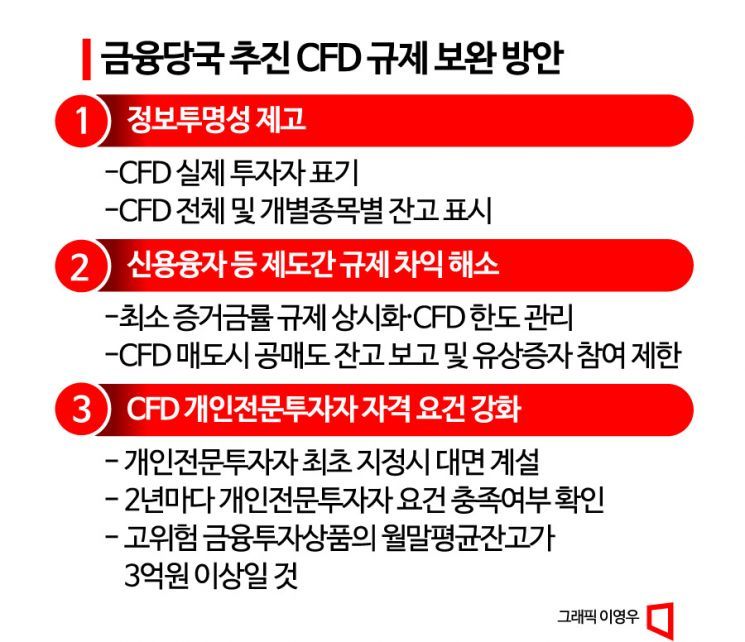
The regulatory enhancement measures can be summarized into three main points: ▲ improving transparency of CFD-related information ▲ eliminating regulatory arbitrage between systems such as margin loans ▲ strengthening the qualifications for individual professional investors. First, by enhancing CFD information disclosure, the plan is to correct cases where the actual investor is an individual but is formally recorded as a foreign or domestic securities firm, preventing investor misunderstanding. Also, similar to margin loan balances, disclosures will include individual stock balances and total CFD balances. Furthermore, actual investor information will be added to the Korea Exchange’s TR reporting items for market surveillance purposes.
To eliminate regulatory arbitrage between systems, a minimum margin rate regulation of around 40% (maximum leverage of 2.5 times) will be made permanent, and CFDs will be included in securities firms’ credit extension limits. The credit extension limit per securities firm is managed within 100% of their own capital, and this will now include the CFD limit. Moreover, CFDs will be incorporated into the industry’s voluntary risk management best practices, setting stock-specific limits, forced liquidation criteria, and differentiated margin rates and trading limits per investor. A Financial Services Commission official stated, “Although there was a recommendation to set stock-specific limits for CFD investments before, there was no basis for sanctions. Since these matters will be established as best practices, securities firms will be held accountable.” Additionally, the Capital Markets Act will be amended so that actual investors are subject to short-selling balance reporting and restrictions on participation in paid-in capital increases even when selling CFDs. This measure reflects concerns that indirect selling through CFDs could evade short-selling balance reporting and participation restrictions in paid-in capital increases.
Finally, face-to-face account opening will be mandatory to qualify as an individual professional investor. The qualification requirements remain the same, but there will be strengthened verification and confirmation of investor intent at the designation stage. Securities firms that fail to verify individual professional investor qualifications every two years will face fines of up to 50 million KRW and administrative sanctions under the Financial Investment Business Regulations. Furthermore, all solicitation activities aimed at encouraging individual professional investor designation will be prohibited.
Separate and stricter requirements have been established for investors in OTC derivatives such as CFDs. Only those who have obtained individual professional investor status and have a monthly average balance of 300 million KRW or more in stocks, derivatives, and derivative-linked securities with high-risk financial products will be allowed to trade OTC derivatives like CFDs. Previously, individuals could use CFDs if they invested only in lower-risk products such as ELS, bonds, and funds with a monthly average balance of 50 million KRW or more, but now experience investing in products with potential losses exceeding principal is considered essential.
A Financial Services Commission official explained, “It is estimated that only 22% of current individual professional investors meet these requirements, so CFD investors will inevitably shrink. If the individual professional investor qualification is lost, new investments in OTC derivatives beyond existing balances will be prohibited.” He added, “As investor protection strengthens, individuals should recognize that professional investor designation means moving into an area not covered by institutional safeguards.”
Meanwhile, the Financial Services Commission plans to complete changes to the Korea Exchange and securities firms’ IT systems and submit amendments to the Capital Markets Act and Financial Investment Business Regulations by the third quarter of this year (August).
© The Asia Business Daily(www.asiae.co.kr). All rights reserved.
![Clutching a Stolen Dior Bag, Saying "I Hate Being Poor but Real"... The Grotesque Con of a "Human Knockoff" [Slate]](https://cwcontent.asiae.co.kr/asiaresize/183/2026021902243444107_1771435474.jpg)
















