Pig dragged to slaughterhouse falls off truck
Eventually captured and moved back to slaughterhouse
Growing interest in 'alternative meat' made from plant-based ingredients
"Being dragged back to the slaughterhouse... how pitiful."
A pig that was being transported to a slaughterhouse fell off a vehicle, wandered around the city, was captured, and then sent back to the slaughterhouse. This sparked a wave of sympathetic reactions on online communities. Some even suggested that people should consume more alternative meat instead of beef or pork, drawing increased attention to alternative meat.
According to the Daegu Fire and Safety Headquarters, at around 7:46 a.m. on the 23rd, a pig fell off a vehicle traveling near Maechun Bridge in Buk-gu, Daegu. After receiving a report that "there is a pig on Maechun Bridge," firefighters arrived on the scene and found the pig within 20 minutes. At around 8:06 a.m., they captured the pig and used a nearby forklift to load it back onto the vehicle. It was understood that the pig was being transported to a slaughterhouse and was sent back there after capture.
As this news spread, netizens expressed feelings of pity. Comments on related articles included remarks such as "Poor thing," "It's sad but unavoidable," and "Shouldn't we consume alternative meat?" Some also expressed different views, saying, "Chickens are pitiful too," and "Why aren't chickens considered pitiful?"
Alternative meat is a food ingredient made to resemble meat using plant-based materials like soybeans, fungi such as mushrooms, or insects. It is also called "fake meat." It is considered a future food source due to concerns about global warming caused by meat production, ecosystem destruction, animal rights, and environmental issues.
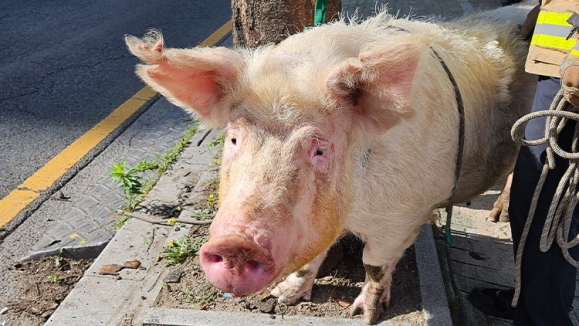 At around 7:46 a.m. on the 23rd, a pig fell from a truck on the road near Maechundaegyo Bridge in Maechun-dong, Buk-gu, Daegu. Rescue authorities arrived at the scene, captured the pig, and loaded it onto a vehicle using a forklift. Photo by Daegu Fire and Safety Headquarters
Especially as value-driven consumption trends, where people express their beliefs through their consumption choices, have become popular mainly among the MZ generation (born between the 1980s and 2000s), the distribution industry is actively entering the alternative meat market. The Korea Agro-Fisheries & Food Trade Corporation predicts that the global alternative meat market will grow from 11.53 trillion won this year to 14.57 trillion won by 2025. The domestic alternative meat market is estimated to be worth 27 billion won.
Controversies surrounding animal slaughter and factory farming are not new. On October 4, 2019, animal rights activists visited a slaughterhouse in Yongin, Gyeonggi Province, on World Animal Day, holding a rally with the message, "It’s life, not meat. Stop the violence." This was the first time South Korea participated in the "Global Lockdown"?a direct animal rights action occupying slaughterhouses?held in 29 cities across 14 countries including the United States, the United Kingdom, and Mexico.
On that day, activists declared the Animal Rights Charter, calling for the legal recognition of animals’ right to protection simply by existing. The Animal Rights Charter originated from "Rose’s Law." "Rose" was the name given by the animal rights group DxE (Direct Action Everywhere) to the only chicken that survived a public rescue from a poultry farm in California in 2018. Activists argue that all animals, like Rose, should be guaranteed the right to live the life they desire.
As activists push for animal rights and more vegetarians try to reduce meat consumption, more than two out of three MZ generation members believe that dining culture should shift to alternative meat for environmental reasons. In an online survey conducted by Shinsegae Food in February last year, targeting 1,000 men and women in their 20s and 30s through the polling agency Embrain, 67.6% responded positively toward alternative meat. The main reasons for consuming alternative meat (multiple responses allowed) were environmental preservation (71.4%), animal welfare (53.0%), healthy eating habits (43.5%), and food shortage preparedness (36.5%).
Given this situation, the distribution industry is actively responding to the alternative meat market. Various alternative meat and vegan food and beverages are being launched, and vegan specialty restaurants are increasing.
Shinsegae Food plans to expand its alternative food business beyond alternative meat to include alternative milk, cheese, and more. Unlike last year, which focused mainly on B2B (business-to-business), this year it started selling "Better Meat Plant-Based Luncheon Canned Ham" through B2C (business-to-consumer) channels. Shinsegae Food had previously introduced luncheon canned ham in July last year. The company is also accelerating the development of alternative food menus in its food service division. It is expanding the use of plant-based ham and patties beyond bakery stores and group meal service sites to the dining industry.
CJ CheilJedang launched a plant-based food brand called "Plantable" last year and is expanding its business domestically and internationally. Plant-based diets refer to environmentally friendly diets consisting of grains, vegetables, nuts, and more. SPC developed a plant-based egg called Just Egg, targeting vegetarian consumers. Focusing on sustainable food, it was produced in collaboration with the Silicon Valley food tech company Eat Just, Inc.
Vegan specialty restaurants are also receiving positive responses in the market. Pulmuone announced that its vegan-certified restaurant "Planted" at COEX surpassed 75,000 cumulative visitors and sold 100,000 menu items about a year after opening. Planted, which opened on May 20 last year, is the first vegan-certified restaurant in the food industry. It reinterprets popular dishes such as pasta, tteokbokki, and bibimbap using entirely plant-based ingredients. In March, it opened its second branch on the 7th floor of Taste Park in Yongsan I'Park Mall, Seoul. There are plans to expand Planted to four branches this year.
Experts suggest that for animal welfare, people should pay attention to how they consume meat. Lee Hyung-joo, CEO of the Animal Welfare Research Institute "Aware," said, "Citizens are well aware of the problems of factory farming. Therefore, I believe we should reduce such consumption," and added, "alternative meat can be an option to improve animal welfare. However, since it is difficult to replace all meat consumption with alternative meat overnight, we need to gradually reduce meat consumption."
© The Asia Business Daily(www.asiae.co.kr). All rights reserved.
![Clutching a Stolen Dior Bag, Saying "I Hate Being Poor but Real"... The Grotesque Con of a "Human Knockoff" [Slate]](https://cwcontent.asiae.co.kr/asiaresize/183/2026021902243444107_1771435474.jpg)















