The appellate court overturned the first-instance ruling that period contract teachers who did not pass the teacher certification exam and regular teachers should be paid wages without discrimination.
The Civil Division 38-2 of the Seoul High Court (Presiding Judges Park Soon-young, Min Ji-hyun, Jeong Kyung-geun) ruled on the 26th in the appeal trial of a wage refund and damages claim lawsuit filed by 25 period contract teachers affiliated with the Korean Teachers and Education Workers Union (JeonGyoJo) against the state, Seoul City, and Gyeonggi Province, stating, "Seoul City and Gyeonggi Province shall pay unpaid retirement allowances of up to approximately 500,000 won each to 16 period contract teachers." The court did not recognize the state's liability for compensation.
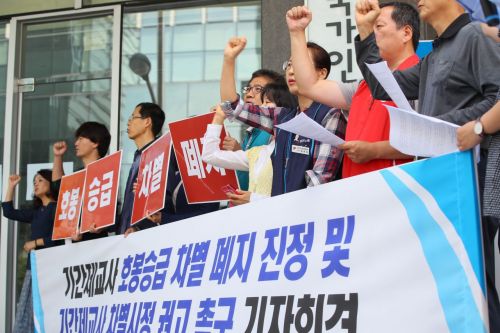
Previously, the first-instance court ordered the state to pay 100,000 won each as consolation for mental distress to six period contract teachers and ruled that Seoul City and Gyeonggi Province pay unpaid wages of up to approximately 2 million won per teacher to 23 teachers.
This ruling effectively overturned most of the first-instance court's judgment. Unlike the first-instance court, the appellate court did not accept the period contract teachers' claim of "wage discrimination."
The court stated, "Regular teachers and period contract teachers are differently defined by law in terms of appointment reasons, routes, duration, service, job security, scope of responsibilities, and authority," and judged that "the difference in treatment between them is difficult to regard as unlawful discrimination."
Furthermore, based on Article 32, Paragraph 2 of the Education Officials Act, which stipulates that "period contract teachers cannot be appointed to positions with heavy supervisory responsibilities," the court explained that "it is difficult for them to be a comparative group to discuss discriminatory treatment."
Regarding the public official remuneration regulations that grant fixed pay to period contract teachers, unlike regular teachers who receive annual step increases, the court ruled, "Considering the characteristics of period contract teachers who are appointed for short-term terms and whose pay is determined each time an employment contract is signed, it is hard to see this as significantly unreasonable."
Consequently, the court ruled that Seoul City and Gyeonggi Province only need to pay the portion where family allowances were not included in the average wage upon the retirement of period contract teachers.
However, the court added, "The content and burden of the work handled by period contract teachers in the field are not significantly different from those of regular teachers," and "It is necessary to review whether the period contract teacher system is being operated according to its purpose and to more seriously consider the desirable direction for the operation of the system."
Period contract teachers filed a lawsuit in November 2019 demanding payment of the increased longevity allowance that was not received due to the lack of timely regular promotion, unlike regular teachers, and the longevity allowance corresponding to the period worked at their previous schools.
Previously, the first-instance court ruled partially in favor of the plaintiffs, stating, "It is difficult to conclude that there is an essential difference in ability or qualification as teachers between period contract teachers and regular teachers based on whether they passed the teacher certification exam."
© The Asia Business Daily(www.asiae.co.kr). All rights reserved.
![Clutching a Stolen Dior Bag, Saying "I Hate Being Poor but Real"... The Grotesque Con of a "Human Knockoff" [Slate]](https://cwcontent.asiae.co.kr/asiaresize/183/2026021902243444107_1771435474.jpg)















