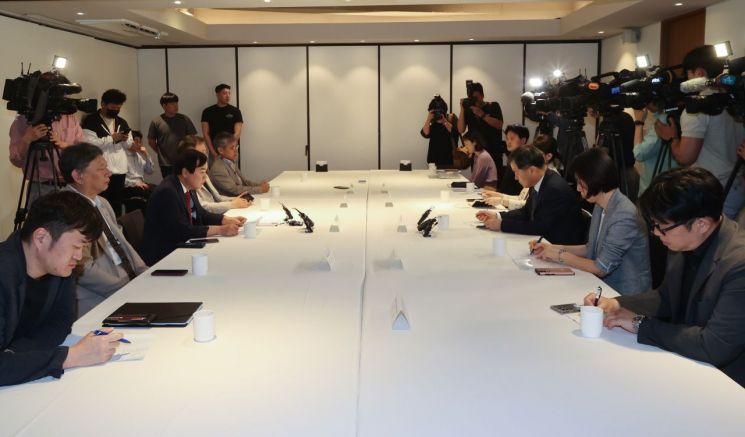
 Medical Issues Council Meeting Discussing Medical School Quotas and Other Topics [Image Source=Yonhap News]
The government is considering increasing the annual medical school quota from 351 to over 500, but concerns have been raised that such an increase will not solve the shortage of essential medical personnel at all.
On the 26th, Professor Kim Yoon of the Department of Health Care Management at Seoul National University said, "The total number of doctors, currently only about 100,000, needs to increase by 50,000 to 100,000 more to reach the OECD average of 3.7 per 1,000 people." He added, "Medical policies must accompany this to ensure that the doctors recruited for essential medical care are evenly distributed," but also said, "An increase of 300 to 500 will not be able to meet the growing medical demand." The Citizens' Coalition for Economic Justice (CCEJ) stated, "Assuming the establishment of public medical schools, the medical school quota should be increased by at least 1,000."
The government holds the position that increasing the medical school quota is urgent to solve the visible shortage of essential medical personnel. The existence of so-called 'PA nurses (Physician Assistants)'?which are not legally recognized in Korea but exist in practice?has also come to light amid conflicts over the Nursing Act. The medical school quota, initially set at 3,058 in 1989, increased to 3,253 in 1994 at one point but has been fixed at 3,058 for 18 years since 2006 following the separation of prescribing and dispensing medicines in 2000.
The Ministry of Health and Welfare is discussing medical issues such as the medical school quota through a medical issue consultative body (consultative body) involving the Korean Medical Association (KMA) and others. The ministry is known to be considering various options, from restoring the 351 reduced due to the separation of prescribing and dispensing medicines to increasing the quota to the low 500s. The focus is on readjusting existing medical school quotas rather than establishing new public medical schools. On the other hand, the KMA maintains a fundamental stance that it is necessary to first question whether an increase in the medical school quota is needed.
Additionally, the KMA argues that increasing the medical school quota will damage the financial soundness of the National Health Insurance. They claim that unless the current issue of unpopular specialties is resolved, the total labor costs for medical personnel will increase. However, there is also an opposing argument that the shortage of doctors actually leads to fee and medical cost increases.
Some criticize whether it is appropriate for the government to discuss important national policies such as increasing the medical school quota only with doctors, who are stakeholders, through the consultative body. The consultative body has been operating since January this year following the formation of the medical-government consultative body through a medical-government agreement after the 2020 medical strike. A Ministry of Health and Welfare official said, "Discussions on the medical school quota are based on the previous government's agreement to discuss them through the medical-government consultative body."
A CCEJ official argued, "The consultative body has no legal basis and should be immediately disbanded." Professor Kim Yoon said, "Discussions in the consultative body only show the government failing to solve urgent medical issues and being led around by the medical associations."
© The Asia Business Daily(www.asiae.co.kr). All rights reserved.

















