As regulatory discourse surrounding the risks of artificial intelligence (AI) expands, Microsoft (MS) has proposed mandating the installation of an 'emergency brake' that can shut down or slow AI in emergencies, similar to a train's emergency brake.
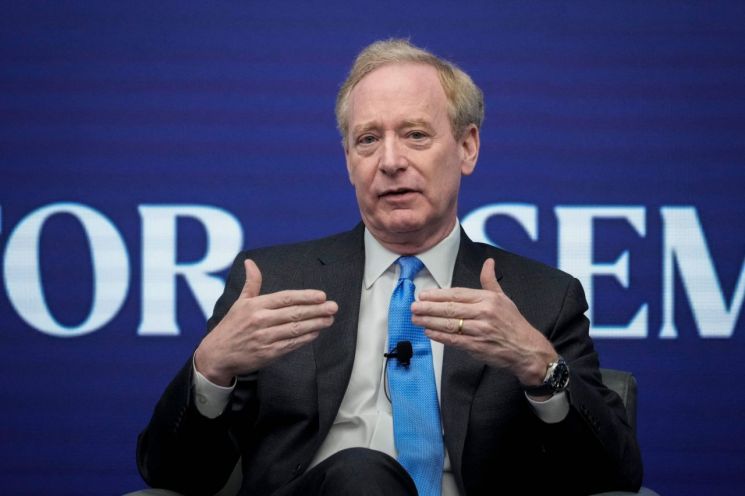
According to major foreign media on the 25th (local time), Brad Smith, MS Vice Chairman and President, warned in a speech at the Seattle headquarters in Washington state that "the biggest concern related to AI is addressing issues related to 'deepfakes,' which manipulate content or videos using AI technology."
He particularly emphasized the influence operations conducted by the governments of Russia, China, and Iran in cyberspace, stating, "We must take measures to prevent the production of fake content intended to deceive people or commit crimes using AI."
He also stressed that, amid the generative AI boom exemplified by ChatGPT, measures should be taken so that people can know whether content, videos, or images are real or maliciously generated by AI when regulating widely spread AI.
On the same day, MS presented 'Five Principles to Consider for AI Regulation' through a blog post. The first principle proposed mandatory installation of safety brakes on certain AI systems used in critical infrastructure.
They urged the U.S. Congress to ensure that AI used to control critical infrastructure such as power grids and water supply systems has safety brakes so that humans can maintain control. This is similar to a train's emergency brake, allowing AI used in critical infrastructure facilities to be completely shut down or slowed in emergencies.
They added that such brake devices have long been embedded in other technologies like elevators, school buses, and high-speed trains. MS also proposed building government-led guardrails for AI technology use, explaining that organizations such as the National Institute of Standards and Technology (NIST) under the Department of Commerce could establish these.
Additionally, they emphasized establishing legal frameworks for apps, advanced foundational models, and AI infrastructure, as well as funding academic and nonprofit research on AI.
They also proposed building public-private partnerships to address the societal impact of AI. MS stated that all organizations creating or using advanced AI systems should develop and implement their own governance systems, noting that MS has been building such systems for the past six years.
MS sparked a global AI technology competition by investing over $1 billion in OpenAI. By integrating AI chatbots into all its products, including the Bing search engine and document tools, MS is considered to be leading this competition alongside OpenAI.
Meanwhile, MS founder Bill Gates said on the 22nd, "The top company of the future will be the one that creates personal digital agents, that is, AI personal assistants," adding, "It is unclear who among big tech companies like Google will be the future AI winner."
He predicted that AI would accelerate innovation in new drug development, with human trials occurring within ten years. He also likened AI technology to a 'game changer' that will significantly impact white-collar workers, forecasting that humanoid robots emerging later will also greatly affect blue-collar workers.
© The Asia Business Daily(www.asiae.co.kr). All rights reserved.
![Clutching a Stolen Dior Bag, Saying "I Hate Being Poor but Real"... The Grotesque Con of a "Human Knockoff" [Slate]](https://cwcontent.asiae.co.kr/asiaresize/183/2026021902243444107_1771435474.jpg)















