"Preventing Recurrence of the Druking Incident"
All-Out Public Opinion Battle Ahead of April General Election Next Year
Successive Portal Regulation Bills Proposed
The People Power Party has been continuously proposing bills to regulate portals. The intention is to prevent public opinion manipulation through portals ahead of the general election in April next year. Experts point out that measures are necessary as the influence of portal news is growing.
According to the National Assembly Legislative Information System on the 26th, Yoon Doo-hyun, a member of the National Assembly's Science, Technology, Information and Broadcasting and Communications Committee from the People Power Party, recently took the lead in proposing the "Amendment to the Act on Media Arbitration and Damage Relief," which defines portals such as Naver as media outlets. The amendment includes adding internet news services to the scope of media.
Ruling Party Members Successively Lead Portal Regulation Bills
Rep. Yoon argued, "In the past, portal news merely relayed news provided by traditional media, but now it performs a role similar to media through the editorial function of arranging a large volume of supplied articles." He pointed out, "Portal news overwhelms existing media outlets in influence, exerts enormous social influence, and generates huge economic profits, yet cleverly avoids social responsibility and legal regulation under the guise of being a 'distributor.'"
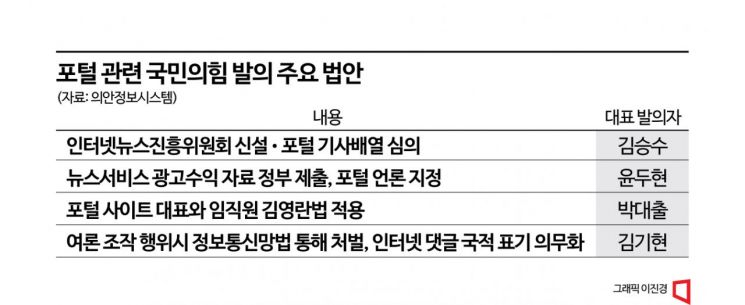
Yoon, a former journalist, had earlier proposed a bill requiring portals to compulsorily submit profit and loss data such as advertising revenue from news services to the government. He stated, "Through this amendment, I hope to correct the media market devastated by portal news and ensure that news content, the result of journalists' hard work and effort, is recognized with its rightful value."
The People Power Party has continuously introduced portal regulation bills. Park Dae-chul, a former journalist and the party's policy chief, led a bill in 2020 to apply the "Act on the Prohibition of Improper Solicitation and Graft" (Kim Young-ran Act), which applies to journalists, to portal executives as well. Party leader Kim Ki-hyun also prepared an amendment to the "Act on Promotion of Information and Communications Network Utilization and Information Protection" in January this year, requiring nationality to be indicated on internet portal comments. Rep. Kim Seung-soo proposed an amendment to the Newspaper Act to establish the "Internet News Promotion Committee" to review portals' article arrangement criteria.
Why Did the People Power Party Draw the Sword Against Portals?
The People Power Party's move to regulate portals is interpreted as a strategy to prepare for the public opinion battle ahead of next year's general election. In fact, during the 2017 presidential election, Democratic Party members posted comments favorable to Moon Jae-in, the Democratic presidential candidate. This is known as the 'Druking incident.' At that time, former Governor Kim Kyung-soo of Gyeongnam was found to be involved in comment manipulation and was sentenced to two years in prison, losing his governorship. The People Power Party believed that favorable public opinion was created for President Moon through comment manipulation, leading to their defeat in the election. The case of former Minister of Justice Cho Kuk was similar. Supporters of the Democratic Party posted the keyword "Cheer up, Cho Kuk," which quickly rose to number one on Naver's real-time search rankings.
Because of this, the People Power Party has pointed out the bias of portals. At a party strategy meeting on the 9th, Policy Chief Park Dae-chul criticized, "If you type the keyword 'Yoon Seok-yeol' on Naver and sort articles by relevance, the first article that appears is from Hankyoreh titled 'Yoon Seok-yeol Prosecution Politics Dividing All Citizens into Guilty and Innocent.'" On the same day, Lee Cheol-gyu, Secretary-General of the People Power Party, also pointed out, "When searching for Yoon Seok-yeol, articles criticizing him by third parties such as Ahn Cheol-soo and Yoo Seung-min appear in the relevance ranking, which is impossible without manipulation."
The People Power Party also opposed content services promoted by Naver and Daum. Recently, Naver and Daum launched 'Trend Topic' and 'Today Bubble' services respectively, but the People Power Party criticized these services as a revival of the real-time search rankings, which were abolished amid manipulation controversies. Rep. Park Dae-chul warned on his Facebook, "Although they are packaged as different services from the real-time search rankings abolished three years ago, they seem to be a trick to revive real-time search rankings," adding, "I hope portals do not make the mistake of creating playgrounds for public opinion manipulation and agitation ahead of next year's general election." Rep. Kim Sang-hoon wrote on his Facebook, "This is a restoration of 'manipulation-led growth,' which once controlled political public opinion through real-time search rankings and generated huge profits," and criticized, "Naver and Daum Kakao are staging an outdated public opinion manipulation. Policy treatment appropriate for withdrawal symptoms is inevitable."
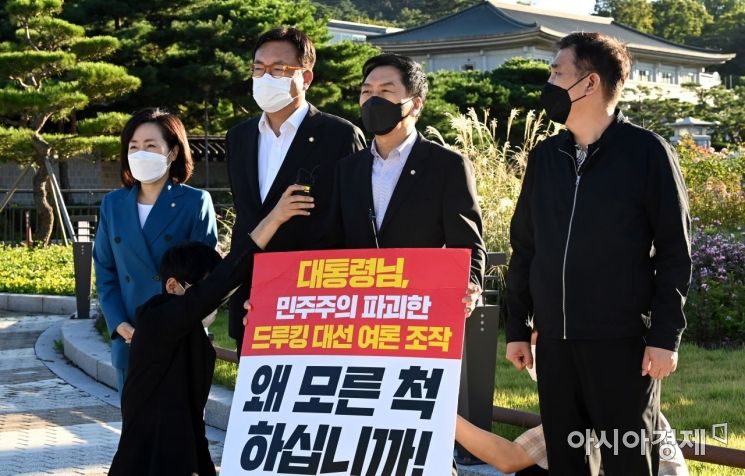 Kim Ki-hyun, floor leader of the People Power Party, and Chung Jin-seok, deputy speaker of the National Assembly, are expressing their stance while holding a solo protest condemning the Druking presidential election opinion manipulation in front of the Blue House fountain in Jongno-gu, Seoul on the 16th. Photo by the National Assembly Press Photographers Group
Portals Bowing to Pressure from the Ruling Party
Some criticize that the People Power Party's pressure on portals is a form of taming ahead of next year's general election. In fact, Naver announced it will fully review the Trend Topic service, which sparked controversy over the revival of real-time search rankings. Also, the Portal News Cooperation Evaluation Committee (hereafter, the Evaluation Committee), which oversees news partnership reviews between Naver, Kakao, and media companies, will temporarily suspend its activities after seven years since its launch. The Evaluation Committee is an autonomous organization established for partnerships between news services operated by Naver and Kakao and media companies, and it is analyzed that it ceased activities due to the ruling party's crackdown on portals.
However, experts agree that as the social influence of portal news grows, their public functions should also be strengthened. According to the "2022 Media Audience Survey" released by the Korea Press Foundation, the news usage rate via the internet was 77.2%, surpassing the television news usage rate of 76.8%. The internet portal news usage rate among people in their 20s and 30s reached an average of 90.9%. Yang Jeong-ae, a part of the Media Research Center at the Korea Press Foundation, said, "Foreign search operators and domestic portals have had different characteristics," adding, "In terms of influence, portals are recognized as a platform that forms public opinion, so they should fulfill their public responsibilities as much as possible." Professor Kwon Sang-hee of Sungkyunkwan University's Department of Media Communication also suggested, "From the perspective of the platform era, portals act as 'remediated' media, clearly playing a framing role," and added, "It is desirable for portals to secure publicness in the media ecosystem and partially perform the role of traditional media even now."
© The Asia Business Daily(www.asiae.co.kr). All rights reserved.
![Clutching a Stolen Dior Bag, Saying "I Hate Being Poor but Real"... The Grotesque Con of a "Human Knockoff" [Slate]](https://cwcontent.asiae.co.kr/asiaresize/183/2026021902243444107_1771435474.jpg)

















