Professor Chan-Young Park's team from the Department of Life Sciences at UNIST has, for the first time, elucidated the mechanism of infection-induced ciliary damage caused by the interaction between the protein protease called 'main protease' and the 'septin' protein, which maintains cell structure and regulates cell division and movement.
Cilia are often compared to cellular antennas and play a crucial role in overall life activities, from embryonic development to maintaining bodily homeostasis. They also prevent external pathogens from entering the respiratory tract and are involved in signal transmission in various cells, including olfactory neurons.
A representative specific signaling pathway of cilia is the Sonic hedgehog (SHH) signaling, which is involved in cell division and differentiation, playing an important role in tissue regeneration and development.
Recent studies have revealed that coronaviruses cause infections in respiratory ciliated cells. Although there have been many reports of ciliary damage caused by coronavirus infection, the exact mechanism of ciliary damage in infected cells and abnormalities in ciliary signaling have not been specifically elucidated.
Coronaviruses, including SARS-CoV-2 which causes COVID-19, invade human ciliated cells and use host cell resources inside the cell to produce viral genes and proteins.
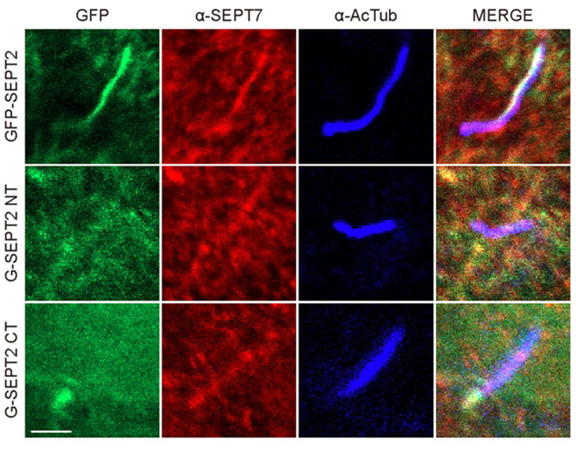 Image of cilia damage caused by inhibition of normal septin function due to septin fragments cleaved by coronavirus protease.
For coronavirus replication, a coronavirus protein protease is required. This protease cleaves the protein chains produced by the coronavirus to create various functional proteins necessary for viral replication.
The research team discovered that the coronavirus protease not only cleaves viral proteins but also cleaves proteins in infected cells, facilitating viral infection or causing damage to the infected cells.
According to this study, the coronavirus protein protease cleaves the septin protein, which is essential for maintaining the structure and function of cilia. This cleavage results in shortened cilia length and a decrease in cell number, confirming damage to both cilia and ciliated cells.
Furthermore, the cleaved septin fragments bind with uncleaved septin proteins to form complexes, which interfere with the normal movement of septin proteins, leading to structural maintenance failure and functional damage of the cilia.
The research team also confirmed that the Sonic hedgehog (SHH) signaling pathway is impaired due to the damaged ciliary structure. This abnormality in the specific ciliary signaling mechanism may cause problems in cell division and differentiation of ciliated cells, indicating the possibility of primary tissue damage.
Additionally, the team confirmed that using a coronavirus protein protease inhibitor before viral infection can prevent ciliary damage.
They also verified that administering the inhibitor after viral infection alleviates damage to the SHH signaling system. These findings can serve as a starting point for drug research aimed at preventing or mitigating ciliated cell damage caused by viruses.
Professor Chan-Young Park of the Department of Life Sciences stated, “This study revealed the interaction between coronavirus and proteins within infected cells, as well as the mechanism of ciliary structural and functional damage.”
He added, “We expect this research to provide diversity in studies on cellular abnormalities caused by coronavirus infection and to aid in understanding the mechanisms of infected cell abnormalities such as loss of smell and taste due to ciliary defects, as well as follow-up studies on viral cellular response mechanisms.”
This research was supported by the Ministry of Science and ICT-Korea Research Foundation’s Global Ph.D. Fellowship Program, Mid-career Researcher Support Program, and the Institute of Science and Technology Joint Research Program. The research results were published online on February 24 in the international journal Journal of Medical Virology.
© The Asia Business Daily(www.asiae.co.kr). All rights reserved.
![Clutching a Stolen Dior Bag, Saying "I Hate Being Poor but Real"... The Grotesque Con of a "Human Knockoff" [Slate]](https://cwcontent.asiae.co.kr/asiaresize/183/2026021902243444107_1771435474.jpg)















