European Space Agency Studies Human Body Changes in Space
Head Tilted 6 Degrees Below Horizontal
Addressing Human Body Changes in Microgravity Conditions
A part-time job that pays 25 million won for lying in bed for three months is becoming a hot topic online.
On the 23rd (local time), the British Daily Mail reported that the European Space Agency (ESA) is conducting a study called "Bed Rest with Artificial Gravity and Bicycle Exercise" to address the changes the human body experiences in space.
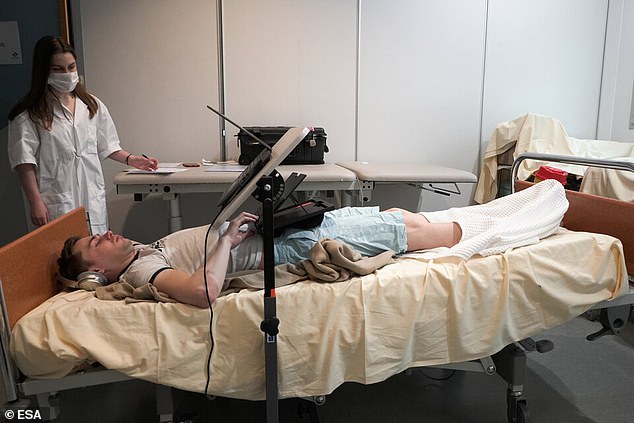 The European Space Agency (ESA) announced that it is conducting research on "bed rest and cycling exercise using artificial gravity" to address the changes experienced by the human body in space.
 [Photo by European Space Agency]
The study involves 12 men aged 20 to 45 and lasts for 88 days. During the study, they will lie in beds tilted 6 degrees downward from horizontal at the head side for 60 days. Even when eating, showering, or going to the bathroom, they must always keep one shoulder in contact with the bed mattress. In return, each participant will receive 18,000 euros (approximately 25.64 million won).
ESA has participants lie in bed continuously to find ways to cope with the changes the human body undergoes in the microgravity environment of space. When a person lies down continuously, blood flows to the head, and muscles and bones weaken. This is what astronauts actually experience outside Earth.
The beds of the study participants are equipped with a special horizontal bicycle. This bicycle prevents blood from pooling in the feet when gravity increases in the centrifuge device.
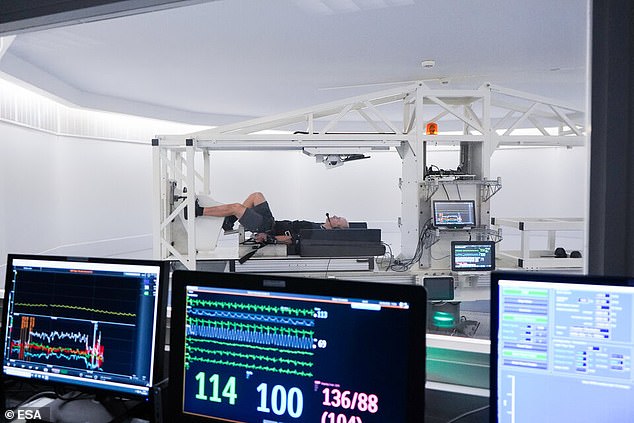 Each research participant's bed is equipped with a special bicycle that can be ridden horizontally. This bicycle prevents the participants' blood from pooling in their feet when gravity increases in the centrifuge device.
 [Photo by European Space Agency (ESA)]
The bicycle is a very important exercise device for astronauts' health on the International Space Station.
Meanwhile, ESA and NASA have previously conducted studies where participants were kept in bed for extended periods to study physical changes. However, unlike previous studies, this study focuses on actively responding to the microgravity environment of space.
The study started in April and will continue until July. Follow-up research is scheduled for January to April next year.
ESA explained, "Space medicine research like this experiment can also help patients on Earth," adding, "Results obtained in space help develop better treatments for the elderly, musculoskeletal diseases, and osteoporosis patients."
© The Asia Business Daily(www.asiae.co.kr). All rights reserved.
![Clutching a Stolen Dior Bag, Saying "I Hate Being Poor but Real"... The Grotesque Con of a "Human Knockoff" [Slate]](https://cwcontent.asiae.co.kr/asiaresize/183/2026021902243444107_1771435474.jpg)
















