"Nuriho Success, Space Power G7 Achievement"
Unlike Past Launches, Actual Satellite Onboard
The Korean launch vehicle Nuri (KSLV-II) was successfully launched on the 25th, placing satellites into their planned orbits. Unlike the previous two launches that carried satellite models, this was the 'first operational launch' carrying actual satellites.
According to the Korea Aerospace Research Institute (KARI) on the 25th, Nuri took off as scheduled at 6:24 PM, and all launch procedures proceeded normally.
The original launch date was the 24th, but the launch was postponed by one day due to technical issues.
There was also a delay in the second launch schedule. At that time, strong winds of 7 m/s blew while Nuri was in a vertical position, causing a delay in the launch. Additionally, an anomaly was detected in the oxidizer tank sensor, leading to another postponement. Eventually, the second launch took place on June 21 last year, six days later than originally planned.
Although the weather conditions on the 24th were better than during the second launch, a problem occurred during the valve control process supplying cryogenic helium. Oh Tae-seok, First Vice Minister of the Ministry of Science and ICT, explained in a briefing, "An abnormal communication occurred between the launch control computer and the computer controlling the launch pad equipment during the valve control process supplying cryogenic helium. This issue did not occur during the inspection process on the morning of the day before the launch, but it happened around 3 PM on the launch day, the 24th."
The Nuri Launch Management Committee completed measures to address the anomaly detected during the inspection process the previous day and conducted the third launch of Nuri at the same time on the 25th. Starting with the Next-Generation Small Satellite 2, Nuri successfully separated eight satellites, including CubeSats, at 20-second intervals and ended its flight 1,138 seconds after launch.
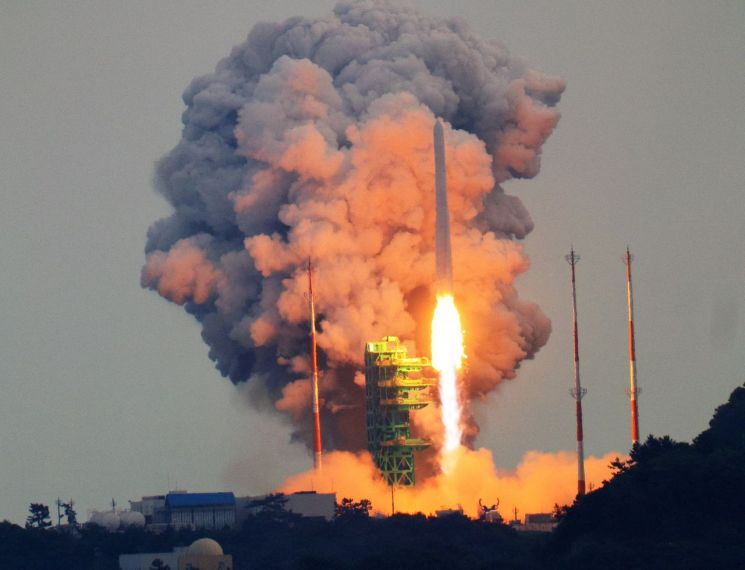 The Korean launch vehicle Nuriho (KSLV-II), developed with domestic proprietary technology, is being launched on the afternoon of the 25th at Naro Space Center in Goheung-gun, Jeollanam-do. [Image source=Yonhap News]
This launch is considered successful because Nuri entered the target orbit and safely separated the Next-Generation Small Satellite 2. President Yoon Suk-yeol stated, "This is a great achievement declaring that our country has joined the space powerhouse G7 (Group of Seven major countries)," and added, "Only the United States, France, Japan, Russia, China, and India have launched domestically manufactured satellites on domestically manufactured launch vehicles into space orbits."
President Yoon continued, "The global perspective on South Korea's space science technology and advanced industries will change significantly," emphasizing, "The third Nuri launch placed eight practical satellites into orbit, which is a tremendous advancement compared to the second launch that placed one experimental satellite into orbit."
The reason this launch is called the 'first operational launch' is that actual satellites were onboard. The previous two launches primarily focused on verifying Nuri's performance. The first launch on October 21, 2021, carried a satellite mock-up, and the second launch last June carried a satellite mock-up along with a performance verification satellite and four CubeSats. Nuri's current mission was to place eight practical satellites into orbit at an altitude of 550 km.
Dr. Lee Ho-sung of the Korea Aerospace Research Institute explained in an interview with YTN's 'News Live' on the 24th, "The previous launches carrying satellite mock-ups only matched the weight and had basic devices to confirm their location. This time, the satellites actually have batteries and transmit signals while operating. Moreover, it has great significance as various payloads developed domestically are being tested in the space environment."
The Next-Generation Small Satellite 2, which was also onboard, is equipped with a synthetic aperture radar (SAR) device developed purely with domestic technology. Dr. Lee explained, "In the past, observations were optical, but with this satellite, radar observations will be possible, allowing us to see through rain or clouds."
However, due to high power consumption, the satellite must always receive sunlight to recharge its power. This is why the Next-Generation Small Satellite must be placed in a dawn-dusk orbit (altitude 550 km), which passes through the ascending node of the sun-synchronous orbit.
© The Asia Business Daily(www.asiae.co.kr). All rights reserved.

















