The Backlash of Climate Change... Domestic Influx Through Logistics Movement
Faster Hatching and Growth as Weather Warms
"Invasive Termites Are Not the Only Problem, Wooden Cultural Heritage at Risk"
In various parts of the city, citizens are experiencing discomfort as large swarms of mayflies, black flies, and invasive species of termites have appeared in large numbers.
Recently, tens of thousands of Oriental mayflies have been rampant in eastern Seoul and southern Gyeonggi Province. On the 18th, at the Seoul Jamsil Baseball Stadium, where the professional baseball game between KT Wiz and LG Twins took place, there were continued reports of large swarms of mayflies.
Mayflies are not pests. They are aquatic insects that inhabit water quality of grade 2 or higher, and since their mouths are degenerated and they cannot bite, they do not transmit diseases. However, because their wingspan reaches 4 to 5 cm and they appear in large swarms, residents are complaining of inconvenience. The accumulation of dead bodies also causes foul odors.
However, there are no clear pest control measures in place. The Han River basin, where the mayfly swarms appear, is a water source protection area, making it difficult to use insecticides.
Yang Young-cheol, adjunct professor of Health, Environment, and Safety at Eulji University, explained in an interview on June 24 with SBS Radio's "Kim Tae-hyun's Political Show," "The population will gradually decrease after June. Since the Han River basin and tributaries of the Bukhan River are water source protection areas, it is not easy to eliminate Oriental mayflies through artificial pest control. However, it is possible to control the population by improving the environment, such as increasing the number of natural predators."
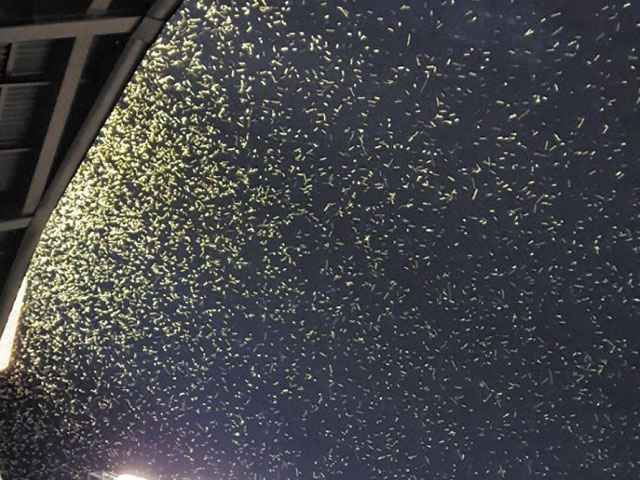 On the 18th, an Oriental mayfly appeared at Jamsil Baseball Stadium in Seoul, where the KT Wiz and LG Twins game was held. [Image source=Twitter]
Experts attribute the large-scale emergence of flying insects to climate change. On the 16th, the daytime high temperature rose above 30 degrees Celsius in Seoul and most parts of the country, bringing early heat compared to the average year, which helped the hatching and growth of insects.
The swarm of black flies rampant in newly built apartment complexes in the new city of Incheon is a similar case. It is known that the eggs or larvae remain in the raw materials of furniture or other household items and emerge through gaps between furniture once they become adults. The warm weather appears to have led to rapid hatching and growth.
Black flies also do not transmit diseases, but since they are very small, about 1 mm in size, they can enter the human body through food or respiratory pathways. Numerous black fly eggs and larvae have been found throughout these apartments, and concerns are especially high in households with children.
A bigger problem is the termites recently found in Gangnam, Seoul, and Asan, Chungnam. Termites gnaw on wood and are known as the "grim reaper of wooden houses." The Ministry of Environment considers the risk of termite outbreaks to be significant and has launched a joint investigation with related agencies.
The termites found this time in Gangnam, Seoul, were identified as the invasive species "drywood termite," but invasive termites are not the only concern. In 1998, domestic termites damaged the wooden printing blocks of the Tripitaka Koreana stored at Haeinsa Temple in Hapcheon-gun, Gyeongnam, prompting the Cultural Heritage Administration to conduct termite control. Professor Yang expressed concern, saying, "Most houses in Korea are made of concrete, so it may not be a big problem, but in Gangnam, there are places like Bongeunsa Temple and other temples. If termites invade these areas, it could be problematic."
The exact route of termite introduction has not been identified, but it is presumed they entered the country through logistics movements. Professor Yang said, "A similar case was the red imported fire ant, which caused controversy. It was found to have entered through overseas containers, leading to careful quarantine and pest control."
When stung by red imported fire ants, one feels a burning pain and itching, and in severe cases, hypersensitive shock symptoms such as dizziness may occur. Since being discovered at Busan Port and Incheon Port in 2017-2018, they have been found in large numbers every year. Last year, red imported fire ants were also found at the Okcheon logistics warehouse, Busan Port, and Pyeongtaek Port.
© The Asia Business Daily(www.asiae.co.kr). All rights reserved.
![Clutching a Stolen Dior Bag, Saying "I Hate Being Poor but Real"... The Grotesque Con of a "Human Knockoff" [Slate]](https://cwcontent.asiae.co.kr/asiaresize/183/2026021902243444107_1771435474.jpg)















