Saudi Arabia Meets Kakao... Joining Hands to Build Tourism Infrastructure
Naver Visits Saudi Arabia... Exploring Collaboration on Mega AI Projects
Naver and Kakao have stepped up as technology partners in Saudi Arabia's digital transformation. In line with government projects, they are promoting the export of IT technologies such as artificial intelligence (AI) and cloud computing, as well as K-content including webtoons and entertainment. Attention is focused on whether they can spark an IT Hallyu wave in the Middle East, starting with Saudi Arabia.
On the 23rd, Kakao held discussions at its Pangyo office with the Saudi Tourism Authority to build mobile infrastructure to revitalize tourism in Saudi Arabia. Attending from Saudi Arabia were Alhassan Aldabag, Chief Executive Officer for the Asia-Pacific region of the Saudi Tourism Authority, and Chun Kuk, Chief Technology Officer. The Saudi side had held a roadshow in Seoul on the 22nd to promote tourism revitalization, which led to this office visit.
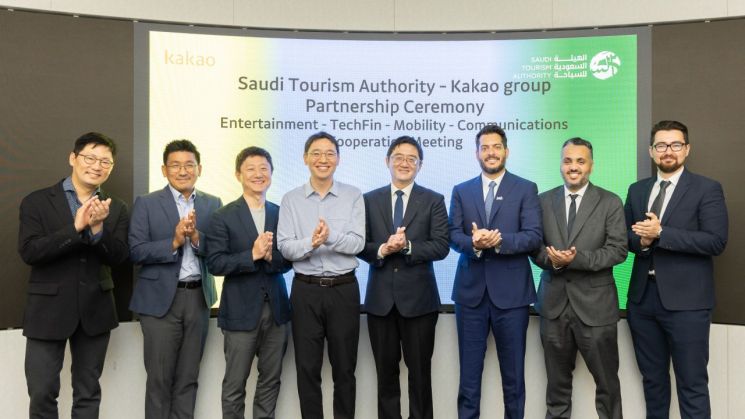 On the 23rd, Kakao held discussions with officials from the Saudi Arabia Tourism Authority at its Pangyo office to collaborate on building mobile infrastructure to promote tourism in Saudi Arabia.
 [Photo by Kakao]
Saudi Arabia is promoting 'Saudi Vision 2030' to foster high value-added industries such as culture and tourism. As part of this, it plans to invest $1 trillion (approximately 1,300 trillion KRW) in the tourism industry over the next decade. The policy is to enhance IT infrastructure for tourists' convenience and activate cultural exchange using K-content.
Both sides agreed to collaborate on technologies applicable to the tourism industry, including communication platforms, payment, and mobility. This includes ▲developing a local information sharing platform using KakaoTalk ▲advancing vehicle call infrastructure based on Kakao Mobility technology ▲establishing a tourist payment system through Kakao Pay. Additionally, they plan to discuss ways to link Kakao Entertainment's intellectual property (IP) with the cultural tourism industry.
Naver is also actively working to expand its export path to Saudi Arabia. Since agreeing to cooperate on digital transformation with the Saudi government earlier this year, exchanges have continued. On the 20th, Ha Jung-woo, head of Naver Cloud AI Innovation Center, departed for a business trip to Saudi Arabia. It is known that the Saudi government has a high interest in AI technology and arranged the meeting. Naver explained that it will promote its self-developed super-large AI 'HyperCLOVA X,' scheduled for release this summer, and seek collaboration opportunities.
In March, Naver agreed to join forces with the Saudi Ministry of Municipal and Rural Affairs and Housing and the Ministry of Investment on digital transformation projects. Saudi Arabia, led by Crown Prince Bin Salman, is promoting the mega smart city NEOM City. Naver will collaborate with the Ministry of Housing, which is leading this effort, on digital twin and super app (tentative name) development. A digital twin is a virtual world that scans the real space entirely. It is an infrastructure technology necessary for smart cities, such as high-precision maps required for robots or autonomous vehicles. The super app will provide public services to Saudi citizens by linking cutting-edge digital technologies such as robots and AI applied in NEOM City.
Naver and Kakao plan to accelerate market expansion through their entry into Saudi Arabia. The Middle East, with a strong will for digital transformation, has emerged as a battleground for IT companies including cloud services. The digital market size in the Middle East and North Africa (MENA) region is expected to grow from about $40 billion (approximately 53 trillion KRW) currently to $400 billion (approximately 525 trillion KRW) by 2030. The population reaches 700 million with a high proportion of young people. The IT industry is being fostered at the national level, so the market potential is large. Analysts say that if technological capabilities are proven in the Middle East including Saudi Arabia, there is a high possibility of expanding to Southeast Asia, Europe, and other regions with high digital demand.
© The Asia Business Daily(www.asiae.co.kr). All rights reserved.
![Clutching a Stolen Dior Bag, Saying "I Hate Being Poor but Real"... The Grotesque Con of a "Human Knockoff" [Slate]](https://cwcontent.asiae.co.kr/asiaresize/183/2026021902243444107_1771435474.jpg)
















