Utilizing Mechanisms of Reduced Cardiomyocyte Activity
Expectations for Heart Failure Drug Development
Factors regulating the proliferation of cardiomyocytes and the regenerative capacity of the heart have been identified by a domestic research team.
On the 23rd, Professor Youngseop Yoon's research team from the Department of Biomedical Sciences at Yonsei University College of Medicine announced that they discovered the 'Cbx7' gene, which plays an important role in heart regeneration and functional recovery, and elucidated the heart regeneration effects according to the level of activation of this gene in animal models. The results of this study were published in the world-renowned journal Circulation (IF 39.92).

Heart disease is difficult to treat because the heart's regenerative capacity is very limited. This is due to the fact that cardiomyocytes, which play a major role in the heart, do not proliferate well. Cardiomyocytes proliferate actively during the fetal stage but their proliferative ability decreases after birth, almost stopping proliferation in adults.
The research team first identified a gene that reduces the proliferative ability of cardiomyocytes. They analyzed in real-time how polycomb group proteins, which regulate the cell cycle, are expressed in the hearts of three mouse models: fetal, neonatal, and adult. As a result, the gene Cbx7 was found to increase sharply immediately after birth and remain highly expressed in the adult heart, affecting the proliferation of cardiomyocytes.
The team applied this mechanism to mouse models to analyze whether increasing the proliferative ability of cardiomyocytes could induce heart regeneration. When the Cbx7 gene was overexpressed in mouse models, cardiomyocyte proliferation decreased. Conversely, in mouse models where the Cbx7 gene was removed, cardiomyocyte proliferation increased. Heart regeneration also occurred when the Cbx7 gene was removed in mouse models induced with myocardial infarction.
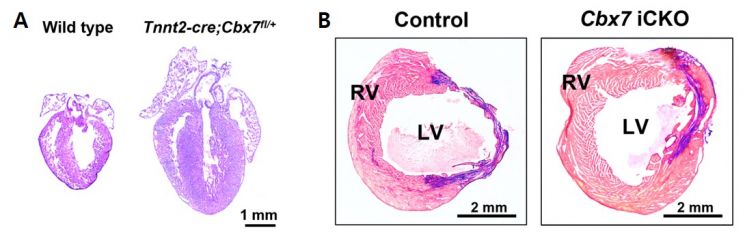 A: When the activity of the Cbx7 gene was regulated to suppress cardiomyocytes in the heart (left) of a mouse model, the size of the heart increased and the thickness of the myocardium increased. B: In a mouse model of myocardial infarction (left), removal of the Cbx7 gene resulted in reduced cardiac fibrosis and increased myocardium.
 [Photo by Yonsei Medical Center]
The research team discovered the mechanism by which the Cbx7 gene influences cardiomyocyte proliferation. It was found that the Cbx7 gene binds to the protein TARDBP and induces the expression of the cell cycle-regulating protein RBM38. Overexpression of RBM38 suppressed cardiomyocyte proliferation. The RNA-binding protein TARDBP binds to mRNA and affects mRNA stability, transport, and modification. Among the genes influenced by TARDBP, the protein RBM38 was shown to be induced by Cbx7 expression, and RBM38 is known as a protein that halts the cell cycle and suppresses cell proliferation.
Professor Yoon said, "Through this study, we revealed that the gene Cbx7 is an important factor regulating the proliferative ability of cardiomyocytes and the regenerative capacity of the heart," adding, "If the heart regeneration effects of a Cbx7 small molecule inhibitor are elucidated in the future, it is expected that the development of heart failure treatments will be possible."
© The Asia Business Daily(www.asiae.co.kr). All rights reserved.
![Clutching a Stolen Dior Bag, Saying "I Hate Being Poor but Real"... The Grotesque Con of a "Human Knockoff" [Slate]](https://cwcontent.asiae.co.kr/asiaresize/183/2026021902243444107_1771435474.jpg)
















