As concerns about the slowdown in China's economic recovery have emerged, voices emphasizing 'qualitative growth theory' are growing stronger internally. Although the foreign exchange authorities have taken measures to respond to market reactions such as the depreciation of the yuan, they have externally expressed the position that they are maintaining an autonomous monetary policy thanks to low inflation.
According to the state-run Global Times on the 21st, local economists have expressed optimistic views about the 'qualitative growth' of the Chinese economy one after another. Wang Yiming, deputy director of the China Center for International Economic Exchanges, said at the recent 'Tsinghua PBCSF Global Finance Forum' held in Beijing, "This year, the Chinese economy will generally improve and enter the trajectory of economic recovery," adding, "The key to steady recovery lies in the recovery and expansion of demand."
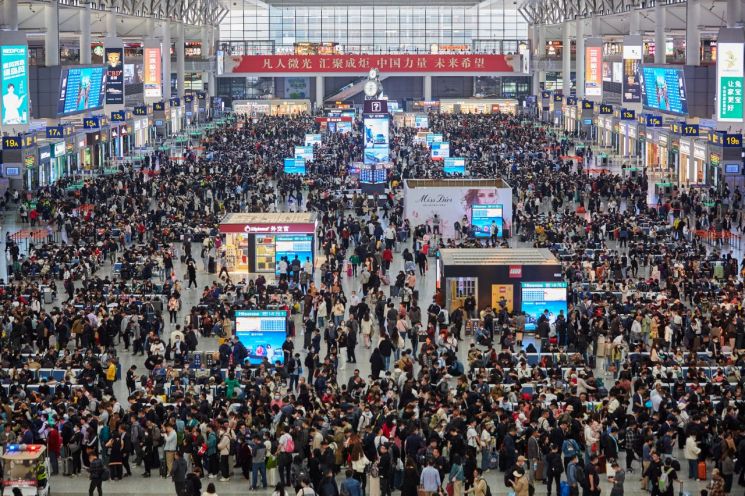
Deputy Director Wang further emphasized, "The Chinese economy, which was hit by COVID-19 over the past three years, will not recover overnight," and added, "The recovery process must be transformed through the country's growth model transition, economic structure optimization, and the discovery of new growth drivers to sustain the rebound."
The Global Times reported on this, stating, "Experts acknowledge the short-term challenges of weak endogenous momentum and insufficient demand, while expecting that the long-term outlook and qualitative growth trend of the economy will remain unchanged."
As the yuan's value plunged due to concerns over the slowdown in China's economic recovery, the foreign exchange authorities took measures to respond but maintained a composed stance externally. At the same forum, Ding Zhejie, director of the Foreign Exchange Research Center at the State Administration of Foreign Exchange, said the long-term outlook for the Chinese economy is bright and the trend of high-quality growth will not change. He particularly praised, "Stable prices allow for the maintenance of monetary policy autonomy amid the inflation trends in the US and Europe."
Earlier on the 18th, the China Foreign Exchange Market Guidance Committee held its first meeting of the year, announcing that it would strengthen management, supervision, and monitoring of the foreign exchange market and suppress speculation and sharp exchange rate fluctuations if necessary. On the following day, the 19th, the People's Bank of China, the central bank, set the yuan's central parity rate against the dollar at 7.0356 yuan, surpassing 7 yuan for the first time in five months since December 5, 2022 (7.0384 yuan).
Jiang Yansheng, chief researcher at the China Center for International Economic Exchanges, gave an optimistic outlook on trade despite weakening external demand and rising geopolitical tensions in an interview with the Global Times. Researcher Jiang explained, "The country's foreign trade will rebound more resiliently," adding, "It will follow the path toward stable growth through the green economy and technology."
© The Asia Business Daily(www.asiae.co.kr). All rights reserved.
![Clutching a Stolen Dior Bag, Saying "I Hate Being Poor but Real"... The Grotesque Con of a "Human Knockoff" [Slate]](https://cwcontent.asiae.co.kr/asiaresize/183/2026021902243444107_1771435474.jpg)















