Annual Increase in Alighting Passengers
Land Price per Pyeong Also 'Soars'
Rent Growth Rate Up 14%
The Apgujeong Rodeo commercial district is experiencing a revival. Even during the pandemic, steady sales growth was observed, and as more and more hot places frequented by the MZ generation (Millennials + Generation Z) emerged, the floating population increased, resulting in a virtuous cycle where restaurants and cafes in the vicinity are once again opening.
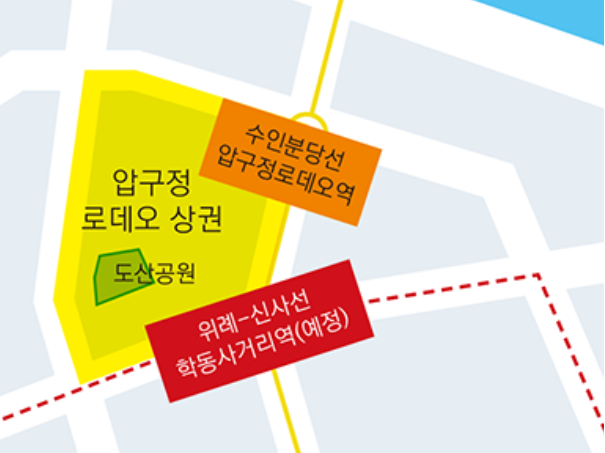
The revitalization of the commercial district is also confirmed by statistics. According to data from the Seoul Open Data Plaza on the 21st, the number of subway passengers alighting at Apgujeong Rodeo Station on the Suin-Bundang Line, the starting point of the commercial district, increased annually: 40,800 in December 2020, 60,100 in December 2021, and 69,400 in December 2022.
Sales have also supported this trend. According to NICE Gini Data, while other commercial districts saw a decline in sales during the COVID-19 pandemic, the Apgujeong Rodeo commercial district recorded an upward sales graph. The Apgujeong Rodeo commercial district generally refers to the area starting from Apgujeong Rodeo Station on the Suin-Bundang Line subway and extending westward. The commercial district is mainly formed around Hakdong Intersection and Dosan Park.
This atmosphere has acted as a factor driving up real estate prices in the area. According to commercial building statistics from Real Estate Planet, the land transaction price per pyeong in Sinsa-dong, where Apgujeong Rodeo is located, rose from about 100 million KRW in 2019 to about 186 million KRW in 2022, an increase of approximately 86% compared to 2019. This is higher than the average increase rate in Seoul during the same period (42%).
Rent prices are also on the rise. According to the 2022 Seoul Commercial Lease Survey, the average rent in Apgujeong Rodeo increased by about 14%, from 90,600 KRW per m² in 2021 to 103,400 KRW in 2022, whereas the average increase rate in major Seoul commercial districts was about 6.6%, showing a higher increase rate than the average rent in major Seoul commercial districts.
How was the revival of the Apgujeong Rodeo commercial district, once considered a declining area, possible? In a report titled "How Did the Apgujeong Rodeo Commercial District Revive?" by Woori Financial Management Research Institute, it was analyzed that "the revival began in 2017 when a single dining company made a large-scale capital investment and opened a handmade hamburger brand and a donut brand store in Dosan Park, respectively," and "these stores immediately received great responses from the MZ generation and became hot places."
The second factor cited was the synergy with the nearby Cheongdam-dong commercial district and Apgujeong Galleria Department Store. The report explained, "During the COVID-19 pandemic, secondary consumption increased as customers who shopped at the luxury stores lining Apgujeong Galleria Department Store and Cheongdam-dong commercial district, which were not greatly affected in sales, used cafes, restaurants, and complex cultural spaces in Apgujeong Rodeo afterward."
© The Asia Business Daily(www.asiae.co.kr). All rights reserved.

















