Cooperation Between the Two Countries for Future Peace and Prosperity
The Presidential Office stated on the 21st that the joint visit by President Yoon Suk-yeol and Japanese Prime Minister Fumio Kishida to the memorial monument for Korean atomic bomb victims in Hiroshima signifies the commitment of South Korea and the United States to future peace and prosperity cooperation, as well as joint responses to nuclear threats in Northeast Asia and the international community.
Lee Do-woon, spokesperson for the Presidential Office, held a briefing in the press room set up at a hotel in Hiroshima that morning and said, "The two leaders paid tribute to the Korean atomic bomb victims and expressed condolences to the surviving victims, while also expressing their will for cooperation between South Korea and Japan for future peace and prosperity."
He added, "It also includes the meaning that the two leaders and the two countries will jointly respond to nuclear threats in Northeast Asia and, furthermore, in the international community, together with their ally, the United States."
President Yoon and Prime Minister Kishida jointly visited the memorial monument for Korean atomic bomb victims in Hiroshima Peace Memorial Park that morning. The monument was established to commemorate the souls of Koreans who lost their lives due to the atomic bombing on August 6, 1945.
The monument was built in April 1970 near Honkawa and Aioi Bridge in Hiroshima by the Hiroshima Prefectural Headquarters of the Zainichi Korean Residents Union in Japan (currently the Zainichi Korean Residents Union in Japan), and was relocated to its current location in the Peace Memorial Park after Hiroshima City approved its installation in 1999.
The joint visit was arranged following Prime Minister Kishida's proposal at the Korea-Japan summit held in Seoul on the 7th. It was the first time a Korean president visited the memorial monument and the first time the leaders of South Korea and Japan jointly paid tribute. Among Japanese prime ministers, Keizo Obuchi (1937?2000) visited the monument in 1999.
Regarding the plaque inscribed in Hangul on the monument, Spokesperson Lee said, "'At the end of World War II, about 100,000 Koreans lived in Hiroshima as soldiers, military auxiliaries, conscripted laborers, mobilized students, and ordinary citizens. Approximately 20,000 Koreans lost their precious lives instantly due to the atomic bombing,' is written."
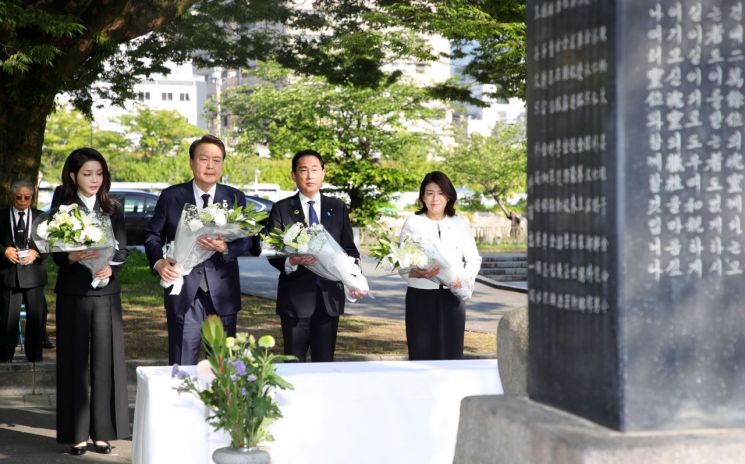
Along with the visit, the wives of President Yoon, Kim Geon-hee, and Prime Minister Kishida, Yuko Kishida, as well as ten Korean atomic bomb victims, including Park Nam-joo (91), chairman of the Korean Atomic Bomb Victims Special Measures Committee and a first-generation survivor, and Kwon Jun-oh (74), vice chairman of the Zainichi Korean Residents Union in Japan and a second-generation survivor, participated together.
In his remarks at the Korea-Japan summit held after the visit to the monument, President Yoon said, "It will be remembered as the prime minister's courageous act to express condolences to the Korean atomic bomb victims and prepare for a peaceful future."
Prime Minister Kishida also said about the joint visit to the memorial monument by the two leaders, "I believe it is important for bilateral relations and world peace," and added, "I hope to join other leaders later to visit the Peace Memorial Museum together and offer prayers at the monument."
© The Asia Business Daily(www.asiae.co.kr). All rights reserved.
![Clutching a Stolen Dior Bag, Saying "I Hate Being Poor but Real"... The Grotesque Con of a "Human Knockoff" [Slate]](https://cwcontent.asiae.co.kr/asiaresize/183/2026021902243444107_1771435474.jpg)















