Mo Yan Uses ChatGPT to Praise Famous Writer Yu Hua
ChatGPT Use Illegal in China... May Face Legal Action
Mo Yan (68), the first Chinese writer to receive the Nobel Prize in Literature in 2012, shocked the literary world by confessing that he used ChatGPT to write a piece praising his fellow writer Yu Hua.
On the 19th, Hong Kong's South China Morning Post (SCMP) reported that Mo Yan attended the 65th anniversary celebration of the literary magazine Shouhuo held in Shanghai, China, on the evening of the 16th as a presenter. The award recipient that day was another famous writer, Yu Hua. As the two giants representing Chinese literature stood side by side on stage, the atmosphere in the venue reached its peak.
Standing on the podium, Mo Yan began his speech by saying, "The person receiving this award is truly outstanding. And of course, he (Yu Hua) is my good friend," adding, "He is extraordinary, and I must be as well." The attendees, eagerly awaiting his next words, were unable to hide their shock and embarrassment at his following confession. Mo Yan revealed, "I had to write a praise piece for him as a customary practice, but after days of pondering, nothing came to mind," and continued, "So I asked a doctoral student to help me use ChatGPT."
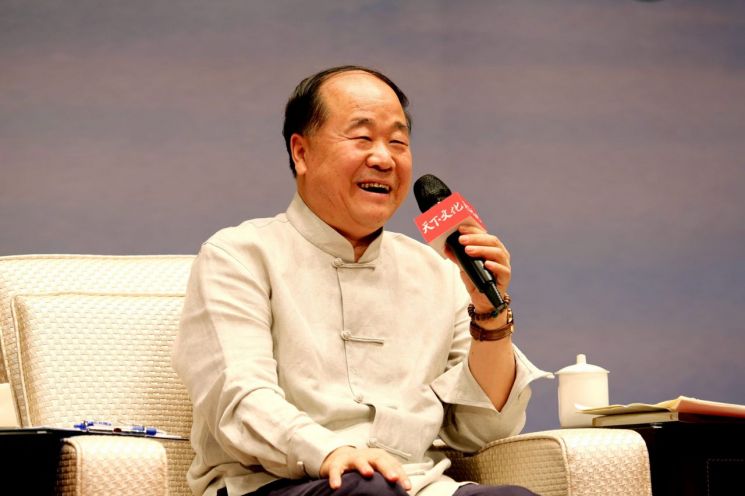 Mo Yan, the first Chinese author to win the Nobel Prize in Literature in 2012, confessed that he wrote a praise article for a literary awards ceremony using ChatGPT.
 [Image source=EPA Yonhap News]
Mo Yan said he gave the student a list of key keywords, including the titles of Yu Hua’s books such as 'Original Sin' and the word 'balchi.' SCMP reported that 'balchi' is presumed to be related to Yu Hua’s past work as a dentist.
Mo Yan seemed satisfied with the result, saying, "As soon as I provided the materials, over 1,000 words of Shakespeare-style praise were generated instantly." He also emphasized that he wrote all of his own novels himself to preempt controversy. He added, "I have enjoyed the power of writing and will continue to do so," and further stated, "Writing leads me to explore different identities and perspectives."
SCMP noted, "It is unclear exactly how ChatGPT was used, but it appears the student input those words into ChatGPT, which then generated sentences accordingly," and reported that "Mo Yan is the first Nobel laureate writer to publicly admit to using AI to write."
Yu Hua did not comment on Mo Yan’s confession about using ChatGPT. However, the video of the event was promptly uploaded to Chinese social networking services (SNS), sparking active discussions among netizens. Many expressed positive reactions, deeply impressed by Mo Yan’s open attitude in exploring new technologies and tools to support creative activities.
However, some users on China’s SNS Weibo pointed out that Mo Yan and his colleagues should have consulted a lawyer before using ChatGPT. This is because ChatGPT services are not officially available in China. If Mo Yan and others accessed ChatGPT through a virtual private network (VPN), they could face fines or imprisonment. The Chinese government blocks the use of VPNs necessary to access ChatGPT locally to prevent access to inappropriate or sensitive information.
Mo Yan’s representative works include Hong Gaoliang Family, Frog, and Life is Hard. Hong Gaoliang Family was also adapted into the film Red Sorghum directed by Zhang Yimou. Mo Yan’s real name is Guan Moye, and his pen name Mo Yan means "does not speak."
© The Asia Business Daily(www.asiae.co.kr). All rights reserved.

![User Who Sold Erroneously Deposited Bitcoins to Repay Debt and Fund Entertainment... What Did the Supreme Court Decide in 2021? [Legal Issue Check]](https://cwcontent.asiae.co.kr/asiaresize/183/2026020910431234020_1770601391.png)














