Meeting with TF and Wade Allison at the National Assembly
"Fukushima seafood is the same as Korean products"
"Tritium is not a concern"... Denying domestic researchers' worries
Wade Allison, an emeritus professor at the University of Oxford in the UK who claimed that "one liter of Fukushima contaminated water can be drunk," attracted attention by stating at a ruling party debate held at the National Assembly that "one can drink even 10 times (1 liter)." Regarding seafood from Fukushima, he also argued that "it is the same as seafood from any region in the world," but even the ruling party that invited Professor Allison drew a line by stating that their stance on regulating seafood around Fukushima remains unchanged.
The People Power Party's Task Force (TF) for Protecting Our Seas invited Professor Allison to the National Assembly on the 19th to hold a meeting on the theme of "Radiation Fear Rumors and Fukushima." Professor Allison caused a stir by stating at a press conference held by the Korea Atomic Energy Research Institute and the Korean Nuclear Society on the 14th that "if there is 1 liter of contaminated water treated by the Advanced Liquid Processing System (ALPS) in front of me, I can drink it."
Professor Allison claimed that the radiation dose from contaminated water treated by the facility is less than that from medical equipment such as CT scans. He said, "The radiation level in our body could double for about 12 days after ingesting 1 liter of treated contaminated water," adding, "However, when exposed to radiation from CT scans and the like, one can receive up to 10 times more radiation." He also explained, "There is nothing to consider regarding possible side effects from contaminated water, because when we undergo CT scans, we are exposed to radiation, but this does not cause physical effects or raise concerns."
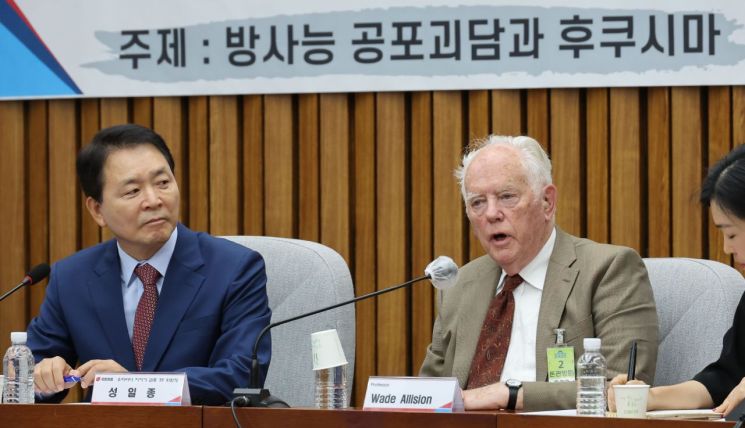
Furthermore, he declared that it is possible to drink up to 10 liters of treated contaminated water, not just 1 liter. Professor Allison said, "Even if you drink about 1 liter of water, the effects will subside after about two weeks, and I am willing to drink more afterward. I can drink about 10 times that amount," adding, "The only reason I haven't drunk it yet is that I haven't had the opportunity. If possible, I am willing to drink it on TV as well."
When asked whether seafood from Fukushima can be considered scientifically safe if the contaminated water is safe, Professor Allison responded affirmatively. He said, "I judge Fukushima seafood to be the same as Korean seafood and seafood from anywhere in the world," adding, "(Rather) the problem lies with nuclear technology. Radiation levels can be measured down to very small amounts, and in such cases, measurements are taken even when the levels are so low that they are meaningless, which I think is the problem."
Seong Il-jong, chairman of the TF, emphasized in response to Professor Allison's answers, "The government's position is not to import seafood from eight prefectures including Fukushima. Please understand this accurately." He said, "Public safety, public health, and protection of fishermen come first. Above all, the government has focused on this and will continue to do so."
Additionally, Professor Allison pointed out that excessive fear of nuclear safety has been created. He explained, "After the Fukushima nuclear accident, no major problems caused by radiation occurred. The bigger problem was that people felt too much fear and anxiety at the time," adding, "This is because science and regulatory authorities lost trust. I think the same applies to Korea." He continued, "We will live in the nuclear age going forward," and said, "For the sake of future generations, I think we need to correct these issues."
Regarding tritium, a radionuclide not removed by the Advanced Liquid Processing System and a subject of ongoing concerns, Professor Allison claimed there is no need to worry. He said, "From a biological and chemical perspective, tritium is a form of hydrogen, so it does not accumulate in the body," adding, "If tritium enters the body, its half-life is 12 to 14 days, so after 12 days, half of it is gone, and after another 12 days, it is all eliminated from the body."
When asked about domestic scientists who have directly refuted his claims, Professor Allison replied, "I don't think that is a scientific statement," and said, "I would like to talk with the person who actually made such a statement." Earlier, Professor Seo Kyun-ryeol, emeritus professor of nuclear engineering at Seoul National University, argued in a YTN radio interview on the 17th regarding Professor Allison's "1 liter" statement, "If tritium binds to organic matter, the situation changes. It is not filtered out." Professor Seo said, "If the inspection team goes, I will believe it only if they drink 1000cc of all the contaminated water stored by Tokyo Electric Power Company, not verifying anything else."
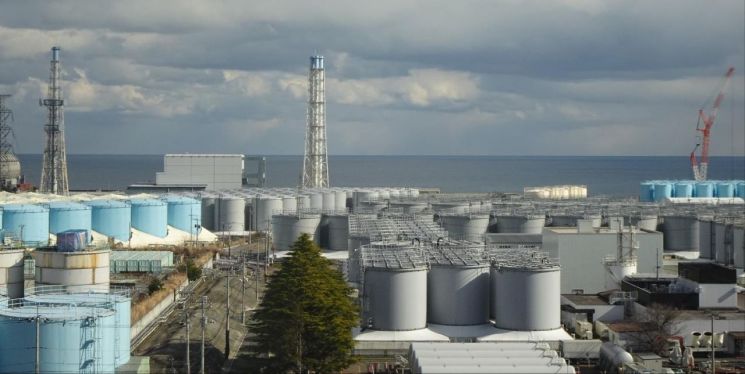 Storage tanks holding contaminated water inside the Fukushima nuclear power plant in Japan, photographed in February this year [Image source=Yonhap News]
Meanwhile, a domestic fishermen representative invited to the meeting expressed hope that the issue of Japan's contaminated water discharge would be resolved quickly. He said, "Regarding radiation, it is not important whether it is good or bad, whether cesium or radionuclides are present; I just want it to be resolved quickly. If such discussions continue, seafood consumption will decline, fishermen's income will decrease, and they will have no choice but to give up fishing and switch jobs. This is a national loss," adding, "I hope the issue of nuclear power plant contaminated water discharge will be resolved soon so that fishermen can engage in fishing with peace of mind."
© The Asia Business Daily(www.asiae.co.kr). All rights reserved.
![Clutching a Stolen Dior Bag, Saying "I Hate Being Poor but Real"... The Grotesque Con of a "Human Knockoff" [Slate]](https://cwcontent.asiae.co.kr/asiaresize/183/2026021902243444107_1771435474.jpg)
















