At the Group of Seven (G7) summit, the issue of regulating artificial intelligence (AI) also emerged as a hot topic. Amid growing concerns over fake content freely produced by AI and the resulting economic and criminal losses, attention is focused on whether this will become a turning point for world leaders to actively pursue regulations on 'super-large machine intelligence.'
British Prime Minister Rishi Sunak told reporters at the G7 summit held in Hiroshima, Japan, on the 19th, "AI must be developed safely, reliably, and with clear guidelines." He added, "AI technology is evolving rapidly, and regulations must evolve accordingly," stating that G7 leaders will cooperate on AI regulation.
Two days before visiting Japan, Sunak attended a meeting of the Council of Europe, a European democracy and human rights monitoring organization, in Reykjavik, Iceland, where he discussed the need for AI regulation with member state leaders.
Bloomberg News evaluated Sunak’s remarks as signaling a policy shift by the UK government, which has been leading the development and expansion of the AI ecosystem. Earlier, in an AI-related white paper published in March, the UK government stated its goal to become the best place in the world to build and test AI technology. However, as the AI development boom and its widespread use swept the world, accompanied by repeated warnings, the government appears to have emphasized the necessity of regulation.
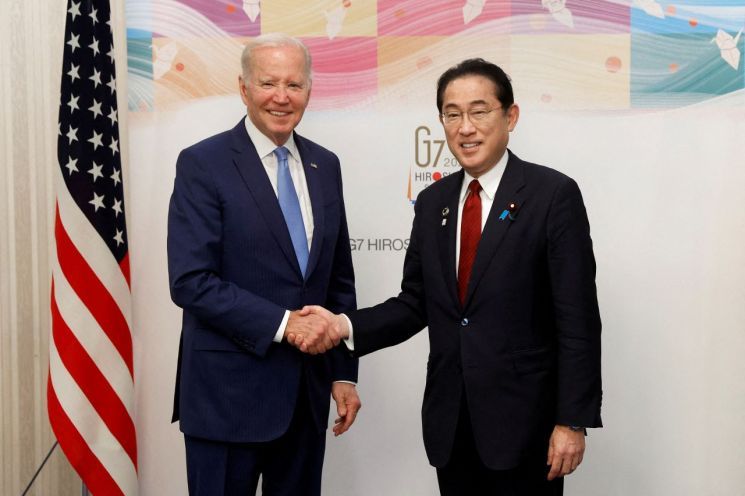
At this G7 summit, AI regulation was also one of the main agenda items. In a joint statement released on the 20th, the G7 leaders announced that they will conduct international discussions based on democratic values to achieve the common goal of "trustworthy AI."
The G7 leaders agreed to establish international norms related to generative AI, such as ChatGPT, and create platforms for international information exchange. However, the joint statement only contained a broad consensus on the need for international regulation, without specific details.
Generative AI, like ChatGPT, which creates text and videos, has rapidly expanded in use since its emergence. However, warnings and calls for regulation have also been raised regarding the dangers of AI beyond human control, including the flood of fake content and criminal losses caused by AI.
Geoffrey Hinton, a professor at the University of Toronto and known as the "godfather of deep learning," resigned from Google, expressing fear that AI could become "killer robots." Industry leaders such as Sam Altman, CEO of OpenAI, and Mustafa Suleyman, co-founder of Google DeepMind, have also collectively warned about the risks of AI.
Altman, the creator of ChatGPT, appeared at the first-ever AI hearing held by the U.S. Congress on the 16th, stating, "OpenAI was founded with the belief that AI will improve almost every aspect of our lives, but serious risks also exist," and warned, "As a powerful model, government regulatory intervention is important to mitigate risks."
© The Asia Business Daily(www.asiae.co.kr). All rights reserved.
![Clutching a Stolen Dior Bag, Saying "I Hate Being Poor but Real"... The Grotesque Con of a "Human Knockoff" [Slate]](https://cwcontent.asiae.co.kr/asiaresize/183/2026021902243444107_1771435474.jpg)















