Home Shopping 4 Companies Q1 Operating Profit Down 32.4%
Decline in TV Viewership and Persistent Transmission Fee Burden
Focus on Mobile Content Expansion to Find Breakthrough
The home shopping industry continues to struggle with poor performance in the first quarter of this year. The decline in TV viewership is impacting sales in their core business, TV home shopping, and they are also burdened by persistently high TV broadcasting fees. Although they are seeking breakthroughs through mobile live commerce, YouTube, and various experiential content, it is analyzed that these attempts will require time before becoming stable major revenue sources.
 Lotte Homeshopping is showcasing live commerce featuring the virtual human 'Lucy' as the host.
 [Photo by Lotte Homeshopping].
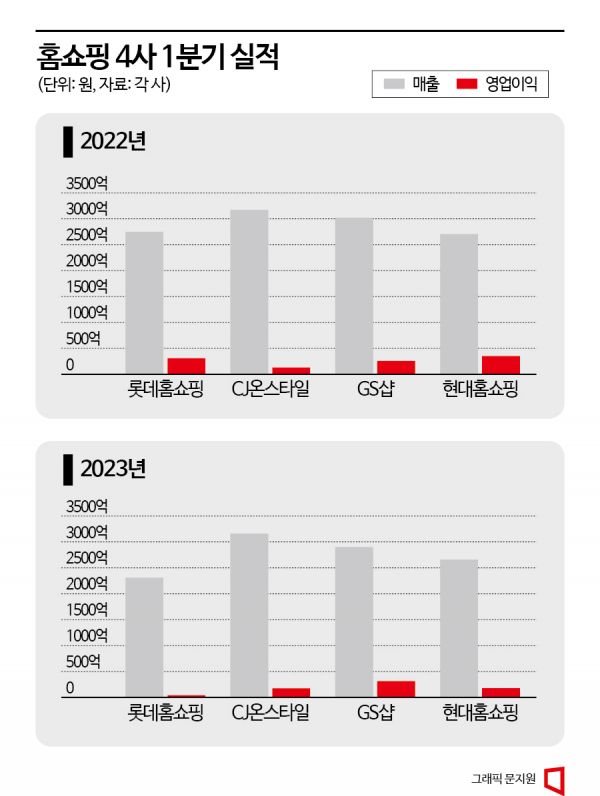
According to the distribution industry on the 21st, the operating profit of the four home shopping companies?CJ OnStyle, GS Shop, Hyundai Home Shopping, and Lotte Home Shopping?in the first quarter was 71 billion KRW, down 32.4% from 105.1 billion KRW in the same period last year. Sales amounted to 1.1033 trillion KRW, a 5.3% decrease from 1.1649 trillion KRW in the previous year. Lotte Home Shopping’s first-quarter operating profit was only 4 billion KRW, plunging 87.6% year-on-year. Sales dropped by 16%. Although there was an impact from the ban on broadcasting during early morning hours, the decline was significant even considering this. Hyundai Home Shopping also saw its operating profit fall by 49.3% during this period, with sales decreasing by 4.8%. GS Shop and CJ OnStyle experienced sales declines of 4.1% and 0.4%, respectively.
In the first quarter, concerns over economic contraction weakened fashion sales compared to the previous year, and reductions in home shopping programming for home appliances and rentals, as well as sluggish living category sales, also had an impact. However, structural issues such as the declining TV home shopping viewership and the ongoing burden of broadcasting fees, which amount to about 2 trillion KRW annually, were pointed out as chronic problems.
A common concern in the home shopping industry is the increasing burden of broadcasting fees every year. According to the TV Home Shopping Association, the broadcasting fees for seven domestic TV home shopping companies were 1.5497 trillion KRW in 2019, 1.675 trillion KRW in 2020, and 1.8074 trillion KRW in 2021, increasing annually. Meanwhile, TV viewership is decreasing as audiences disperse to online video services (OTT). According to the Ministry of Science and ICT, as of the end of 2021, the number of paid broadcasting subscribers (SO) was about 12.93 million, down 300,000 from the previous year. The "2022 Broadcasting Media Usage Behavior" survey by the Korea Communications Commission also confirmed that average daily TV usage time (including paid broadcasting) was 2 hours and 36 minutes, marking a decline for two consecutive years. The industry views the Ministry of Science and ICT’s revision of the "Home Shopping Broadcasting Channel Usage Contract Guidelines," which allows broadcasting fees to be negotiated between paid broadcasters and home shopping companies, as encouraging. However, since the two industries still have differing perspectives on the pricing criteria, they believe it is necessary to observe the situation carefully.
The home shopping industry is focusing on "home shopping accessible outside of TV" to adapt to the new environment. They have extended their reach to mobile live commerce, YouTube studio channels, experiential services utilizing virtual reality (VR) technology, exhibitions and merchandise using character intellectual property (IP), among others. Through this, they aim to diversify the age range of home shopping users and create new breakthroughs. However, it is noted that it will take time for home shopping mobile channels to penetrate the MZ generation (Millennials + Generation Z), who are familiar with mobile, and that fluctuations in performance during the investment period should be considered.
Home shopping companies are leveraging their professional skills and experience gained through broadcasting to strengthen live commerce with a more expert edge. CJ OnStyle is reinforcing its "one-platform" strategy, which organically combines channels such as TV, e-commerce, and mobile live commerce. This year’s core goal is to foster planned mobile live commerce to enhance differentiated content commerce competitiveness. Results are emerging. The flagship program "Edge Show" recorded sales volume comparable to TV home shopping, with order amounts increasing by about 60% compared to the same period last year. CJ OnStyle stated, "We will significantly increase the scheduling of the live commerce channel 'Live Show' during prime times such as weekdays from 10 a.m. to 12 p.m. and 7 p.m. to 10 p.m., and operate fixed programs like 'Bteuina Life' to grow a loyal fandom."
Lotte Home Shopping will also launch a mobile live talk show called "Jiune" on the 23rd, led by the influencer Mijiu, who has 11 million followers. This strategy targets younger audiences in their 30s and 40s compared to the existing fixed TV home shopping viewers by emphasizing fun and communication rather than simple product sales through mobile content. Previously, they released live content using character IP businesses such as Bellygom and virtual human "Lucy." Hyundai Home Shopping is also attracting customers in their 20s and 30s through mobile live commerce "Showra" and its own YouTube channel "Hook TV." The proportion of 20-30-year-old customers who made two or more purchases from Showra between January and March this year increased by 43% compared to December last year.
© The Asia Business Daily(www.asiae.co.kr). All rights reserved.
![Clutching a Stolen Dior Bag, Saying "I Hate Being Poor but Real"... The Grotesque Con of a "Human Knockoff" [Slate]](https://cwcontent.asiae.co.kr/asiaresize/183/2026021902243444107_1771435474.jpg)

















