Earth-sized planet 'LP-791-18 d'
Land covered with volcanoes presumed to exist
An alien planet similar in size to Earth, presumed to have active volcanic eruptions, has been discovered.
It is estimated that water, considered an essential element for the emergence and sustenance of life, exists in the cooler regions of this planet, which has an atmosphere due to volcanic activity.
On the 18th, according to the National Aeronautics and Space Administration (NASA), researchers from the Trottier Institute for Research on Exoplanets (iREx) at the University of Montreal announced on the 18th in the scientific journal Nature their observations of planet d in the red dwarf star system LP 791-18.
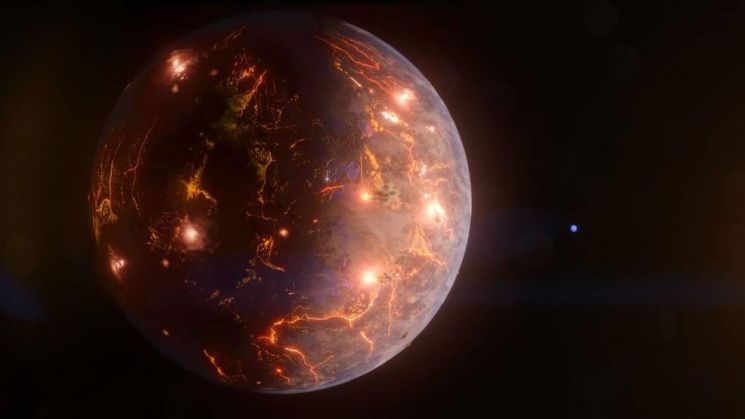 An artist's impression of the exoplanet LP 791-18 d, located 90 light-years away, presumed to have active volcanic activity
 [Image source=NASA's Goddard Space Flight Center/Chris Smith (KRBwyle)]
In this planetary system, planet b, about 20% larger than Earth, and planet c, 2.5 times Earth's size with a mass seven times greater, had already been discovered. Planet d is understood to be slightly larger in size and mass than Earth.
This planet passes close to planet c during its orbit, and under the influence of the massive gravitational forces, it has acquired an elliptical orbit. Each time it approaches the star, deformation occurs within the planet, generating friction that accumulates heat and triggers volcanic activity on its surface.
LP 791-18 d is located at the inner edge of the habitable zone where liquid water can exist on the surface without evaporating. If, as the research team suggests, it is geologically active, it could maintain an atmosphere that allows water to condense on the cooler night side of the planet.
The research team utilized data from NASA's Transiting Exoplanet Survey Satellite (TESS), which detects exoplanets by capturing the dimming of starlight as planets transit in front of their stars, along with data from the Spitzer Space Telescope and ground-based telescopes.
Spitzer, which conducted infrared observations, observed the LP 791-18 system during its final observation campaign before its retirement in January 2020.
Dr. Bj?rn Benneke, an astronomy professor at iREx and co-author of the paper, explained, "LP 791-18 d is a tidally locked planet, meaning one side always faces its star. While the day side may be too hot for liquid water to exist on the surface, volcanic activity occurring across the planet is presumed to maintain an atmosphere that allows water to condense on the night side."
Dr. Jessie Christiansen of NASA's Exoplanet Science Institute stated, "One of the biggest questions in astrobiology is whether geological structures or volcanic activity are essential for the emergence of life. In addition to providing an atmosphere, these processes can stir up materials considered vital for life, such as carbon, preventing them from settling and becoming trapped in the crust."
© The Asia Business Daily(www.asiae.co.kr). All rights reserved.
![Clutching a Stolen Dior Bag, Saying "I Hate Being Poor but Real"... The Grotesque Con of a "Human Knockoff" [Slate]](https://cwcontent.asiae.co.kr/asiaresize/183/2026021902243444107_1771435474.jpg)















