1 Night 2 Days Trip to Gwangju, Opposition Strengthens Public Sentiment
District Lawmakers: "Gwangju Public Sentiment Is Not Good"
Support Rate Declines Amid Party Crisis
The public sentiment in Gwangju, a stronghold of the Democratic Party of Korea, is becoming uneasy. This follows a series of setbacks including the judicial risks faced by Lee Jae-myung, the party leader, the money envelope scandal at the party convention, and the coin investment controversy involving lawmaker Kim Nam-guk. On the 43rd anniversary of the May 18 Democratic Uprising, the Democratic Party has put forward a "one-point constitutional amendment" to enshrine the spirit of May 18 in the constitution, aiming to soothe public sentiment.
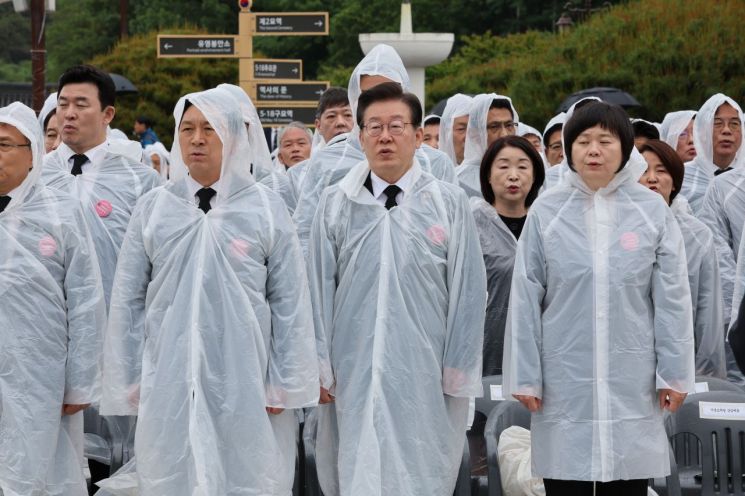
According to the Democratic Party on the 18th, the leadership, including Lee Jae-myung, has been conducting a 1-night, 2-day tour of Gwangju to address local livelihood issues since the previous day. After attending the May 18 eve ceremony, they also participated in the commemorative event on the day. They also proposed to the People Power Party to include the spirit of May 18 in the preamble of the constitution through a constitutional amendment.
The reason the Democratic Party is emphasizing its activities in Gwangju is largely interpreted as a response to the recently cooled local public sentiment. Lawmakers with constituencies in the Honam region unanimously stated that Gwangju citizens are viewing the party’s successive incidents with stern eyes. One lawmaker said, "Gwangju citizens tend to view the party’s situation more strictly," adding, "The evaluations regarding disguised party withdrawal, judicial risks, and the money envelope scandal were not favorable."
The deteriorated public sentiment is confirmed by poll results. According to a survey conducted by Realmeter commissioned by Media Tribune from the 2nd to the 4th among 1,504 people aged 18 and over (95% confidence level, margin of error ±2.5 percentage points; for detailed information, refer to the National Election Commission website), the Democratic Party’s support rate in the Gwangju and Jeolla regions was 67.3%. However, following the emergence of the controversy over lawmaker Kim’s coin investment allegations on the 5th, a survey conducted from the 8th to the 12th among 2,503 people aged 18 and over (95% confidence level, margin of error ±2.0 percentage points) showed a drop to 56.7%, a decline of 10.6 percentage points.
Public sentiment in Honam has been uneasy since last year. In the local elections last June, the voter turnout in Gwangju was the lowest ever at 37.7%, the lowest among all metropolitan governments nationwide. Jeonbuk also fell below the national average with 48.6%, and Jeonnam recorded 58.4%. At the party convention on August 28 last year, when Lee was elected, the average primary turnout in the Honam region was 35.49% (Jeonbuk 34.07%, Jeonnam 37.52%, Gwangju 34.18%), below the overall average turnout of 37.69%.
In Gwangju, there is only one incumbent lawmaker serving a second term, while there are as many as seven first-term lawmakers, reflecting strong public demand for a "refresh" of incumbents. This is why Gwangju district lawmakers are highly sensitive to public sentiment ahead of the general election race.
Professor Park Sang-byeong of Inha University Graduate School of Policy said, "Losing the core support base in Honam would be a critical blow to the Democratic Party," adding, "Despite the party’s unfavorable situation, the reason Lee and the Democratic Party can hold on is because of the core supporters, especially those in their 50s and from Honam. Although unlikely at this point, in the worst case, a new party originating from Honam could emerge."
© The Asia Business Daily(www.asiae.co.kr). All rights reserved.
![Clutching a Stolen Dior Bag, Saying "I Hate Being Poor but Real"... The Grotesque Con of a "Human Knockoff" [Slate]](https://cwcontent.asiae.co.kr/asiaresize/183/2026021902243444107_1771435474.jpg)















