What Does the Display Industry Innovation Strategy Contain?
The display industry innovation strategy aims for ▲a 50% global market share by 2027, ▲expanding the technology gap with competing countries to over 5 years, ▲an 80% self-reliance rate in materials, parts, and equipment (SoBuJang), and ▲training 9,000 specialized personnel by 2032. The government has identified expanding the OLED market, increasing the self-reliance rate of SoBuJang, and resolving workforce shortages as core tasks for the display industry, and has established five major promotion strategies to achieve the world's number one display market position by 2027.
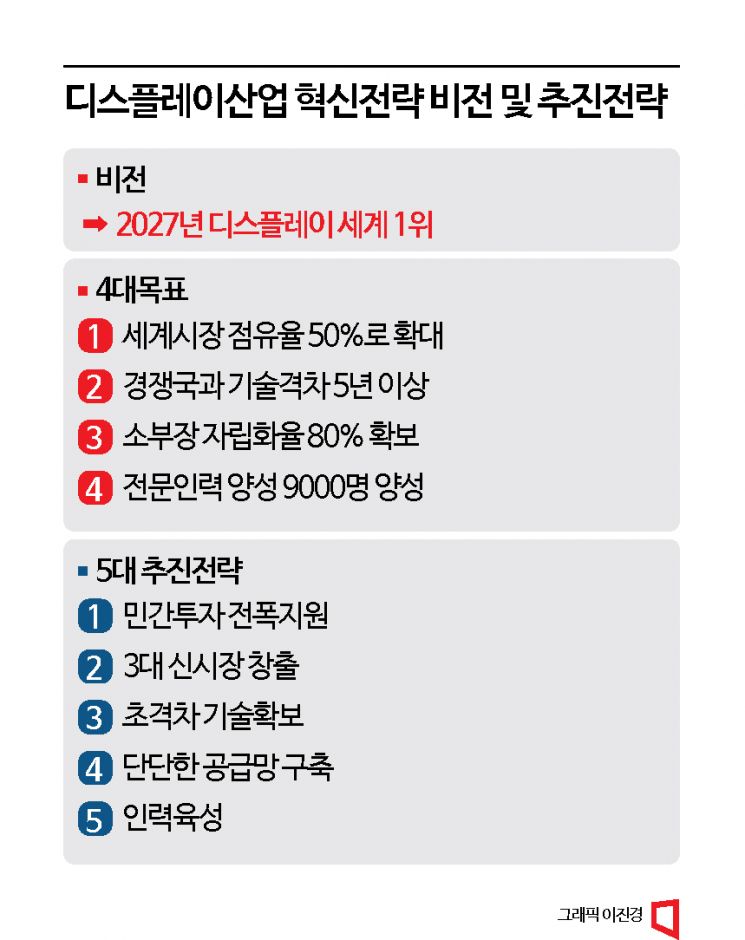
Full Support for Private Investment
Panel companies plan to invest more than 65 trillion KRW by 2027 in expanding IT OLED production lines (48.8 trillion KRW) and next-generation display R&D (16.5 trillion KRW). The government will support timely private investment through tax incentives, policy financing, infrastructure, and regulatory improvements.
First, following the designation of five core display technologies as national strategic technologies under the Restriction of Special Taxation Act in February this year, major financial institutions such as the Korea Development Bank and the Korea Credit Guarantee Fund will provide approximately 900 billion KRW in policy financing for new panel facility investments and display equipment manufacturing funds to significantly reduce corporate investment burdens.
Within the first half of the year, the government plans to actively consider designating specialized display complexes and accelerate infrastructure support such as electricity, water supply, wastewater treatment, and roads. Additionally, safety inspections for facilities handling hazardous chemicals will be flexibly applied, extending from annual inspections to up to four years. Local governments will also work on regulatory improvements to simplify approval periods and procedures required for transporting large equipment.
The government expects that approximately 65 trillion KRW in display industry facility and R&D investments over the next five years will generate a related ripple effect of 109 trillion KRW for SoBuJang companies.
Creation of Three New Markets
To grow the three major display market sectors?transparent, XR, and automotive displays?from 900 million USD last year to about 15 billion USD by 2027, the government plans to allocate approximately 60 billion KRW in budget support. About 10 billion KRW will be invested in demonstrating transparent displays in museums, subway screen doors, etc., to integrate with various industries such as exhibitions and advertising.
Also, to verify the performance of ultra-small (panel size 0.3 inches or less) displays for XR devices, which are expected to grow rapidly in the metaverse era, a testbed will be established from 2024 with an investment of about 30 billion KRW. In the second half of this year, a public-private alliance consisting of the government, panel makers, SoBuJang companies, content providers, and set companies will be formed to revitalize the XR market. Furthermore, for automotive displays, a demonstration center capable of comprehensively verifying product safety will be built, and about 20 billion KRW will be invested in related demonstration projects. Cooperation between the automotive and display industries will also establish related international standards and safety regulations.
Securing a Super-Gap in Technology
To expand the technology gap with competing countries to over five years, the government will concentrate approximately 420 billion KRW in R&D funding to advance mass production technologies for IT 8th generation and TV 10th generation equipment and processes. This will lower production costs and significantly improve OLED performance such as flexibility and luminous efficiency. In the second half of this year, a large-scale preliminary feasibility study project will be promoted to establish a domestic production foundation covering the entire cycle from materials and parts to processes, infrastructure, and product mass production technologies.
Building a Robust Supply Chain
The government plans to raise the self-reliance rate of SoBuJang to 80% through over 50 billion KRW in R&D funding. Focus will be on 80 key items for technological independence, including major items with high overseas dependence due to technical difficulty such as FMM, lithography equipment, sealing equipment, and future growth items like high-transparency electrode materials and LED epitaxial growth equipment. Successfully localized items will receive full-cycle support from performance evaluation to commercialization in connection with demand companies.
Next-generation technologies such as quantum dots will be added to the core strategic SoBuJang technologies, and companies possessing these core strategic technologies will be designated as top-tier companies to receive package support for technology development, commercialization, and regulation. The number of top-tier display SoBuJang companies will expand from 6 to 20, and companies with sales exceeding 1 trillion KRW will increase from 8 to 15. Additionally, an OLED Innovation Process Center equipped with 65 types of joint test production equipment (OLED 2nd generation level) and cleanrooms, comparable to domestic panel companies, will be established in Chungnam in the first half of 2024 to allow SoBuJang companies to freely verify new technologies. From 2025, the government will also promote the establishment of an inorganic light-emitting smart modular center for research on inorganic light-emitting (micro and nano LED, etc.) pixel manufacturing processes and panel application evaluation.
Workforce Development
The public and private sectors will jointly train a total of 9,000 personnel over the next 10 years, including 7,000 design and R&D experts to lead next-generation display technologies and 2,000 field workers such as current employees. Companies will nurture personnel aligned with corporate demand in a timely manner through recruitment-linked contract departments. The government will actively support the establishment of specialized graduate schools and industry-academia R&D to train master's and doctoral level personnel and plans to introduce new undergraduate major tracks. Support to protect core personnel and technologies will also be strengthened. Retired display industry personnel will be hired as professors and practical instructors at the OLED Innovation Process Center to ensure the transfer of industry know-how.
© The Asia Business Daily(www.asiae.co.kr). All rights reserved.
![Clutching a Stolen Dior Bag, Saying "I Hate Being Poor but Real"... The Grotesque Con of a "Human Knockoff" [Slate]](https://cwcontent.asiae.co.kr/asiaresize/183/2026021902243444107_1771435474.jpg)















